
How to Build an AI-Powered Fitness App Using Flutter and FlutterFlow in the USA: 2026 Guide
Fitness App Using AI, Flutter, and FlutterFlow in/for United States of America (USA) (2026 Guide)
AI fitness apps for the US market in 2026: personalization, Flutter/FlutterFlow delivery, and what product teams should plan before launch.
· · Written by Virtuous Techlogic · 10 min read
Introduction:
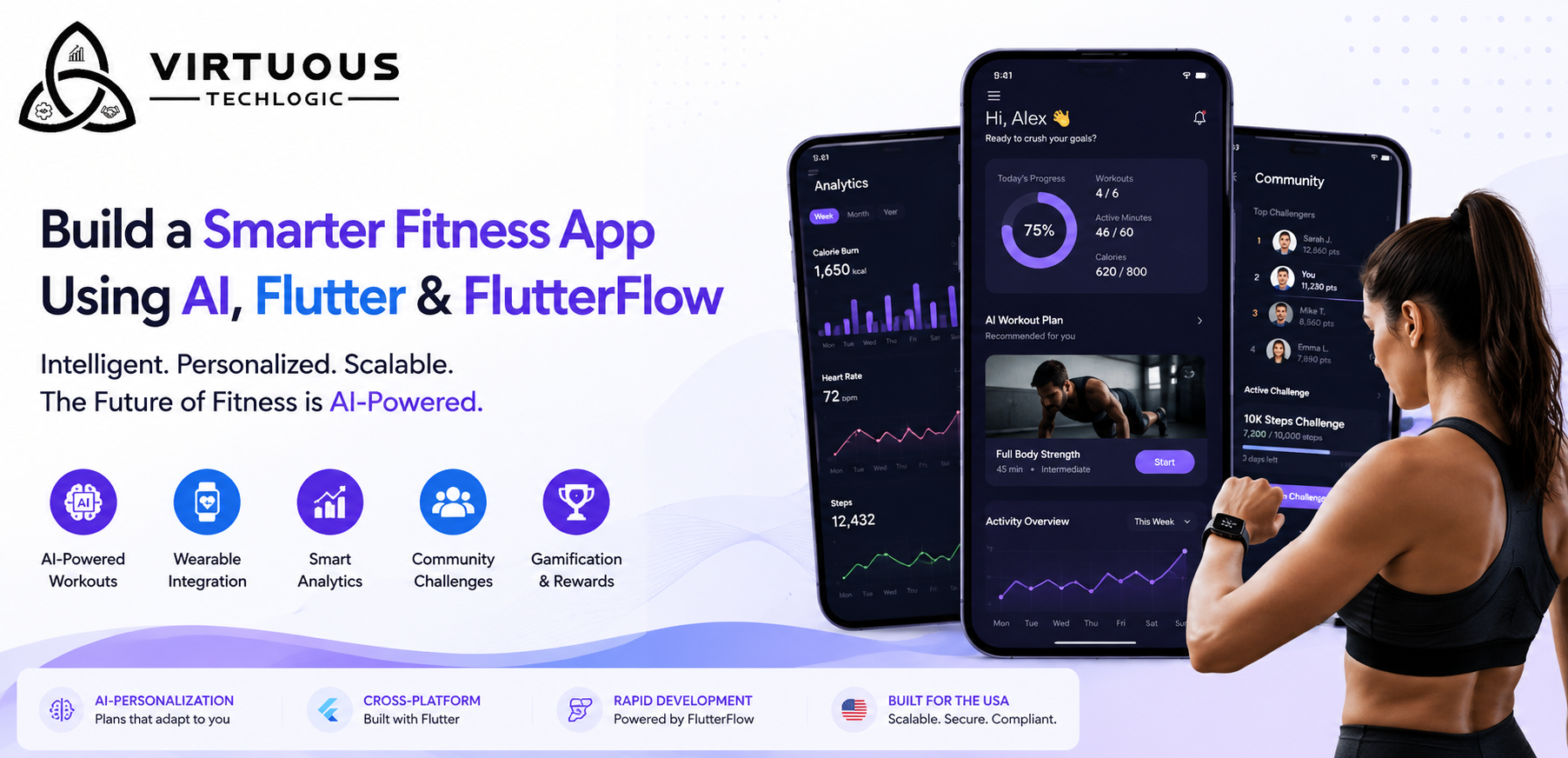
In 2026, fitness apps in the United States are no longer just step counters or timer stopwatches; they’re intelligent, adaptive, AI‑driven wellness platforms capable of understanding user behavior, predicting fitness trends, and motivating millions toward healthier lifestyles. The intersection of Artificial Intelligence (AI), Flutter (a powerful cross‑platform framework), and FlutterFlow (a rapid low‑code visual app builder) is transforming how fitness applications are built, personalized, and scaled, especially in a diverse and competitive market like the USA.
This comprehensive guide walks you through everything you need to build a Fitness App Using AI, Flutter, and FlutterFlow in/for the United States of America (2026), including market insights, essential features, development strategy, technical architecture, regulatory guidance, future trends, and a section on how Virtuous Techlogic can help you succeed.
Why Fitness Apps Matter in the USA (2026)
The United States continues to lead global digital health adoption, and fitness apps are a cornerstone of this trend. Key factors fueling the fitness app boom include:
- Mobile and wearable usage: The vast majority of Americans own smartphones, and fitness wearables (Apple Watch, Fitbit, Garmin) are commonplace.
- Health consciousness: From prevention to performance tracking, users demand smarter tools to manage activity, sleep, diet, and overall wellness.
- AI expectations: Users increasingly expect apps to “know them,” recommending workouts, tracking habits, and guiding progress intelligently.
- Hybrid fitness lifestyles: Gym attendance blends with home workouts, outdoor routines, and digital coaching, requiring flexible, adaptive apps.
With consumers expecting personalization, motivational feedback, and real‑time guidance, fitness apps must be more than trackers; they must behave like intelligent fitness companions
The Power of Combining AI, Flutter, and FlutterFlow
Artificial Intelligence (AI) — Personalized Fitness Journeys
AI empowers fitness apps to go beyond static features:
- Intelligent Workout Generation: Machine learning analyzes users’ goals, behavior, history, and biometric data (from wearables) to generate custom routines that evolve with performance.
- Adaptive Goal Setting: AI identifies plateaus and suggests achievable dynamic goals to maximize progress.
- Behavior Prediction: AI predicts user engagement trends and sends personalized motivation nudges at the right time.
- Contextual Recommendations: AI can suggest activities, recovery tips, nutrition insights, and habit goals based on user routines.
In a market where personalization drives retention, AI is the core differentiator.
Flutter — Consistent Cross‑Platform Performance
Flutter, developed by Google, allows developers to build high‑performing mobile applications for both iOS and Android from a single codebase.
Benefits of Flutter for Fitness Apps:
- Native‑like performance: Smooth animations and responsive UI are essential for interactive fitness dashboards.
- Reduced development cost: One codebase means faster development and easier maintenance.
- UI flexibility: Beautiful, customizable interfaces for progress charts, input forms, and AI dashboards.
- Scalability: Easier addition of features like community challenges or virtual coaching.
Whether your users use the latest iPhone or the newest Android device, Flutter ensures a consistent and fluid experience.
FlutterFlow — Speed, Prototyping & Visual Build
FlutterFlow is a low‑code visual development platform built on Flutter that accelerates app build cycles:
- Drag‑and‑drop design: Visualize UI without writing every line of code.
- Rapid MVP creation: Launch a testable version of your app quickly.
- Backend integration: Connect with APIs, Firebase, and authentication systems.
- Exportable production code: FlutterFlow produces ready‑to‑use Flutter code for advanced development.
FlutterFlow reduces time‑to‑market, a huge advantage in the competitive U.S. app space where speed and early adoption matter.
Must‑Have Features For a Competitive U.S. Fitness App
To stand out in the crowded U.S. market, your fitness app should offer:
1. AI‑Powered Personalized Workouts
Text and visual AI‑generated fitness plans based on user goals, fitness level, time availability, and progression data.
2. Wearable & Health Data Integration
Real‑time sync with Apple Health, Google Fit, Garmin Connect, Fitbit, and other fitness devices to capture activity, sleep, heart rate, and recovery.
3. Intelligent Analytics Dashboards
Interactive visual reports showing progress, trends, calories, performance scores, and goal predictions.
4. Smart Notifications & Motivation
AI‑driven nudges that adapt messaging to keep users on track.
5. Nutrition & Lifestyle Recommendations
AI‑suggested diet, hydration reminders, and sleep optimization tips tied into fitness goals.
6. Social & Community Elements
Leaderboards, group challenges, friend invites, and shareable achievements create engagement loops and increase retention.
7. Gamification Features
Badges, point systems, daily streaks, and reward triggers boost motivation and participation.
8. Secure User Authentication & Profiles
Secure login systems (email, phone, OAuth), encrypted data storage, and user‑controlled privacy settings.
Technical Stack & Architecture Overview
Here’s what a modern AI fitness app for the U.S. should include:
Frontend
- Flutter: UI rendering, cross‑platform components, navigation, and responsive design.
- UI modules include AI dashboards, wearable data views, challenge screens, and social feeds.
AI Layer
- Integration with cloud AI services (TensorFlow, private ML models, or cloud‑based solutions).
- Models handle workout generation, trend prediction, and recommendation delivery.
Backend & Data
- Cloud backend (Firebase, AWS, or custom servers) with secure APIs.
- Real‑time data sync from wearables and health solutions.
- Encrypted user data storage and privacy management tools.
Development Workflow
- UI/UX prototyping: via FlutterFlow to generate visual designs early.
- Code export & refinement: FlutterFlow designs converted into production Flutter code.
- CI/CD pipelines: Automatic testing, deployment, and updates via DevOps tools.
This architecture ensures performance, scalability, and modular expansion, key factors in the U.S. market where users expect continuous improvement and feature richness.
Compliance & Data Privacy in the USA
Unlike Europe’s GDPR, the U.S. does not have centralized nationwide privacy legislation. Instead, privacy and health data are governed by:
1. HIPAA (Health Insurance Portability and Accountability Act)
If your fitness app collects medical or protected health information (PHI) beyond general wellness data, especially if tied to clinical or medical programs, it must comply with HIPAA regulations. This affects:
- Data storage
- Access control
- Encryption
- Audit trails
- Consent management
2. State Privacy Laws
Several states (California, Virginia, Colorado) have privacy laws (e.g., CCPA) that govern personal data rights and transparency.
3. Industry‑Standard Security
Regardless of regulation, users in the U.S. expect:
- Encrypted transmission and storage
- Strong authentication
- Clear privacy policies
- User control over data sharing
A privacy‑by‑design approach builds trust and positions your app as credible and user‑centric.
How Virtuous Techlogic Can Help You Build & Launch Your Fitness App
Building a fitness app that uses AI, Flutter, and FlutterFlow and thrives in the U.S. requires strategic planning, engineering expertise, regulatory insight, and scalable architecture. This is where Virtuous Techlogic becomes your ideal technology partner.
1. Vision & Product Strategy
Virtuous Techlogic starts by helping you define:
- Target demographics
- Core value propositions
- Feature prioritization
- Monetization strategy (subscriptions, in‑app purchases, premium coaching)
This ensures your app resonates with U.S. consumers and meets business goals.
2. AI Architecture & Personalization Engine
Our AI specialists design machine learning models that deliver:
- Real‑time adaptive workout plans
- Predictive engagement scoring
- Personalized coaching and feedback
- Behavioral insights
We deploy scalable and efficient AI that evolves as users grow.
3. Flutter & FlutterFlow Development Expertise
Virtuous Techlogic provides:
- Custom UI/UX development with Flutter
- Rapid MVP prototyping and iteration with FlutterFlow
- Clean, modular code structure for future scalability
- Seamless integration with backend and wearable APIs
We leverage both tools to balance speed and quality.
4. Wearable & Health API Integrations
We build robust integrations with:
- Apple HealthKit
- Google Fit
- Fitbit API
- Garmin Health
This gives users accurate tracking and meaningful insights, turning data into actionable feedback.
5. Security & Compliance Implementation
Virtuous Techlogic embeds:
- Encryption best practices
- Role‑based access controls
- Consent and privacy dashboards
- HIPAA readiness where required
- Transparent privacy policies
Your app becomes secure, trustworthy, and compliant from the earliest stages.
6. Analytics, Testing & Optimization
We help you:
- Set up analytic dashboards (user engagement, retention, churn)
- Conduct A/B testing
- Optimize features based on data
- Improve performance and usability over time
This ensures your app continues to grow and evolve post‑launch.
Step‑by‑Step Roadmap to Develop Your Fitness App
Here’s a roadmap you can follow for development and success:
1. Discovery & Research
Define user personas, market gaps, and competitive analysis.
2. UI/UX Design
Prototype app screens using FlutterFlow and validate user flows early.
3. Core AI & Backend Setup
Develop AI models, backend APIs, and data pipelines.
4. Frontend Development (Flutter)
Build interfaces, integrate wearable APIs, and implement tracking dashboards.
5. Testing & Compliance Audit
Complete QA testing, security checks, and privacy reviews.
6. Beta Release & Feedback
Deploy a beta version to a limited audience and gather insights.
7. Full Launch
Publish on Google Play and Apple App Store with marketing support.
8. Post‑Launch Growth
Monitor analytics, add features, optimize retention, and scale.
Future Trends in Fitness Apps (2026 & Beyond)
Immersive AI + VR/AR Workouts
Next‑generation fitness experiences that combine virtual environments with real workouts.
Emotion‑Aware Coaching
AI systems that adapt recommendations based on user mood and stress indicators.
Predictive Injury Prevention
Machine learning models that anticipate injury risk based on activity patterns.
Holistic Wellness Platforms
Integrating fitness with mental well‑being, sleep tracking, nutrition, and lifestyle coaching.
By embracing these trends now, your fitness app positions itself at the forefront of innovation.
Conclusion
The United States fitness app market in 2026 is a fertile ground for innovation, driven by user demand for personalization, smart technology, and seamless experiences. By leveraging AI for intelligent coaching, Flutter for high‑performance cross‑platform apps, and FlutterFlow for rapid development and prototyping, your fitness app can stand out in a crowded space and build lasting engagement with users.
With Virtuous Techlogic as your trusted partner offering strategic planning, engineering expertise, compliance insight, and ongoing optimization, you can reduce risk, accelerate time‑to‑market, and launch a product that truly resonates with fitness‑focused audiences across the USA.
Frequently Asked Questions
Build Your App with Virtuous Techlogic
Book a Free ConsultationTrusted by clients across Clutch and Upwork
Want proof before starting? View our client reviews and agency profiles on Clutch and Upwork.