
How to Build an AI-Powered Healthcare App Using Flutter and FlutterFlow in the USA: 2026 Guide
Healthcare App Using AI, Flutter, and FlutterFlow in/for the United States of America (2026 Guide)
Building AI healthcare apps for the US market in 2026 with Flutter and FlutterFlow—patient UX, care workflows, and privacy-minded product scoping.
· · Written by Virtuous Techlogic · 9 min read
Introduction:
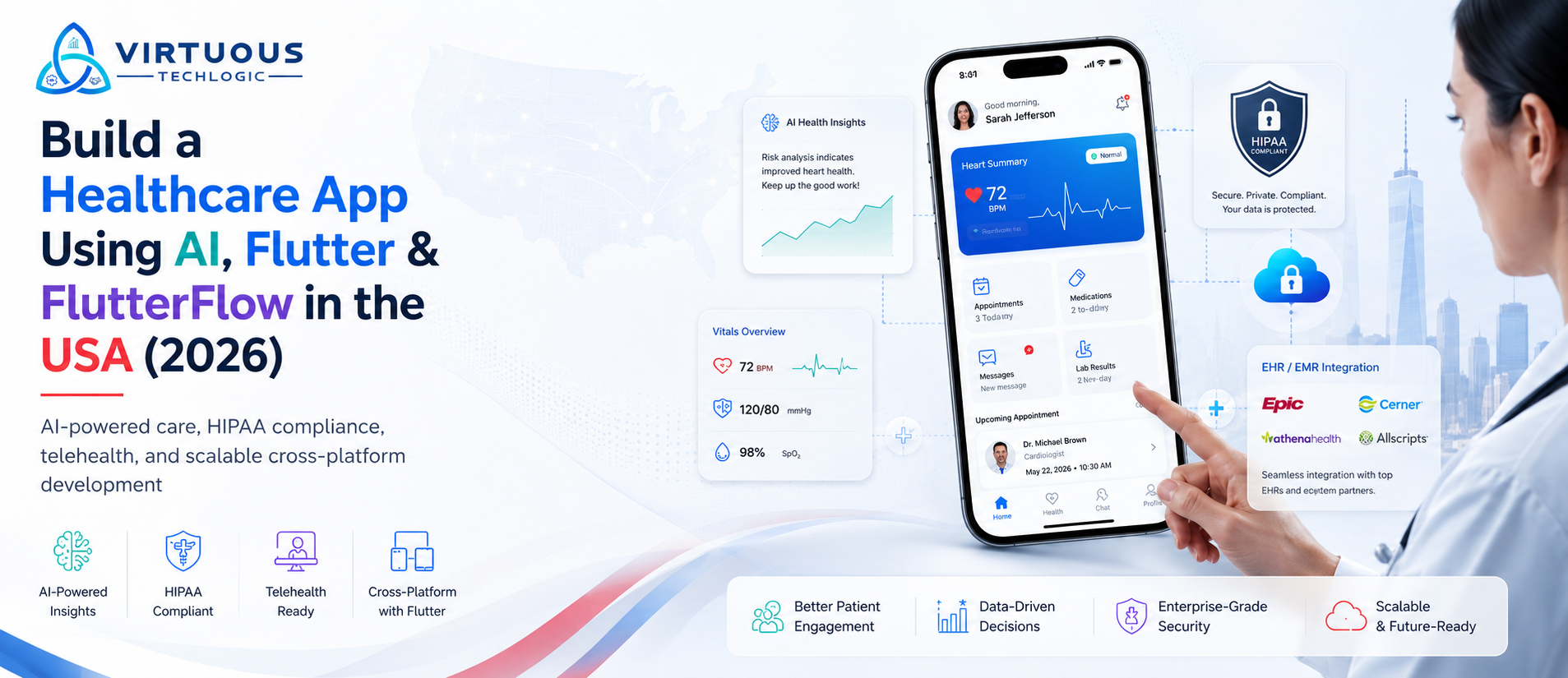
By 2026, the United States will be one of the most dynamic markets for digital healthcare innovation globally. Fueled by a massive shift in consumer expectations, expansive telehealth adoption, regulatory modernization, and breakthroughs in Artificial Intelligence (AI), the U.S. healthcare ecosystem is ripe for apps that deliver intelligent, secure, and patient‑centric experiences.
Combining the power of AI, the flexibility of Flutter, and the speed of FlutterFlow, developers and healthcare organisations can build cutting‑edge applications that meaningfully transform care, streamline workflows, and drive outcomes, all while navigating a complex regulatory landscape.
In this definitive guide, we break down everything you need to know to build a healthcare app using AI, Flutter, and FlutterFlow in the United States (2026), including market trends, compliance essentials, technical strategy, and how Virtuous Techlogic can be your trusted partner to build and launch your vision.
Why Healthcare Apps Matter in the U.S. (2026)
The United States healthcare system is one of the largest in the world, with fast‑growing investment in digital health solutions. Patients increasingly expect personalised, convenient, and data‑driven care experiences whether it’s remote monitoring, virtual visits, personalised health dashboards, or predictive insights powered by AI.
Key trends shaping the market include:
- Telehealth adoption has become mainstream after the pandemic.
- AI diagnostic tools are being integrated into clinical workflows.
- Health data interoperability initiatives such as TEFCA (Trusted Exchange Framework and Common Agreement).
- Rising consumer demand for self‑managed care platforms.
According to industry analysts, digital health investment in the U.S. continues to surge, with thousands of healthcare startups and digital tools now serving millions of users nationwide.
Core Technologies for Modern Healthcare Apps
To build a future‑ready healthcare application in the U.S., three technologies matter most:
1. Artificial Intelligence (AI) Intelligence that Improves Care
AI isn’t just a buzzword, it’s transforming how data is interpreted, risks are predicted, and care plans are personalised. In healthcare apps, AI can:
- Analyse complex health data to identify trends and risks.
- Support clinical decision‑making with predicted insights.
- Enable personalised recommendations and health coaching.
- Automate administrative workflows like triage, reminders, and messaging.
However, in the U.S., AI in healthcare must meet responsible use and transparency standards, especially where clinical decisions and patient safety are concerned.
2. Flutter Cross‑Platform UI Powerhouse
Flutter, developed by Google, has emerged as one of the most powerful cross‑platform frameworks. It allows developers to build highly responsive, visually consistent applications for both iOS and Android from a single codebase.
Key benefits for healthcare apps include:
- Fast development cycles with hot‑reload features.
- Consistent performance across devices.
- Customisable and accessible UI components are critical for patient engagement.
- Ease of maintenance through unified code.
With a diverse user base in the U.S. using various devices and screen sizes, Flutter ensures a smooth and uniform experience for everyone.
3. FlutterFlow Rapid Low‑Code Development
FlutterFlow is a low‑code visual development tool built on top of Flutter that enables teams to build app screens, workflows, and logic faster without sacrificing quality or scalability.
FlutterFlow advantages include:
- Fast prototyping and MVP creation are ideal for validating ideas quickly.
- Drag‑and‑drop UI design with exportable Flutter code.
- Visually designed logic and integrated backend services.
- AI‑assisted UI suggestions and modular components.
For healthcare innovation, where timelines and regulatory overhead can be significant, FlutterFlow gives teams a huge speed advantage without sacrificing technical depth.
U.S. Regulatory Landscape for Healthcare Apps
One of the biggest challenges and differentiators for healthcare apps in the U.S. lies in regulatory compliance. The U.S. has a robust set of rules meant to protect patients, secure data, and ensure safety.
1. HIPAA Health Insurance Portability & Accountability Act
HIPAA is one of the most important regulations for healthcare apps in the United States. It mandates:
- Secure handling of Protected Health Information (PHI).
- Administrative, physical, and technical safeguards for data.
- User consent and access controls.
- Breach reporting and compliance documentation.
If your app stores, transmits, or processes any PHI, including appointments, vitals, test results, or patient identifiers, HIPAA compliance is required.
2. FDA Regulation of Medical Software & AI Tools
In the U.S., the Food and Drug Administration (FDA) regulates certain software functions as Software as a Medical Device (SaMD), particularly when decisions influence diagnosis, treatment, or clinical decisions. This includes some AI‑driven components.
Depending on functionality, you may need:
- FDA evaluation and clearance (510(k) or De Novo pathways).
- Clinical performance evidence supporting claims.
- Quality management systems like ISO 13485 for development processes.
This distinction matters, and not all healthcare apps are regulated, but those that provide diagnostic or clinical outputs often are.
3. Interoperability & Health Data Standards
The U.S. is actively pushing healthcare data interoperability through standards like:
- FHIR (Fast Healthcare Interoperability Resources).
- HL7 data standards.
- National interoperability frameworks like TEFCA.
These standards allow healthcare apps to integrate with Electronic Health Records (EHRs), patient portals, and broader health information exchanges, creating seamless workflows for users and clinicians.
Key Features of a Successful U.S. Healthcare App
A high‑value healthcare application in the U.S. must include the following core features:
1. Secure Authentication & Role‑Based Access
- Multi‑factor authentication (MFA) to protect patient accounts.
- Role‑based access control for clinicians, administrators, and patients.
2. HIPAA‑Compliant Data Management
- Encrypted data at rest and in transit.
- Secure API gateways and trusted cloud infrastructure.
3. Telehealth & Scheduling
- Video and chat consultations.
- Calendar integrations with push notifications.
4. AI‑Powered Insights & Alerts
- Predictive analytics for risk scores.
- Smart reminders and personalised health alerts.
5. EHR Integration & Interoperability
- FHIR‑based APIs to connect with major EHR systems.
- Secure data syncing across providers.
6. Analytics Dashboards
- Visual dashboards for clinicians and patients.
- Trend graphs, vitals summaries, and interactive charts.
7. Notifications & Patient Engagement
- Push notifications, reminders, and educational content.
How Virtuous Techlogic Can Help You Build Your Healthcare App
At the intersection of healthcare, technology, and regulation, Virtuous Techlogic is uniquely positioned to help you design, develop, and launch a successful healthcare app in the United States.
1. Full‑Cycle App Development
Virtuous Techlogic starts with strategic planning and market research, then builds your app using Flutter and FlutterFlow, ensuring fast delivery without compromising quality.
2. Secure & Compliant By Design
We embed HIPAA‑compliant architecture and strong security controls into the core of your solution, including encrypted data flows, access controls, and audit trails.
3. AI Strategy & Implementation
Our team guides you on choosing the right AI models and ensuring they comply with responsible use standards, especially in high‑risk clinical support areas.
4. Regulatory Navigators
We help you identify whether your app needs FDA clearance and manage documentation, testing requirements, and workflows to meet regulatory expectations.
5. Scalable & Maintainable Architecture
Your app will be built with scalability in mind, modular architecture, secure backend services, and analytics hooks that allow you to evolve over time.
6. User‑Centric Experience
Our UX designers prioritise intuitive interfaces, accessibility, and a frictionless experience for both patients and providers.
With Virtuous Techlogic, you’re not just building an app, you’re building a trusted digital healthcare platform ready for the U.S. market.
Step‑by‑Step Guide to Build Your Healthcare App
- Define Your Vision & Target Audience
Understand who your users are, their pain points, and your unique value proposition.
- Prototype With FlutterFlow
Quickly iterate with visual UI design and backend logic.
- Build AI Features Transparently
Develop predictive models and analytics components that add real user value.
- Integrate Security & Compliance Workflows
Establish HIPAA‑aligned authentication and encryption frameworks.
- Connect EHR & Interoperability Standards
Use FHIR and TEFCA principles to integrate health data securely.
- Test, Validate, & Prepare for Launch
Conduct QA, security audits, and performance testing.
- Deploy & Monitor
Launch on app stores and continuously collect metrics to optimise.
Future Trends in U.S. Healthcare Apps (2026 & Beyond)
- AI‑Driven Personalised Medicine – Predictive health modeling for individual care paths.
- Wearables Integration – Real‑time monitoring connected to clinical workflows.
- Federated Learning for Secure AI Models – Train AI on distributed data while preserving privacy.
- Enhanced Interoperability Platforms – Seamless interconnection across health systems.
These trends represent opportunities for developers and healthcare organisations to lead innovation.
Conclusion
In 2026, the United States remains one of the most fertile and competitive markets for healthcare app innovation, but success depends on combining powerful technology, robust compliance, and user‑centric design.
With AI delivering real‑time insights, Flutter ensuring cross‑platform performance, and FlutterFlow speeding up development, the opportunity is now to build differentiated, high‑impact healthcare products.
And with Virtuous Techlogic as your partner, guiding strategy, security, compliance, and engineering execution, your healthcare app vision can becomea reality.
Frequently Asked Questions
Build Your App with Virtuous Techlogic
Book a Free ConsultationTrusted by clients across Clutch and Upwork
Want proof before starting? View our client reviews and agency profiles on Clutch and Upwork.