
AI Development Companies for Long-Term Business Growth
Find AI development companies that align with long-term business growth objectives.
Learn how to evaluate AI development companies for scalability, security, integrations, measurable ROI, and sustainable long-term business growth.
· · Written by Virtuous Techlogic · 1 min read
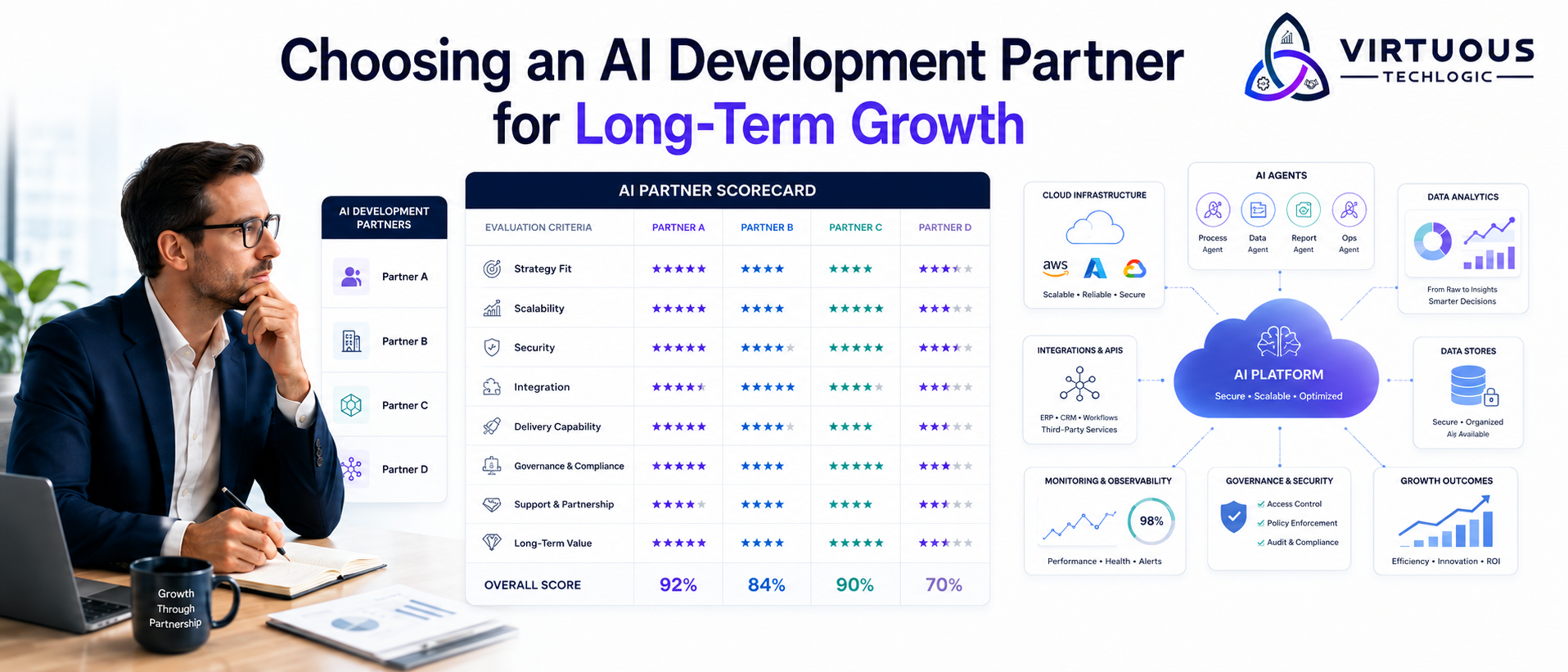
The best AI development companies do more than build chatbots or connect applications to large language models. They identify commercially valuable use cases, integrate AI with existing business systems, create measurable evaluation criteria, protect sensitive data, control operating costs, and improve the solution as the business grows.That distinction matters because an AI prototype can look impressive during a demonstration while still being unreliable, expensive, insecure, or difficult to maintain in production.When comparing AI development partners, evaluate how each company will support your business over the complete AI lifecycle—from strategy and architecture to deployment, monitoring, optimization, and future expansion.
What Makes an AI Development Company a Long-Term Partner?
A development vendor is usually focused on delivering a defined set of features.A long-term AI development partner looks at the wider business system. The team should understand:
- What business problem the AI system must solve
- Who will use it
- Which data sources it needs
- What actions it should be allowed to perform
- How success will be measured
- Which decisions require human approval
- How the system will integrate with existing software
- How usage, quality, latency, and costs will be monitored
- How the product will evolve after launch
This is especially important for AI systems because their outputs can vary even when the input is similar. Conventional software testing alone is therefore not enough. Production AI applications need structured evaluations that measure accuracy, reliability, safety, and task performance against defined success criteria.The goal is not simply to launch an AI feature. The goal is to create a reliable business capability.
Define Your Business Objectives Before Comparing Companies
Before contacting AI development companies, identify the outcome you expect from the project.For example, your objective may be to:
- Reduce customer support response time
- Automate document review
- Help employees search internal knowledge
- Improve product discovery and recommendations
- Qualify sales opportunities
- Generate reports from operational data
- Assist healthcare teams with administrative workflows
- Compare products using structured and unstructured information
- Add an AI assistant to an existing mobile or web application
- Automate repetitive workflows across several business tools
Turn the objective into a measurable statement.Instead of saying:
“We want to use AI in customer support.”
Use:
“We want an AI support assistant that resolves common questions using approved company information, escalates sensitive requests to a human, and reduces repetitive support work.”
This gives potential partners a clear basis for recommending architecture, integrations, timelines, safeguards, and success metrics.A credible AI development company may also tell you that a simpler automation, search system, rules engine, or conventional software feature would solve part of the problem more reliably than AI. That honesty is a positive signal.
10 Criteria for Evaluating AI Development Companies
1. Business and Use-Case Understanding
The company should begin with your users, processes, constraints, and growth objectives—not with a predetermined model or framework.During early conversations, notice the questions the team asks.A strategic partner should want to understand:
- Your revenue model
- Current operational bottlenecks
- Existing software and data sources
- User roles
- Expected usage volume
- Compliance requirements
- Acceptable error levels
- Human approval requirements
- Desired business outcomes
Be cautious when a company recommends a complex AI agent before understanding the workflow it is expected to improve.
2. Production Software Development Experience
An AI model is only one part of an AI product.A production system may also require:
- Mobile or web applications
- Backend services
- Authentication
- Role-based permissions
- Database architecture
- API integrations
- Admin dashboards
- Payment systems
- Analytics
- Logging
- Cloud deployment
- Notifications
- App Store or Play Store publishing
Choose a team that can build the complete product around the AI capability.This is particularly important when adding AI to a customer-facing application. The user experience, backend architecture, data permissions, fallback workflows, and application performance can be just as important as the model response.
3. AI Architecture and Model Flexibility
Your AI development partner should explain how models will be selected and what happens when your requirements change.Ask whether the architecture allows the business to:
- Test different model providers
- Use different models for different tasks
- Replace expensive models with smaller models where appropriate
- Route sensitive or complex tasks differently
- Track model-specific costs and performance
- Avoid unnecessary dependence on one vendor
A sensible approach is to establish a quality baseline with a capable model and then test whether smaller or less expensive models can meet the same accuracy requirements. This supports better cost and latency decisions without weakening the product prematurely.The objective is not to use the largest model available. It is to select the right model for each business task.
4. RAG, Vector Database, AI Agent, and MCP Expertise
Different AI problems require different technical patterns.A qualified company should understand when to use:
- Retrieval-Augmented Generation
- Vector databases
- Structured database queries
- AI agents
- Tool calling
- Workflow automation
- Model Context Protocol integrations
- Fine-tuning
- Conventional APIs and business rules
Retrieval-Augmented Generation, or RAG, connects a large language model with external knowledge sources. It can help an AI application answer questions using company documents, product data, policies, or other approved information.A Vector DB can support semantic retrieval when users may describe the same concept using different words.An AI agent may be suitable when the system needs to reason through a multi-step task and use tools such as databases, CRMs, search systems, calendars, or internal APIs. Agent architectures also require clear tools, instructions, guardrails, and orchestration.Model Context Protocol, or MCP, is an open standard for connecting AI applications with external data sources, tools, and workflows. It can support more standardized integrations, but it should still be implemented with suitable authentication, authorization, and tool permissions.A strong AI company should recommend these technologies because the use case requires them—not because the terms are popular.
5. Data Security and AI Governance
Ask every potential partner how your data will be collected, stored, accessed, transmitted, logged, and deleted.Important areas include:
- Encryption
- Role-based access
- Tenant separation
- Data retention
- Model provider policies
- Personally identifiable information
- Audit logs
- Prompt injection protection
- Tool permissions
- Human review
- Incident response
- Regional or industry requirements
The NIST AI Risk Management Framework organizes AI risk activities around four functions: Govern, Map, Measure, and Manage. It is designed to help organizations incorporate trustworthiness considerations throughout the AI lifecycle.You do not need every vendor to use the same framework. You do need them to show that governance and risk management are built into the delivery process rather than added at the end.
6. Evaluations, Monitoring, and Observability
Do not accept “the responses looked good during testing” as an evaluation strategy.The company should define tests for real business scenarios, including:
- Correctness
- Relevance
- Retrieval quality
- Tool selection
- Structured output accuracy
- Hallucination rate
- Refusal behavior
- Safety
- Latency
- Cost per task
- Escalation accuracy
- Completion rate
A practical evaluation process defines an objective, creates or collects a representative dataset, selects metrics, runs the tests, and compares results as the system changes.Production monitoring should then track both normal software signals and AI-specific quality signals. Current cloud architecture guidance emphasizes monitoring areas such as token consumption, latency, error rates, model quality, safety, and operational cost.Without this capability, it becomes difficult to know whether the system is improving, degrading, or becoming more expensive.
7. Integration Capabilities
Long-term value usually comes from connecting AI to the systems where work already happens.These may include:
- CRM platforms
- ERP systems
- E-commerce stores
- Mobile applications
- Support platforms
- Document repositories
- Healthcare systems
- Internal databases
- Analytics platforms
- Payment gateways
- Communication tools
- Custom APIs
Ask the company to describe the complete data flow.For example:
- Where does the request originate?
- Which user permissions apply?
- Which data is retrieved?
- Which model processes it?
- Which tools can the AI use?
- What happens when confidence is low?
- Where is the result stored?
- How is the action audited?
A team that understands integration architecture is more likely to build AI that becomes part of your operations rather than an isolated feature.
8. Scalability and Cost Control
Long-term growth can increase:
- User volume
- Model calls
- Database usage
- Document volume
- Vector storage
- Retrieval operations
- API usage
- Monitoring requirements
- Support needs
Ask potential partners how the architecture will respond to growth.They should be able to discuss:
- Caching
- Asynchronous processing
- Rate limits
- Model routing
- Usage quotas
- Database indexing
- Horizontal scaling
- Cost dashboards
- Retry policies
- Fallback models
- Batch processing
- Cloud infrastructure
The team should also estimate AI operating costs separately from development costs.A low initial development quote may not be attractive if the resulting architecture creates unnecessary model usage or expensive infrastructure.
9. Documentation, Ownership, and Knowledge Transfer
Your business should not become dependent on one developer who understands the entire system.Confirm that the engagement includes:
- Architecture documentation
- Source code access
- Deployment instructions
- Environment configuration
- Prompt and workflow documentation
- API documentation
- Database structure
- Evaluation datasets
- Test cases
- Access ownership
- Backup procedures
- Knowledge-transfer sessions
Clarify intellectual property ownership, third-party licenses, model provider terms, and access to cloud accounts before development starts.The objective is a maintainable business asset—not a black-box system.
10. Post-Launch Optimization
AI systems require ongoing attention because user behavior, business information, models, costs, and workflows change.Ask what happens after launch.A long-term support plan may include:
- Monitoring
- Evaluation reviews
- Prompt improvements
- Retrieval tuning
- Knowledge-base updates
- Security patches
- Model upgrades
- Cost optimization
- New integrations
- User feedback analysis
- Feature expansion
- Incident support
The best partner will define how improvements are prioritized and how their business impact will be measured.
AI Development Company Evaluation Scorecard
Use this scorecard when comparing shortlisted companies.Evaluation areaKey questionSuggested weightBusiness alignmentCan the company connect the AI solution to a measurable objective?15%Relevant experienceHas the team solved comparable product or workflow problems?10%Full-stack capabilityCan it build the application, backend, integrations, and AI layer?10%AI architectureCan it explain model selection, RAG, agents, tools, and trade-offs?10%Security and governanceAre data access, privacy, risk, and human oversight addressed?15%EvaluationsDoes the company define measurable quality and reliability tests?10%Integration expertiseCan it integrate with your current systems and APIs?10%Scalability and costDoes the architecture support growth and cost monitoring?10%OwnershipWill you receive source code, documentation, and account control?5%Ongoing supportIs there a clear post-launch optimization plan?5%Score each company from one to five in every category. Multiply the score by the category weight.Do not automatically choose the company with the highest number. Use the result to identify risks, compare trade-offs, and structure deeper conversations.
Questions to Ask Potential AI Development Partners
Ask shortlisted companies these questions:
- Which business objective should we validate first?
- What would make you advise us not to use AI for this project?
- Which architecture would you recommend, and what alternatives did you consider?
- How will the AI use our private business information?
- Do we need RAG, a Vector DB, an AI agent, MCP, fine-tuning, or a simpler workflow?
- How will you measure accuracy and business impact?
- How will low-confidence or sensitive cases be escalated?
- What will be monitored after launch?
- How will you control model and infrastructure costs?
- Can we change model providers later?
- Which accounts, source code, and data will we own?
- What documentation and knowledge transfer will you provide?
- Who will maintain the solution after deployment?
- How will new use cases be added without rebuilding the system?
- What are the main technical and business risks?
Compare the clarity of the answers—not just the confidence with which they are delivered.
Red Flags to Avoid
Be cautious when an AI development company:
- Promises perfect accuracy
- Recommends an AI agent for every use case
- Cannot explain how success will be measured
- Discusses models but not business processes
- Has no evaluation or monitoring plan
- Avoids questions about data storage
- Cannot explain operating costs
- Uses only generic demonstrations as proof
- Provides no documentation or handover process
- Builds directly in vendor-owned accounts
- Cannot describe human oversight
- Treats post-launch support as an afterthought
- Guarantees unrealistic financial outcomes
AI projects contain uncertainty. A reliable partner should explain that uncertainty and show how it will be managed.
Choosing the Right Engagement Model
Different business objectives require different engagement models.
AI Discovery or Use-Case Assessment
Best when you have several AI ideas but do not know which one to prioritize.Typical outputs include:
- Use-case analysis
- Feasibility review
- Data assessment
- Risk analysis
- Architecture recommendation
- MVP roadmap
- Budget range
AI Proof of Concept
Best when one technical assumption must be validated quickly.A proof of concept should answer a specific question, such as whether your internal documents can support accurate knowledge retrieval.It should not be mistaken for a production application.
AI MVP Development
Best when you need a usable first product for selected users.The MVP should include enough architecture, security, analytics, and evaluation to generate meaningful evidence—not just a demonstration.
Dedicated AI Development Team
Best for companies with an established product roadmap and ongoing development needs.This model can provide continuous capacity across AI, backend, web, mobile, integrations, testing, and cloud deployment.
Long-Term AI Product Partnership
Best when AI is expected to become a core business capability.The partner supports discovery, development, deployment, monitoring, maintenance, optimization, and future use cases.
How Virtuous Techlogic Supports Long-Term AI Development
Virtuous Techlogic helps startups, agencies, and growing businesses develop AI-powered mobile apps, web platforms, internal tools, automation workflows, and SaaS products.Our AI development capabilities include:
- Custom AI application development
- AI agent development
- RAG implementation
- Vector database integration
- MCP integration
- AI automation workflows
- Chatbot development
- Internal knowledge search
- Product recommendation and comparison systems
- OpenAI and model API integrations
- Firebase and Supabase integration
- Flutter and FlutterFlow AI applications
- Custom backend and API development
- Human-in-the-loop workflows
- Evaluation and monitoring planning
- Production deployment and post-launch support
We focus on building AI systems that connect with real applications, databases, APIs, users, and business processes.That means considering not only what the AI can generate, but also what it should access, which actions it may perform, how its performance will be evaluated, and how the architecture will support future growth.
Final Thoughts
Finding the right AI development company is not about choosing the team with the longest list of AI technologies.It is about finding a partner that can connect those technologies to your long-term business objectives.Start with a measurable use case. Evaluate the company’s complete software engineering capability. Ask how it handles data, integrations, evaluations, human oversight, scalability, cost, ownership, and post-launch support.A well-designed AI solution should become more useful as your business grows—not more difficult to manage.
Frequently Asked Questions
Build Your App with Virtuous Techlogic
Book a Free ConsultationTrusted by clients across Clutch and Upwork
Want proof before starting? View our client reviews and agency profiles on Clutch and Upwork.