
Flutter for Startups: A Comprehensive Review
Have you think that which Factors are affecting in app development
lutter: A Comprehensive Review In today's fast-paced tech landscape, startups often face the challenge of balancing rapid development with maintaining high-quality standards. At Virtuous Techlogic, we understand the importance of efficient...
· · Written by Virtuous Techlogic · 2 min read
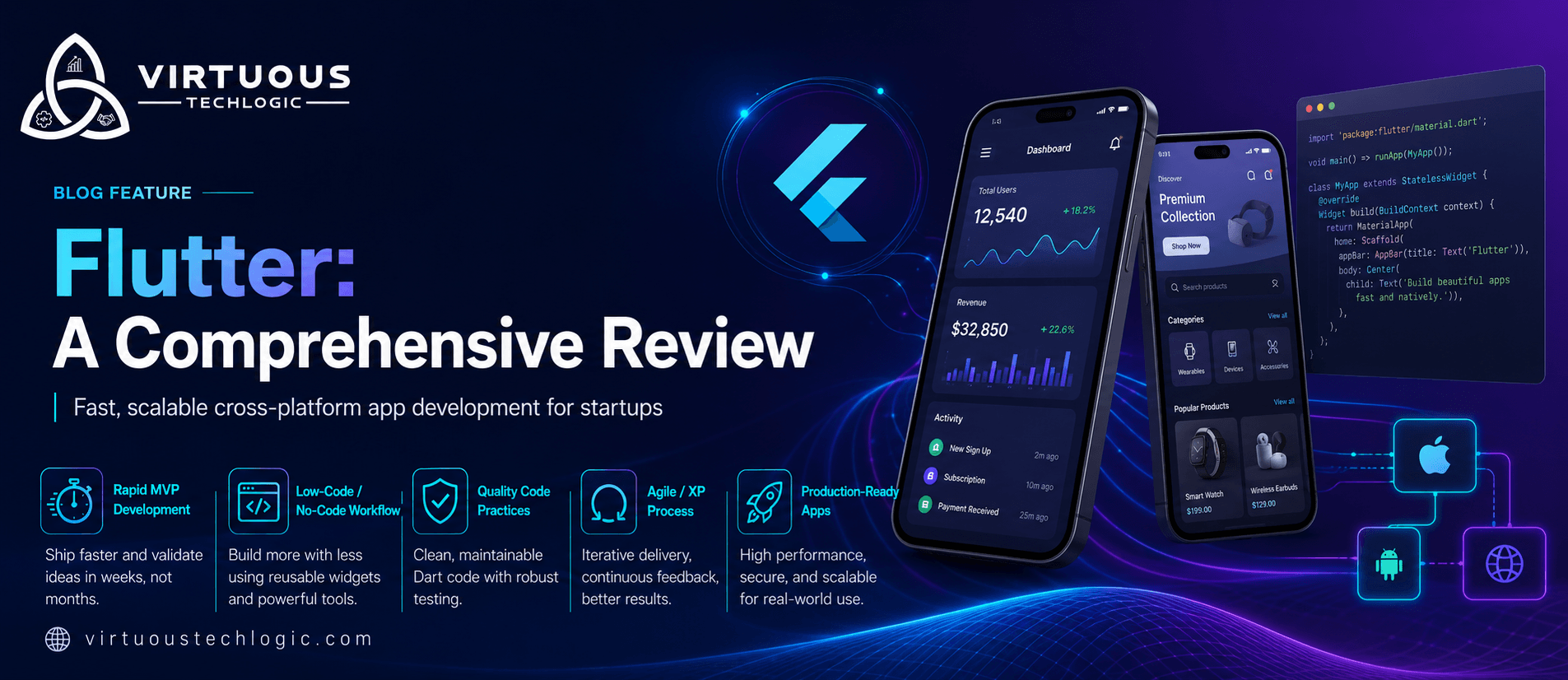
Factors Affecting App Development: What Every Business Should Know
Introduction
Have you ever thought about what factors affect app development?Building a mobile app is not only about writing code. A successful app depends on planning, design, technology, features, testing, security, scalability, and post-launch support. Whether you are a startup founder, business owner, or enterprise team, understanding these factors helps you make better decisions before investing in app development.At Virtuous Techlogic, we help businesses build scalable mobile apps using Flutter, FlutterFlow, AI, secure backend systems, and modern UI/UX design. Before starting any project, we always help clients understand what affects app cost, timeline, quality, and long-term success.
1. App Idea and Business Goals
The first factor is the clarity of your app idea.A simple app idea with clear goals is easier to plan and develop. But if the idea is unclear, the development process may take longer because the team needs more time for research, feature planning, and revisions.Before development, you should define:
- Who will use the app?
- What problem does it solve?
- What features are essential?
- How will the app make money?
- What is the long-term roadmap?
A clear business goal helps developers build the right solution instead of just adding random features.
2. App Complexity
App complexity directly affects cost and timeline.A basic app with login, profile, content pages, and notifications will take less time than an app with real-time chat, payments, AI features, maps, dashboards, and multiple user roles.App complexity usually falls into three categories:Simple App: Basic UI, limited screens, simple backend.Medium App: API integrations, payments, user roles, admin panel, push notifications.Complex App: AI, live tracking, video calling, custom analytics, automation, multi-vendor systems, high scalability.The more complex the app, the more time is needed for design, development, testing, and maintenance.
3. Features and Functionality
Features are one of the biggest factors affecting app development.Common features include:
- User login
- Profile management
- Search and filters
- Push notifications
- Payment gateway
- Chat
- Maps and GPS
- Booking system
- Admin dashboard
- Reviews and ratings
- AI chatbot
- Analytics
- Social login
- File upload
- Video call
- Subscription plans
Every feature requires planning, design, development, testing, and sometimes third-party integration. That is why feature prioritization is important.For startups, it is better to start with an MVP that includes only the most important features.
4. Platform Selection
The platform you choose also affects development.You may build for:
- Android
- iOS
- Web
- Desktop
- All platforms
Native development requires separate apps for Android and iOS, which increases cost and timeline. Cross-platform frameworks like Flutter allow one codebase for Android and iOS, reducing duplicated work.FlutterFlow can also help startups launch MVPs faster using low-code visual development.The right platform depends on your target audience, budget, timeline, and business goals.
5. UI/UX Design
Design is not just about how the app looks. It affects how users feel while using the app.A good UI/UX design makes the app:
- Easy to use
- Fast to understand
- Visually appealing
- User-friendly
- Conversion-focused
- Accessible
Poor design can lead to confusion, low engagement, and uninstallations.Design factors include wireframes, user flow, branding, typography, colors, animations, responsive layouts, and accessibility.At Virtuous Techlogic, we focus on clean and practical UI/UX that supports user engagement and business goals.
6. Backend Development
The backend is the engine behind the app.It handles:
- User data
- Authentication
- APIs
- Payments
- Notifications
- Database
- Admin panel
- Business logic
- Security
- Analytics
A simple app may need a basic backend, while a marketplace, healthcare app, fintech app, or food delivery app needs a more powerful backend.Backend complexity affects performance, scalability, security, and long-term maintenance.
7. Third-Party Integrations
Many apps need third-party integrations.Examples include:
- Google Maps
- Stripe
- Razorpay
- PayPal
- Firebase
- Supabase
- OpenAI APIs
- Twilio
- WhatsApp API
- CRM tools
- Email services
- Analytics tools
- Social login
Each integration adds development and testing time. Some integrations also require approval, documentation, compliance checks, and ongoing maintenance.
8. Technology Stack
Choosing the right technology stack is important for app success.Popular technologies include:
- Flutter
- FlutterFlow
- React Native
- Firebase
- Supabase
- Node.js
- Laravel
- Python
- AWS
- Google Cloud
- PostgreSQL
- MongoDB
The wrong tech stack can create performance issues, scalability problems, and high maintenance costs later.For many startups, Flutter and FlutterFlow are strong choices because they support faster development, cross-platform delivery, and scalable MVPs.
9. Security and Compliance
Security is critical, especially for healthcare, fintech, e-commerce, SaaS, and enterprise apps.Security factors include:
- Secure login
- Data encryption
- API protection
- Role-based access
- Payment security
- Secure cloud storage
- Regular security testing
- Privacy policies
- Data deletion options
If your app handles health, finance, or personal data, compliance becomes even more important.Security should be planned from the beginning, not added at the end.
10. Testing and Quality Assurance
Testing ensures that your app works properly before launch.QA includes:
- Functional testing
- UI testing
- Performance testing
- Security testing
- Device testing
- API testing
- Payment testing
- Bug fixing
Skipping testing may save time in the beginning, but it can damage the app after launch.A buggy app can lead to bad reviews, user loss, and business damage.
11. Scalability Requirements
If you expect the app to grow, scalability must be planned early.A scalable app can handle:
- More users
- More data
- More transactions
- More features
- More locations
- More integrations
Apps like food delivery, taxi booking, marketplaces, healthcare platforms, and SaaS products need strong scalability planning.Poor scalability can cause crashes, slow loading, and poor user experience.
12. Development Team Experience
The quality of your development team affects the final product.A good team includes:
- Project manager
- UI/UX designer
- Flutter developer
- Backend developer
- QA tester
- DevOps/cloud expert
- Business analyst
Experienced teams can identify risks early, suggest better solutions, reduce mistakes, and deliver better quality.Choosing the cheapest team may lead to poor architecture, bugs, delays, and costly rebuilds later.
13. Timeline and Budget
Timeline and budget are connected.If you want an app very quickly, the team may need more resources. If your budget is limited, you may need to reduce features or launch an MVP first.A realistic timeline depends on:
- App complexity
- Features
- Design
- Backend
- Testing
- Integrations
- Team size
- Feedback speed
A simple MVP may take a few weeks to a few months. A complex app may take several months or more.
14. Post-Launch Maintenance
App development does not end after launch.After launch, your app needs:
- Bug fixes
- Security updates
- OS updates
- Feature improvements
- Performance optimization
- User feedback updates
- Analytics monitoring
- App store updates
Post-launch support is essential for long-term success.Apps that are not maintained become outdated, insecure, and less useful for users.
15. Marketing and App Store Optimization
Even a great app needs visibility.App Store Optimization helps improve downloads through:
- App title
- Keywords
- Screenshots
- Description
- Reviews
- Ratings
- App icon
- Preview video
Marketing also affects app success. Startups should plan launch campaigns, social media, paid ads, influencer campaigns, referral programs, and content marketing.
How Virtuous Techlogic Helps
Virtuous Techlogic helps startups and businesses plan, design, develop, test, launch, and scale mobile apps.Our services include:
- Flutter app development
- FlutterFlow development
- Mobile app development
- AI app development
- MVP development
- UI/UX design
- Backend development
- API integration
- Firebase and Supabase integration
- App maintenance and support
We focus on building apps that are not only functional but also scalable, secure, and user-friendly.
Conclusion
Many factors affect app development, including features, design, platform, backend, integrations, security, testing, team experience, timeline, budget, and maintenance.If you understand these factors before starting your project, you can avoid delays, reduce unnecessary costs, and build a better app.The best approach is to start with clear goals, build an MVP, choose the right technology, work with an experienced team, and improve the app based on real user feedback.If you are planning to build a mobile app, Virtuous Techlogic can help you choose the right Flutter, FlutterFlow, AI, and backend approach for your business.
Frequently Asked Questions
Build Your App with Virtuous Techlogic
Book a Free ConsultationTrusted by clients across Clutch and Upwork
Want proof before starting? View our client reviews and agency profiles on Clutch and Upwork.