
Why Healthcare Startups Fail Early, and How Smart Healthcare Apps Drive Success
Healthcare Startup Product Mistakes
Introduction: Big Dreams, Harsh Reality When we think of healthcare innovation, a powerful image often comes to mind: a passionate founder, maybe a doctor frustrated with outdated hospital workflows, or a technologist believing they can democratize...
· · Written by Virtuous Techlogic · 11 min read
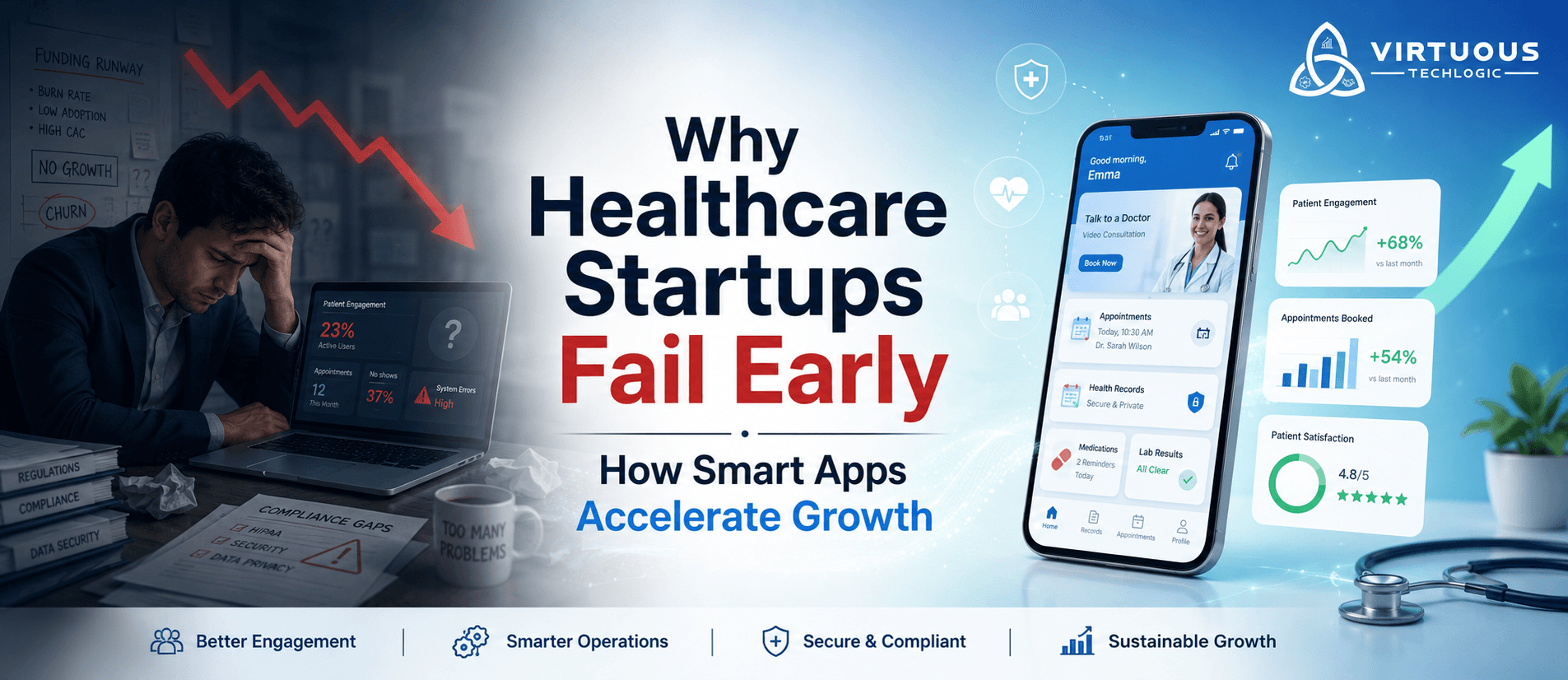
Introduction: Big Dreams, Harsh Reality
When we think of healthcare innovation, a powerful image often comes to mind: a passionate founder, maybe a doctor frustrated with outdated hospital workflows, or a technologist believing they can democratize care via digital tools. They imagine an app that can let remote patients consult doctors, track chronic disease seamlessly, digitize health records, and perhaps even transform how care is delivered. The vision is noble. The mission is inspiring. But for every success story, there are many more quiet failures.
In fact, the health‑tech world has become something like a minefield: high regulatory hurdles, complex stakeholder ecosystems (patients, doctors, insurers, hospitals), data‑sensitivity, and real-world inertia. According to industry analyses, a huge proportion of digital‑health startups never thrive, and some fail within their first few years.
So why do so many promising healthcare startups with smart ideas and good intentions fail early? And how can some manage to survive, even thrive, by using smart healthcare apps built on strong foundations? This post tells that story: from hopeful beginnings to pitfalls, and then, in the best cases, a turn toward success through smart, needs‑based app development.
Why Healthcare Startups Fail Early
Common Causes / Mistakes
- Lack of real market need / solving the wrong problem. Many startups chase hype or trendy ideas instead of genuine unmet clinical needs.
- Disconnect from clinical environment & workflows. Without input from clinicians or understanding of real-world workflows, solutions become impractical.
- Regulatory and compliance challenges. Healthcare is heavily regulated; overlooking compliance, data standards, and interoperability can kill a startup.
- Poor technical choices/infrastructure debt. Startups sometimes pick the wrong tech stacks or take shortcuts that work initially but fail at scale.
- Burn rate and funding issues. Many run out of cash before they can scale or get approvals.
- Weak business model or value proposition. A startup may have an app, but if there’s no clear value for users or stakeholders, adoption fails.
- Underestimating the complexity of the healthcare ecosystem. Focusing narrowly on a single problem without considering how the solution integrates into broader healthcare workflows.
When Smart Healthcare Apps Accelerate Growth: The Turning Point
But now imagine a different story: a startup that recognises early on that success demands more than ambition. They begin with deep research speaking with doctors, patients, and hospitals; validating real clinical problems, mapping regulations, and designing workflows around actual daily practices.
They build a Minimum Viable Product (MVP), not a flashy “all-features” version, but a basic, functional app that solves a core problem: maybe remote consultations, patient-record management, or medication reminders. Compliance, data security, and privacy are integrated from day one. They gather feedback, iterate quickly, and scale only when early indicators of engagement, improved outcomes, and stakeholder buy-in show real promise.
This is exactly where smart healthcare apps built with the right technical partner, such as Virtuous TechLogic, truly shine. By digitizing essential workflows appointments, telemedicine, health records, notifications, and remote monitoring, they remove friction. Patients get easier access to care; providers reduce overhead; data becomes actionable; and care becomes more efficient.
With a team like Virtuous TechLogic, who understand both healthcare workflows and secure app architecture, startups often find themselves solving real problems faster, aligning incentives across stakeholders, and scaling with confidence. By combining clinical insight with strong engineering practices, these apps don’t just survive, they grow.
What It Takes: From Idea to a Sustainable Health-Tech Venture
Building a successful healthcare startup via app development is far more than writing code. It begins with domain-specific research: understanding what doctors, patients, caregivers, and insurers truly need. It requires involving real stakeholders clinicians, caregivers, administrative staff, and regulatory experts rather than building in a vacuum.
On the technical side, the infrastructure must be secure, scalable, and interoperable. The architecture should anticipate growth, integrate with Electronic Health Records (EHR), adhere to data-privacy laws, and meet strict compliance standards. Cutting corners early might speed up development, but it often creates crippling technical and regulatory debt later.
This is why many founders partner with teams like Virtuous TechLogic, who blend healthcare-domain understanding with strong engineering discipline. With experience in building HIPAA-ready architectures, secure backend systems, and intuitive patient-doctor workflows, Virtuous TechLogic helps startups avoid early missteps and design systems that hold up in real medical environments.
Above all, the founding team must combine clinical insight with technical and business acumen. Entrepreneurs who think like clinicians and developers or collaborate with partners who do, such as Virtuous TechLogic tend to build products that scale sustainably and truly make a difference.
Common Mistakes That Sink Health‑Tech Startups (And How Smart Apps Stop Them)
Here’s how the stories of failure often begin and how a smarter approach flips them around:
- Wrong problem, no real need. Many startups chase trendy ideas instead of genuine clinical problems. Smart apps start with real-world challenges and build only what’s needed.
- Ignoring stakeholders. Building as if patients alone matter, forgetting doctors, hospitals, and payors, usually fails. Smart apps involve all stakeholders from day one.
- Underestimating regulation. Launching without compliance planning often leads to shutdown. Smart apps bake privacy, security, and compliance in from the start.
- Technical shortcuts and debt. Quick builds using an improper stack can collapse under growth or audit. Smart apps use robust, scalable, secure architecture from day one.
- Poor business model / unclear revenue streams. Without buy‑in from payors or partners, even a great app might not make money. Smart apps define business model early (e.g., B2B with clinics, or B2C with subscription, or hybrid).
- Running out of funds before validation. Smart apps begin with MVP and real‑world testing, minimizing waste and ensuring viability before scaling.
The Role of Healthcare App Development in a Startup’s Success
- Starting with clinical‑need validation + market research + stakeholder involvement ensures product‑market fit rather than chasing hype.
- Choosing a robust and scalable technology stack + proper architecture to avoid future technical debt.
- Embedding security, privacy, compliance, and data interoperability from day one is critical in healthcare apps.
- Having a clear business and revenue model, whether B2C (patients), B2B (clinics), or hybrid.
- Partnering with experienced development agencies or teams that know both tech and healthcare to navigate compliance, development, and scaling.
How Smart Apps Prevent Early Failure
- By aligning features with real user needs (patients, doctors, clinics), we can avoid wasted development effort.
- Ensuring compliance, data security, and scalability, it reduces the risk of regulatory or technical breakdowns.
- By offering flexible architecture and maintainability, as the user base grows, the app adapts without collapsing.
- By enabling cost‑efficient operations and better resource utilization, it reduces burn rate.
- By allowing iterative feedback loops, easy updates & improvements based on real user feedback, we can improve retention and adoption.
Most Common Mistakes We See
- Building for hype, not for real clinical need.
- Ignoring clinical workflows and not involving medical professionals.
- Underestimating regulatory, compliance, and data interoperability requirements.
- Technical shortcuts leading to infrastructure debt.
- Weak or unclear business models and value propositions.
- Running out of funds before scaling or validation.
- Poor technology partner or an in-house team inexperienced in healthcare app development.
Solutions & Best Practices
- Conduct thorough market research + clinical need validation + stakeholder interviews before product development.
- Build an MVP (minimum viable product) with core essential features, then iterate based on feedback.
- Use scalable, secure, compliant architecture from the start (data encryption, interoperability, HIPAA / relevant compliance, secure data handling).
- Work with experienced, specialized healthcare‑app development teams or agencies (who understand tech + medical domain).
- Lay out a clear business model, revenue streams, and growth plan (subscription, B2B licences, partnerships with clinics/hospitals, etc.).
- Manage finances carefully realistic burn‑rate projections, milestones for funding rounds, efficient resource allocation.
- Build for user‑adoption, usability, trust, and long‑term engagement ensure the app solves tangible problems for users.
Technical Requirements for Medical / Healthcare App Services
- Secure data storage and encryption, compliance with data privacy laws (HIPAA or local equivalents if you operate in a region like India).
- Interoperability with existing health systems (EHR/EMR), support for standard data formats, APIs, and integrations.
- Scalable backend infrastructure cloud‑based, load balancing, and the ability to handle many users concurrently.
- Role‑based access control (patients, doctors, admin), audit logging, and data security protocols.
- User‑friendly UI/UX for both patients and healthcare professionals, intuitive, responsive, and accessible across devices.
- Real‑time communication modules: chat, video‑consultation, notifications, reminders.
- Analytics and reporting to track usage, health metrics, compliance, and performance.
- Regulatory and compliance: local laws, data privacy, health data standards, consent management, possibly medical device regulations, depending on app features.
Success Story: When Smart Apps Win
One real‑world example of health‑tech reaching scale is Lybrate, a mobile healthcare‑technology platform from India. Lybrate connects patients and doctors through online consultations, letting people book appointments, talk to physicians via chat or video, and access lab and diagnostic services remotely. Over time, Lybrate expanded its services to include home‑sample lab testing, online consultations, and patient management services.
What works about Lybrate’s story is that they didn’t just build an app; they addressed a real problem: access to doctors, especially for people far from urban centers or busy lifestyles. By offering convenience, affordability, and a simple way to connect with qualified physicians, Lybrate turned digital healthcare from a buzzword into a practical service many people in India use today.
Their success underscores a lesson: health‑tech is not about building the fanciest feature set, it’s about meeting real human needs, creating trust, and making care accessible.
Conclusion
The path from “I have an idea” to “I have a thriving health‑tech startup” is littered with hidden obstacles: regulation, adoption resistance, technical debt, unclear business models, and funding constraints. Many good ideas, even backed by strong intentions, never make it.
Yet there is a way through: by embracing smart, purposeful healthcare‑app development that starts with real problems; involves stakeholders; prioritizes compliance, usability, and scalability; and builds incrementally with feedback.
Smart apps don’t just digitize care they humanise it, streamline it, and make it accessible. For founders in health‑tech, the message is clear: don’t build hype. Build value. Don’t chase features. Solve real pain points. Invest in trust, compliance, and user‑centred design. That’s the difference between becoming another failed startup and building something that lasts long, grows, and truly helps people.
Frequently Asked Questions
Build Your App with Virtuous Techlogic
Book a Free ConsultationTrusted by clients across Clutch and Upwork
Want proof before starting? View our client reviews and agency profiles on Clutch and Upwork.