
How Developers in France Are Using AI to Build Smarter, Faster Apps
How French Developers Are Using AI to Build Smarter, Faster Mobile Apps
Introduction Artificial Intelligence (AI) is no longer a distant concept confined to research labs. In France, it has become a transformative force, fundamentally reshaping how mobile applications are designed, developed, and optimized for users....
· · Written by Virtuous Techlogic · 10 min read
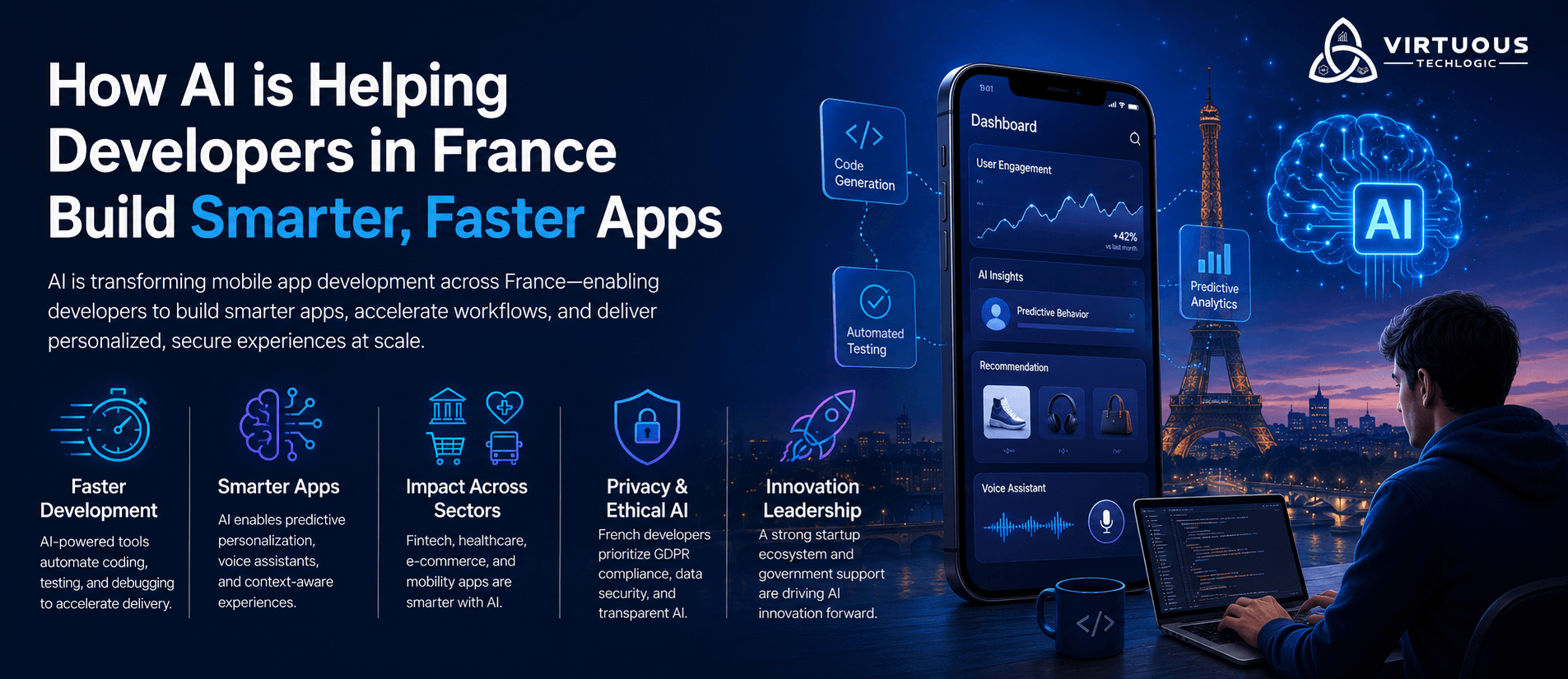
Introduction
Artificial Intelligence (AI) is no longer a distant concept confined to research labs. In France, it has become a transformative force, fundamentally reshaping how mobile applications are designed, developed, and optimized for users. Over the past few years, French developers have accelerated their adoption of AI technologies, leveraging them not just for automation but to drive deeper personalization, faster development, smarter decision-making, and competitive user experiences across diverse sectors.
From Parisian fintech startups to healthcare innovators in Lyon, developers across France are integrating AI capabilities to build apps that not only meet user needs but anticipate them. With robust government support, a thriving AI talent pool, and increasing demand for intelligent digital experiences, France is emerging as a European powerhouse in AI-driven mobile app development.
Let’s explore how developers in France are using AI to build smarter, faster apps and what that means for the future of digital innovation.
The Rise of AI in France’s Digital Ecosystem
France has rapidly positioned itself at the forefront of digital transformation in Europe. The French government has made AI development a national priority, launching initiatives such as the “France 2030” plan and investing billions of euros to foster innovation. As a result, startups and enterprises alike are increasingly embracing AI across sectors, particularly in mobile app development.
The growing availability of AI tools, cloud platforms, and frameworks such as TensorFlow, PyTorch, Hugging Face (based in Paris), and OpenAI integrations has empowered developers to implement sophisticated AI features faster than ever. Whether it’s using machine learning to predict user behavior or integrating voice assistants through natural language processing (NLP), French developers now have access to a powerful AI toolbox that enhances nearly every aspect of the app lifecycle.
Faster Development Through AI-Powered Tools
One of the most notable shifts in mobile app development in France is the use of AI for speed and efficiency. Developers no longer need to manually test every line of code or spend weeks debugging; AI is now being used to automate these tedious tasks.
AI-powered code generation tools like GitHub Copilot or Tabnine are helping developers write cleaner code faster. Meanwhile, automated testing platforms powered by machine learning ensure apps are thoroughly tested under various real-world conditions before launch.
Beyond development, AI also accelerates UI/UX design. Tools that use generative AI can suggest interface improvements, predict user paths, and recommend visual hierarchies based on heatmaps and behavior data. These capabilities allow French developers to reduce the app development cycle significantly, launching products faster while maintaining high standards of quality and performance.
Smarter Apps: Predictive, Personalized, and Context-Aware
AI is also transforming what apps can do. In France, app users expect seamless, intelligent, and personalized experiences. This demand has driven developers to integrate smart AI features that go beyond basic functionality.
One major area of innovation is predictive personalization. Mobile apps in France, from e-commerce to banking, are using machine learning models to analyze user data and predict what users will want next. This could mean personalized shopping recommendations, predictive financial advice, or curated news feeds, all tailored in real-time.
Voice assistants, powered by NLP, are also becoming common. French-speaking users benefit from apps that understand and respond to spoken commands with increasing accuracy. AI is even being used to adjust in-app language automatically based on the user’s dialect, creating hyper-localized experiences across regions like Île-de-France, Provence-Alpes-Côte d'Azur, and Nouvelle-Aquitaine.
AI Use Cases Across Key Sectors in France
French developers are not just using AI as a novelty, they’re embedding it into real-world applications that drive value across industries:
1. Fintech:
French fintech companies use AI to detect fraud, assess creditworthiness, and deliver personalized financial insights. Apps like Lydia, Qonto, and Shine integrate AI to automate expense management and user guidance.
2. Healthcare:
AI-driven healthcare apps in France assist with early diagnostics, remote monitoring, and patient scheduling. French startups are leveraging computer vision to interpret X-rays and scans with higher precision than ever before.
3. E-Commerce:
Retail and e-commerce apps are benefiting from AI-powered recommendation engines, visual search via camera input, and AI chatbots that enhance customer service 24/7.
4. Mobility & Transport:
Mobility apps, especially in cities like Paris and Lyon, use AI to optimize routes, predict traffic patterns, and improve ridesharing efficiency.
These use cases highlight the growing sophistication of AI implementations by French developers, shifting from backend efficiency to front-end value creation.
Data Privacy and Ethical AI: The French Approach
France is a strong proponent of ethical AI and data privacy, especially under the umbrella of GDPR compliance. Developers in France are highly attuned to the importance of securing user data, offering transparent consent mechanisms, and ensuring AI decisions are explainable.
Before integrating AI features, developers must consider how data is collected, stored, and processed. Tools that anonymize and encrypt user data are widely adopted, and explainable AI models are becoming the standard, particularly in industries like finance and healthcare, where transparency is critical.
This compliance-first mindset gives users greater trust in AI-powered apps and supports long-term engagement.
Startups, Scaleups, and the AI Edge
France’s vibrant startup ecosystem is another reason why AI is thriving in mobile app development. Many French startups especially those in “La French Tech” hubs like Station F in Paris are building AI-first apps from the ground up.
These startups often operate with agility, experimenting with new AI models, APIs, and low-code tools to create innovative mobile experiences. This startup energy is complemented by mid-sized scaleups and enterprise developers who are retrofitting existing apps with AI capabilities to stay competitive.
At Virtuous Techlogic, we’ve supported both startups and enterprises in their AI journeys. Our development teams leverage cloud-native AI services, custom model training, and scalable infrastructures to deliver next-gen mobile applications that are not just smart but future-ready.
Challenges in AI Implementation and How to Overcome Them
Despite its benefits, AI integration in app development comes with its own set of challenges:
- Data Quality: Poor data leads to poor predictions. Developers must ensure clean, structured, and relevant datasets.
- Bias in AI Models: Training AI on biased datasets can result in unfair or inaccurate outcomes. Fairness auditing is crucial.
- Complex Integration: Embedding AI into existing app architectures can be technically complex without a modular design.
- Talent Shortage: Skilled AI engineers and data scientists are in high demand. Collaboration with experienced partners becomes essential.
French developers are overcoming these hurdles through upskilling, the adoption of low-code AI platforms, and partnerships with AI specialists and agencies.
The Future of AI in French App Development
Looking forward, AI will become an even deeper part of app development in France. As edge AI becomes more powerful, expect to see apps processing data directly on devices, reducing latency and improving privacy. Voice interfaces will become more natural, and AI will support immersive AR/VR experiences in apps across education, tourism, and retail.
French developers are also exploring AI models that learn continuously, adapting to user behavior in real-time. This creates apps that evolve not just in function, becoming smarter with every interaction.
Conclusion: Building the Future, Smarter and Faster
AI is fundamentally changing how apps are developed, designed, and delivered in France. By embracing AI technologies, French developers are not just following trends; they’re setting them. From faster development timelines to smarter, more intuitive apps, the transformation is clear and accelerating.
Companies like Virtuous Techlogic are at the forefront of this evolution, helping businesses implement AI across their mobile ecosystems from ideation to deployment. As AI tools become more accessible and user expectations grow, developers in France have a unique opportunity to lead the world in creating intelligent, impactful, and ethical mobile applications.
Whether you're a startup building your first AI-powered app or an enterprise looking to scale smart features, the time to act is now. In France, the future of app development is not just digital, it’s intelligent.
Frequently Asked Questions
Build Your App with Virtuous Techlogic
Book a Free ConsultationTrusted by clients across Clutch and Upwork
Want proof before starting? View our client reviews and agency profiles on Clutch and Upwork.