
Vendor Intelligence Hub by Virtuous Techlogic
How to Choose an AI Development Partner
AI development company AI vendor management software AI supplier management system custom vendor management software vendor management system integration AI procurement software development supplier risk management software vendor onboarding automation AI contract analysis procurement workflow automation AI automation services AI agent development RAG development vendor performance dashboard supplier data management custom procurement software
· · Written by Virtuous Techlogic · 1 min read
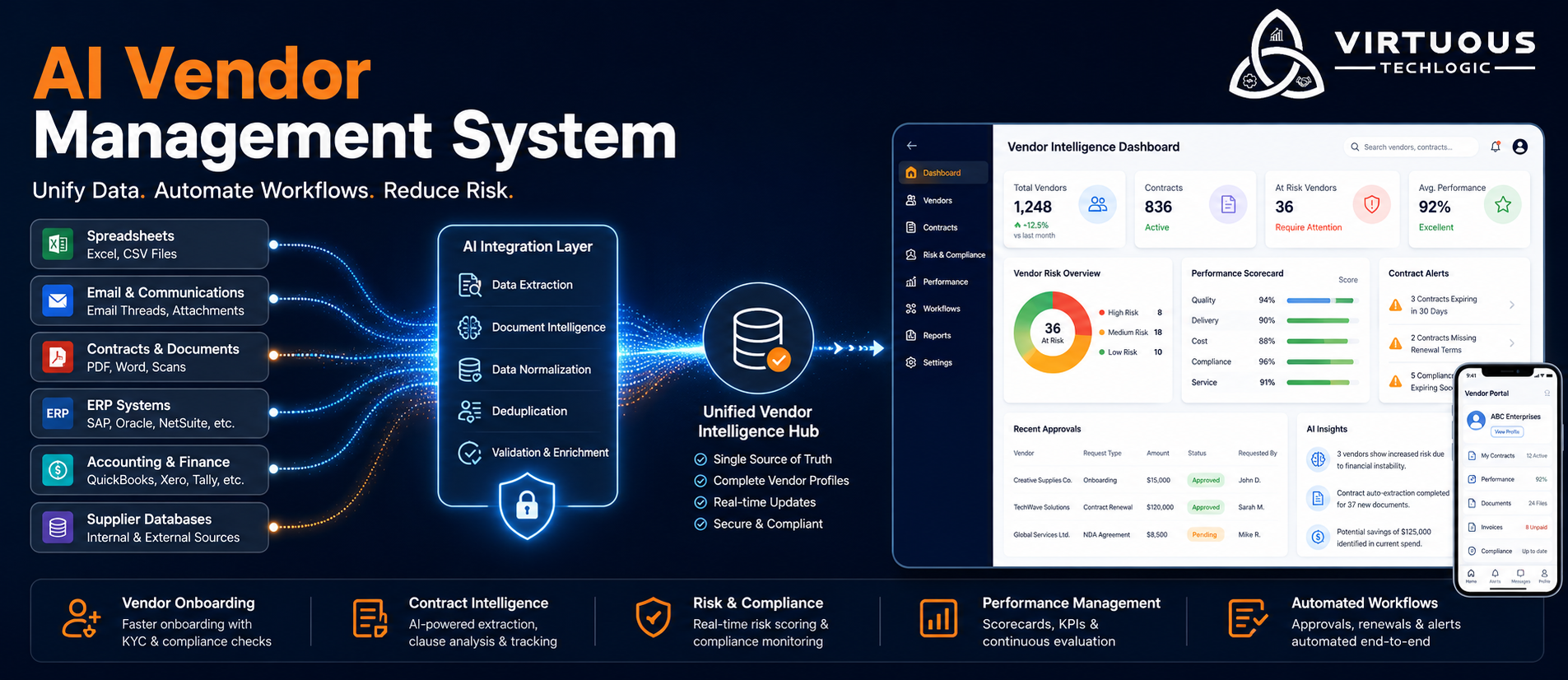
A reliable AI development company should do more than add a chatbot to your procurement portal. It should help you connect fragmented vendor data, standardize supplier records, automate repetitive workflows, extract information from documents, identify risks, and provide decision support without removing human control.Vendor information is commonly distributed across ERPs, accounts payable systems, sourcing tools, spreadsheets, emails, contracts, and third-party risk platforms. This fragmentation creates inconsistent information, duplicate records, weak governance, and slower procurement decisions.For businesses facing this problem, the right approach is usually not to replace every system immediately. A more practical strategy is to create a secure vendor intelligence layer that connects existing systems and gradually becomes the central operating platform for vendor-related work.
What Is an AI Vendor Management System?
An AI vendor management system is a web, mobile, or enterprise software platform that uses artificial intelligence to organize supplier information and improve activities such as:
- Vendor onboarding
- Supplier document verification
- Contract analysis
- Risk assessment
- Performance monitoring
- Spend analysis
- Compliance tracking
- Approval routing
- Vendor communication
- Procurement reporting
Traditional vendor management software primarily stores information and displays dashboards. An AI-enabled system can also classify documents, summarize contracts, detect missing information, surface anomalies, answer questions about supplier records, recommend next steps, and initiate governed workflows.The goal is not to allow an AI model to make uncontrolled procurement decisions. The goal is to give procurement and operations teams better information while automating low-risk, repetitive work.
Why Fragmented Vendor Management Becomes a Business Risk
A fragmented vendor management environment usually develops gradually.Finance may maintain payment information in an accounting platform. Procurement tracks onboarding in spreadsheets. Legal stores contracts in shared folders. Operations manages performance through email. Compliance uses a separate risk tool, while leadership relies on manually prepared reports.Each system may work individually, but the overall vendor lifecycle remains disconnected.
Common problems include:
- Duplicate supplier records
- Inconsistent company names and identifiers
- Missing compliance documents
- Expired certificates or insurance records
- Contracts that cannot be searched easily
- Slow vendor approval cycles
- Unclear ownership of corrective actions
- Limited visibility into supplier performance
- Manual preparation of management reports
- Delayed identification of supplier risk
- Poor coordination between procurement, finance, legal, and operations
AI cannot correct these issues merely by being connected to disorganized data. The implementation must include data mapping, identity resolution, validation rules, integration architecture, permissions, and workflow redesign.
How AI Can Improve Vendor Management
1. Create a Unified Vendor Record
An AI-enabled vendor platform can collect information from multiple sources and create a consolidated vendor profile.The profile may include:
- Legal business name
- Supplier category
- Contact information
- Locations
- Tax and banking records
- Contracts
- Insurance and compliance documents
- Purchase history
- Invoice history
- Delivery performance
- Service-level agreement results
- Risk alerts
- Communication history
- Approval status
Machine learning and matching rules can help identify records that appear to represent the same supplier even when names, addresses, or identifiers are slightly different.A human reviewer should approve uncertain matches before records are merged.
2. Automate Vendor Onboarding
A custom onboarding workflow can guide suppliers through registration, document submission, questionnaires, banking verification, policy acceptance, and internal approval.AI can support this process by:
- Extracting data from submitted documents
- Classifying document types
- Identifying missing fields
- Comparing information across forms
- Flagging possible inconsistencies
- Summarizing a vendor’s application
- Routing the application to the correct reviewer
- Sending reminders for incomplete tasks
This reduces administrative work while keeping procurement, finance, compliance, and legal teams in control of final approvals.
3. Analyze Contracts and Vendor Documents
Vendor contracts often contain information that affects cost, risk, and operational performance but remains hidden inside PDFs and document repositories.A document intelligence system can extract and organize:
- Contract start and end dates
- Renewal conditions
- Notice periods
- Pricing terms
- Minimum commitments
- Service levels
- Penalties
- Data protection obligations
- Insurance requirements
- Geographic restrictions
- Termination clauses
A retrieval-augmented generation, or RAG, assistant can then answer questions using approved vendor documents and show the evidence used to generate each response.For example:
“Which logistics contracts renew in the next 90 days?”
“Which suppliers have insurance certificates expiring this quarter?”
“What service-level commitments apply to Vendor A?”
“Show the source clause for this payment term.”
The system should provide document references rather than presenting unsupported AI responses as facts.
4. Monitor Supplier Risk
AI can combine internal and external signals to support vendor risk monitoring.Potential signals include:
- Late deliveries
- Repeated quality issues
- Invoice anomalies
- Service-level breaches
- Expired compliance records
- Contract disputes
- Financial-risk data
- Cybersecurity questionnaires
- Concentration risk
- Geographic disruption
- Negative operational trends
The resulting score should be explainable. A procurement manager should be able to see which signals affected the risk level rather than receiving an unexplained red, yellow, or green rating.
5. Improve Vendor Performance Management
A vendor performance dashboard can combine information from purchasing, quality, delivery, support, finance, and contract systems.The platform can track:
- On-time delivery rate
- Order accuracy
- Defect or rejection rate
- Response time
- SLA compliance
- Invoice accuracy
- Corrective action completion
- Cost changes
- Stakeholder satisfaction
- Risk trends
AI can summarize performance changes and highlight vendors requiring review. It can also prepare a draft performance report before a quarterly vendor meeting.
6. Add an Internal Procurement Assistant
An AI procurement assistant can give authorized employees a natural-language interface to supplier information.Instead of manually checking several systems, a user could ask:
- “Which approved suppliers provide packaging materials in Texas?”
- “Compare the delivery performance of our top three logistics vendors.”
- “Which vendors still need compliance approval?”
- “Summarize the open corrective actions for this supplier.”
- “Show all contracts containing automatic renewal clauses.”
MCP and API-based integrations can connect AI applications with external databases, business tools, and workflows. However, access should be restricted by role, business unit, region, and data sensitivity.
7. Automate Actions with Human Approval
AI agents can prepare or initiate actions such as:
- Sending onboarding reminders
- Opening a document-renewal task
- Drafting a vendor performance summary
- Assigning a compliance review
- Creating a corrective action request
- Preparing a contract-renewal briefing
- Routing an invoice anomaly to finance
High-impact actions—such as approving a vendor, changing banking details, terminating a contract, or releasing a payment—should require explicit human approval.This is important because AI applications face risks such as prompt injection, sensitive-information exposure, improper output handling, and excessive agency. OWASP identifies these among the major security concerns for generative AI applications.
Real AI Vendor Management Platforms to Study
Several established platforms provide useful examples of how AI is being introduced into procurement and supplier management.These are public market benchmarks. Virtuous Techlogic is not claiming to have developed, own, or partner with these products.Real platformPublicly described capabilitiesRelevant lesson for a custom systemCoupaAI-native spend management, supplier risk, spend visibility, and supply-chain resilienceConnect supplier management with purchasing and spend informationSAP Ariba with JouleAI-supported sourcing, supplier recommendations, supplier information search, approval visibility, and certificate trackingMake supplier data searchable and connect AI with structured approval workflowsIvalua IVAAgentic AI across sourcing, contracts, invoicing, and supplier managementGive AI controlled access to workflows instead of creating an isolated chatbotGEP Quantum IntelligenceUnified supplier data, monitoring of performance and risk signals, alerts, and corrective-action workflowsMove from passive reporting toward governed, action-oriented supplier managementCoupa positions its platform around AI-native spend management, risk reduction, and supply-chain resilience.SAP states that its procurement AI can automate tasks, generate insights, recommend suppliers, and work with SAP Ariba applications. SAP documentation also describes Joule functionality for finding supplier information, approval status, preferred suppliers, and expiring certificates.Ivalua describes IVA as an agent operating across sourcing, contracts, invoicing, and supplier management while remaining governed by organizational permissions and rules.GEP describes a supplier management model that unifies supplier data, monitors financial stability, compliance, delivery performance, and risk signals, and can trigger corrective-action workflows when thresholds are crossed.
What Virtuous Techlogic Can Build
Virtuous Techlogic can build a custom vendor intelligence platform inspired by these categories of functionality, without copying the interface, source code, branding, or proprietary workflows of an existing product.A suitable working concept is:
Vendor Intelligence Hub by Virtuous Techlogic
The platform would serve as a central integration and intelligence layer across your current vendor ecosystem.
Proposed Core Modules
Vendor Master Data Hub
- Consolidated vendor profiles
- Duplicate detection
- Supplier categorization
- Data validation
- Parent and subsidiary relationships
- Multi-location supplier records
- Record ownership and change history
Vendor Self-Service Portal
- Vendor registration
- Document uploads
- Profile updates
- Questionnaire completion
- Contract access
- Task tracking
- Renewal notifications
- Secure messaging
AI Document Intelligence
- OCR and document classification
- Contract data extraction
- Compliance-document extraction
- Certificate-expiry tracking
- Missing-document detection
- Policy and clause comparison
- Document summaries with source references
AI Procurement Assistant
- Natural-language vendor search
- Contract and policy Q&A
- Vendor comparison
- Performance summaries
- Risk explanations
- Approval-status queries
- Evidence-linked responses
Vendor Risk and Compliance
- Configurable risk models
- Compliance checklists
- Expiry alerts
- Risk trend analysis
- Corrective action workflows
- Reviewer comments
- Escalation rules
- Complete audit history
Vendor Performance Dashboard
- KPI scorecards
- SLA monitoring
- Quality indicators
- Delivery performance
- Spend and invoice data
- Business-unit comparisons
- Trend analysis
- Scheduled reports
Workflow Automation
- Multi-stage approvals
- Conditional routing
- Reminder automation
- Task assignments
- Escalations
- Human-in-the-loop AI actions
- Email and notification workflows
Mobile Application
A Flutter mobile app could provide:
- Approval notifications
- Vendor search
- Task updates
- Performance summaries
- Field inspection forms
- Document capture
- Issue reporting
- Management dashboards
Virtuous Techlogic’s public service positioning includes mobile application development, Flutter, FlutterFlow, web applications, AI agents, RAG, vector databases, MCP integrations, and workflow automation.
Recommended Technical Architecture
The exact stack should depend on your existing software, security policies, transaction volume, and deployment requirements.A possible architecture could include:
User Interfaces
- React or Next.js web portal
- Flutter mobile application
- Vendor self-service portal
- Administrative dashboard
Backend
- Node.js, Python, or another enterprise-approved backend
- REST or GraphQL APIs
- Workflow and business-rules engine
- Event-driven integrations
- Scheduled synchronization services
Data Layer
- PostgreSQL or an existing enterprise database
- Data warehouse integration
- Object storage for contracts and documents
- Vector database for semantic document retrieval
- Vendor identity-resolution layer
AI Layer
- Approved enterprise language model
- RAG pipeline over vendor documents
- Embedding and semantic-search service
- Document extraction models
- Risk and anomaly-detection models
- Evaluation and monitoring framework
- Prompt, model, and response logging with sensitive-data controls
Integration Layer
Subject to available APIs and project scope, the platform could integrate with:
- ERP systems
- Accounting platforms
- Procurement applications
- CRM systems
- Contract repositories
- Microsoft 365 or Google Workspace
- Email systems
- Identity providers
- Business intelligence platforms
- Third-party compliance and risk services
MCP may be appropriate for controlled AI-to-tool connectivity, while conventional APIs, webhooks, queues, and ETL pipelines may remain better for deterministic system synchronization. The architecture should use the appropriate integration method for each workflow rather than forcing every connection through an AI agent.
Security and AI Governance Requirements
Vendor information may contain contracts, banking records, tax details, contact information, pricing, performance data, and internal risk assessments.A production system should therefore include:
- Role-based access control
- Single sign-on
- Multi-factor authentication
- Encryption in transit and at rest
- Tenant or business-unit separation
- Field-level permissions where necessary
- Audit logs
- Data retention policies
- Sensitive-data masking
- AI input and output filtering
- Tool allowlists
- Human approval for sensitive actions
- Model and prompt version control
- AI response evaluations
- Incident monitoring
- Backup and disaster-recovery plans
The NIST AI Risk Management Framework encourages organizations to incorporate trustworthiness considerations into the design, development, deployment, and evaluation of AI systems.
Custom Development or an Existing Vendor Platform?
The correct choice depends on your organization’s requirements.Choose an established platform whenConsider a custom platform whenYour procurement process closely matches standard enterprise workflowsYour processes, vendor types, or approval rules are highly specificYou need a broad source-to-pay suiteYou need to connect selected existing tools rather than replace everythingYou have the budget and internal resources for a large implementationYou want a focused implementation delivered in phasesStandard configuration can meet most requirementsIntegration flexibility is a major requirementYou are comfortable adapting processes to the productThe platform must adapt to your operational modelYou need a recognized enterprise procurement ecosystemYou want greater control over the interface, data model, roadmap, and AI layerA hybrid approach is also possible. An organization can retain its ERP or procurement platform while building a tailored AI assistant, vendor data hub, mobile app, document-intelligence layer, or workflow automation system around it.
How to Evaluate an AI Development Company
1. Start With Integration Experience
The development company should ask where vendor information currently lives and how it moves between systems.A team proposing an AI chatbot before mapping your ERP, spreadsheets, document stores, APIs, user roles, and approval workflows is starting in the wrong place.
2. Look for Production AI Capabilities
The company should understand:
- RAG
- Vector databases
- Document processing
- AI agents
- Evaluation frameworks
- API and MCP integration
- Prompt-injection risks
- Role-based tool permissions
- Human-in-the-loop workflows
- Monitoring and observability
3. Request a Discovery and Data Audit
Before estimating the entire system, the company should review:
- Current applications
- Vendor record formats
- Duplicate-data problems
- Document types
- User roles
- Approval stages
- Reporting requirements
- Integration options
- Security policies
- Regional compliance requirements
4. Ask How AI Accuracy Will Be Evaluated
A reliable AI team should define measurable tests such as:
- Document extraction accuracy
- Retrieval relevance
- Citation correctness
- Duplicate-vendor matching precision
- Risk-alert precision
- Workflow completion rate
- False-positive and false-negative rates
- Human override frequency
- Response latency
- Cost per AI task
5. Ask About Human Control
The vendor should clearly explain which actions AI can perform automatically, which actions require approval, and how every action is logged.
6. Review Relevant Software Experience
Exact vendor management experience is valuable, but it is not the only relevant qualification.Experience with the following areas is also applicable:
- ERP and CRM-style applications
- Supplier coordination
- Manufacturing dashboards
- Internal business tools
- Role-based workflows
- Document management
- AI assistants
- Mobile apps
- Admin dashboards
- API integrations
- Workflow automation
7. Avoid Unsupported Promises
Be cautious of companies promising:
- Completely autonomous procurement
- Error-free AI decisions
- Immediate replacement of every legacy platform
- Guaranteed savings without analyzing spend data
- Perfect contract interpretation
- Fixed project estimates before discovery
- Compliance certification without a formal assessment
Why Consider Virtuous Techlogic?
Virtuous Techlogic is an AI app development and software engineering company working across AI automation, AI agents, RAG, vector databases, MCP integrations, mobile apps, Flutter, FlutterFlow, web platforms, dashboards, and backend integrations.For a fragmented vendor management environment, the relevant strengths include:
- Custom AI application development
- Web and mobile platform development
- Flutter applications for iOS and Android
- AI assistants grounded in private documents
- API and business-system integration
- Admin dashboards
- Role-based workflows
- Firebase, Supabase, PostgreSQL, Node.js, React, and Next.js experience
- AI workflow automation
- Custom MVP and phased product development
Virtuous Techlogic’s broader portfolio material also includes experience themes around manufacturing and supply-chain dashboards, supplier coordination, ERP and CRM-style workflows, internal tools, document processes, and business automation.Where no identical public vendor management case study exists, the ethical position is to say that the team has relevant experience with similar system components and operational workflows, not to claim ownership of an unverified procurement platform.
Recommended Implementation Roadmap
Phase 1: Discovery and System Mapping
- Interview procurement, finance, legal, operations, and IT teams
- Map existing systems
- Identify authoritative data sources
- Review document types
- Define user roles
- Prioritize use cases
- Establish security requirements
- Define success metrics
Phase 2: Vendor Data Foundation
- Create the vendor data model
- Connect priority systems
- Import supplier records
- Identify duplicates
- Standardize categories
- Establish validation rules
- Build basic search and dashboards
Phase 3: Vendor Portal and Workflows
- Build supplier onboarding
- Add document collection
- Configure approvals
- Add reminders and escalations
- Implement role-based permissions
- Create compliance tracking
Phase 4: AI Document Intelligence and RAG
- Extract contract and certificate information
- Create semantic document search
- Build evidence-linked Q&A
- Add expiry and obligation alerts
- Test retrieval quality and response grounding
Phase 5: Performance and Risk Intelligence
- Connect operational and purchasing data
- Configure scorecards
- Detect performance changes
- Add risk workflows
- Create corrective-action management
Phase 6: Governed AI Agents
- Automate selected low-risk tasks
- Add approval gates
- Restrict agent permissions
- Log all actions
- Monitor accuracy and usage
- Expand automation only after successful evaluation
Final Recommendation
A fragmented vendor management system should not be treated as a chatbot project.It is an integration, data governance, workflow, security, and product engineering project in which AI provides an additional intelligence layer.The most reliable development partner will begin by understanding your existing systems and operating processes. It will then create a phased roadmap that:
- Unifies vendor data.
- Standardizes onboarding and approvals.
- Makes contracts and documents searchable.
- Improves performance and risk visibility.
- Introduces AI automation with measurable evaluations.
- Keeps people in control of sensitive decisions.
Virtuous Techlogic can help design and build a tailored Vendor Intelligence Hub combining a web platform, mobile app, AI assistant, RAG-based document intelligence, vendor dashboards, API integrations, and governed automation workflows.The objective is not to create another disconnected system. It is to establish a secure vendor operating layer that connects the systems you already use and gives every authorized team a consistent view of supplier information.
Frequently Asked Questions
Build Your App with Virtuous Techlogic
Book a Free ConsultationTrusted by clients across Clutch and Upwork
Want proof before starting? View our client reviews and agency profiles on Clutch and Upwork.