
How to Find the Right AI Development Firm for Machine Learning Customer Acquisition
How to Find AI Development Firms for Machine Learning Customer Acquisition
Find the right AI development firm to integrate machine learning into lead scoring, personalization, CRM workflows, and customer acquisition.
· · Written by Virtuous Techlogic · 1 min read
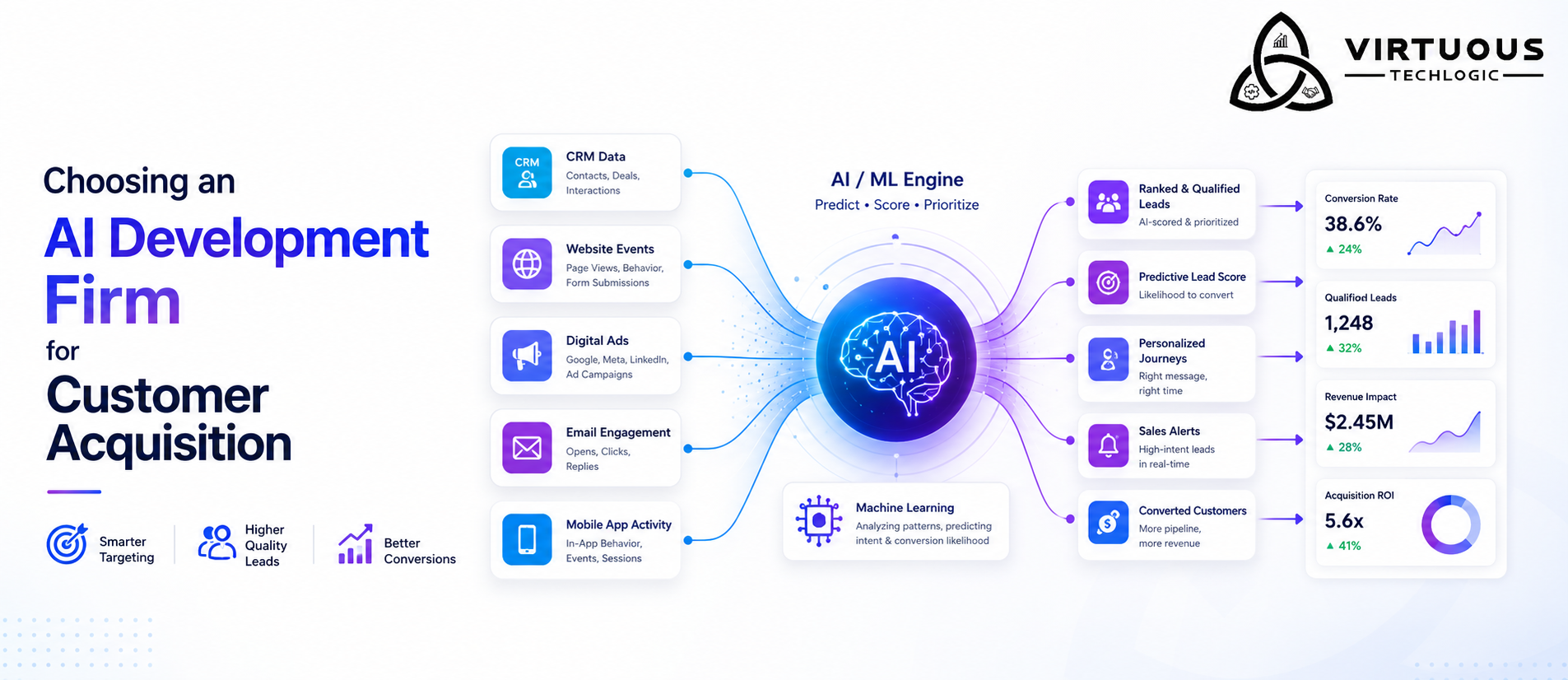
To find the right AI development firms for your customer acquisition strategy, look beyond chatbot demonstrations and impressive model names. The strongest partner will understand your acquisition funnel, connect fragmented customer data, build or configure the right machine learning models, integrate them into your CRM and marketing systems, and measure whether the solution improves conversion, customer acquisition cost, or sales productivity.A successful machine learning customer acquisition project is not simply a model-development exercise. It is a combination of data engineering, predictive analytics, software integration, experimentation, workflow design, security, and continuous monitoring.This guide explains what machine learning can improve, how to identify suitable firms, what questions to ask, and how to compare proposals without being distracted by AI hype.
What Can Machine Learning Improve in Customer Acquisition?
Machine learning works best when it helps a team make a repeated decision more accurately, consistently, or quickly.In customer acquisition, those decisions often include:
- Which lead should sales contact first?
- Which audience is most likely to convert?
- What offer should a visitor see?
- Which channel deserves additional budget?
- When should a prospect receive a follow-up?
- Which customers are likely to generate higher long-term value?
- Which leads require human attention rather than automated nurturing?
Platforms such as Salesforce and Microsoft already use predictive AI to score and prioritize leads and opportunities. Adobe also positions AI and machine learning around customer acquisition, budget planning, analytics, and personalized cross-channel experiences.A custom AI development company can extend these capabilities when your data, scoring rules, customer journey, or integration requirements are more complex than an off-the-shelf platform can support.
1. Predictive Lead Scoring
Predictive lead scoring estimates how likely a prospect is to complete a desired action, such as booking a meeting, starting a trial, requesting a proposal, or becoming a customer.Instead of assigning fixed points for actions such as opening an email or downloading a guide, a predictive model can analyze combinations of signals, including:
- Company size and industry
- Job title or purchasing role
- Website behavior
- Product-page visits
- Form submissions
- Email engagement
- Trial activity
- Sales conversations
- Previous purchases
- Source, campaign, and channel
- Time since the last interaction
Salesforce defines predictive lead scoring as the use of AI and machine learning models to analyze historical and current data and estimate the likelihood of conversion.The output should not remain inside a dashboard. A useful implementation can route high-scoring leads to sales, place lower-scoring prospects into nurturing sequences, alert account owners, or recommend an appropriate next step.
2. Propensity and Customer Lifetime Value Prediction
Not every conversion has equal business value.A low-cost lead that becomes an unprofitable customer may be less valuable than a more expensive lead with strong retention, repeat purchase, or subscription potential.Machine learning models can help estimate:
- Probability of purchase
- Expected order value
- Subscription potential
- Customer lifetime value
- Upsell probability
- Likelihood of repeat purchase
- Risk of early cancellation
This allows acquisition teams to optimize for qualified revenue rather than lead volume alone.For example, an e-commerce business could prioritize campaigns that attract customers with stronger repeat-purchase behavior. A SaaS company could optimize around trial users who are likely to activate important features and remain subscribed.
3. More Useful Audience Segmentation
Traditional segments are often based on simple categories such as location, company size, or age.Machine learning can identify patterns across behavioral, transactional, demographic, product, and engagement data. These patterns can produce more useful groups, such as:
- High-intent visitors who have not submitted a form
- Trial users at risk of abandoning onboarding
- Price-sensitive buyers
- Prospects interested in a specific feature
- Accounts showing signs of expansion
- Customers likely to respond to a consultation offer
- Users whose behavior resembles high-value customers
These segments can then be activated through advertising, email, sales outreach, in-app messages, or personalized landing pages.
4. Personalized Acquisition Journeys
Machine learning can help choose the content, product, offer, channel, or message most relevant to a particular prospect.Adobe describes marketing personalization as using customer data to target leads with messages based on their interests, demographics, and buying behavior.Possible applications include:
- Personalized landing-page sections
- Industry-specific case studies
- Product recommendations
- Dynamic onboarding sequences
- Location-based offers
- Customized consultation questions
- Relevant educational content
- Personalized email timing
- Recommended plans or packages
The objective is not to create hundreds of superficial message variations. It is to reduce friction by helping prospects find the information most relevant to their needs.
5. Next-Best-Action Recommendations
A next-best-action model recommends what should happen after a customer interaction.It might recommend that the business:
- Send a product comparison
- Offer a demonstration
- Route the lead to a specialist
- Trigger a WhatsApp follow-up
- Display a pricing calculator
- Invite the user to complete onboarding
- Pause automated messages
- Escalate the conversation to a human
This can be especially valuable when customer journeys span websites, mobile apps, CRMs, sales calls, email platforms, and customer support systems.
6. AI-Assisted Lead Qualification
An AI assistant can ask initial qualification questions, answer common product questions, collect requirements, summarize conversations, and update CRM records.Modern sales platforms increasingly combine predictive scoring with generative AI and agentic workflows for qualification, outreach, summaries, and recommended actions.A production implementation should clearly define:
- Which questions the assistant can answer
- Which data sources it can access
- Which CRM actions it can perform
- When human approval is required
- How incorrect outputs are identified
- How conversations are logged
- How personal data is protected
For complex products, retrieval-augmented generation can ground the assistant in approved product documents, pricing information, policies, and case studies. MCP or secure API integrations can allow the assistant to retrieve CRM information or trigger approved workflows.
7. Campaign and Budget Optimization
Machine learning can help acquisition teams identify which combinations of audience, offer, creative, channel, and timing are associated with stronger outcomes.Potential applications include:
- Conversion probability forecasting
- Campaign budget recommendations
- Media mix analysis
- Incrementality testing support
- Bid or audience optimization
- Lead-quality forecasting
- Revenue attribution assistance
- Detection of declining campaign performance
Adobe’s customer acquisition positioning includes AI- and ML-powered budget planning, customer data collaboration, measurement, and cross-channel analytics.The important requirement is that the model optimizes for a meaningful business outcome. Optimizing for clicks or form submissions may produce more activity without producing better customers.
Predictive ML, Generative AI, and AI Agents Are Not the Same
When comparing AI development firms, confirm that the team understands the difference between three related but distinct categories.TechnologyPrimary purposeCustomer acquisition examplePredictive machine learningEstimate, rank, classify, or forecastPredict conversion probabilityGenerative AICreate, summarize, or transform informationDraft a personalized follow-upAI agentsUse models, data, and tools to complete workflowsQualify a lead and update the CRMRAGGround model responses in approved knowledgeAnswer questions using product documentsRecommendation systemsRank suitable products, content, or actionsRecommend the most relevant planMarketing automationExecute rules and sequencesSend an email when a score crosses a thresholdA strong solution may combine several of these technologies.For example, a predictive model could calculate conversion probability. A RAG assistant could answer the prospect’s questions. An AI agent could summarize the conversation and create a CRM task. A marketing automation platform could then trigger the appropriate follow-up.The architecture should follow the business need rather than forcing every problem into a single AI tool.
Should You Buy a Platform or Hire a Custom AI Development Firm?
Not every customer acquisition problem requires custom machine learning.Many CRM, advertising, analytics, and marketing automation platforms already provide built-in predictive scoring and personalization features.
Use an existing platform when:
- Most customer data already lives in that platform
- The platform’s scoring model supports your funnel
- Your acquisition process is relatively standard
- Your team needs a faster implementation
- Native reporting and automation are sufficient
- You do not require ownership of a custom model
Hire a custom AI development company when:
- Customer data is spread across several systems
- Your definition of a qualified lead is unique
- You need industry-specific scoring logic
- You want to combine structured CRM data with conversations or documents
- The model must be embedded in a mobile or web application
- You require custom approval workflows
- You need stronger control over model evaluation and monitoring
- The solution must integrate with internal APIs, databases, or proprietary software
Use a hybrid approach when:
- You want to retain your existing CRM or customer data platform
- You need a custom model to generate scores or recommendations
- The outputs must be returned to existing sales and marketing tools
- Generative AI features require access to approved internal knowledge
- Human teams will continue making final decisions
A reliable AI development firm should be willing to recommend a platform, custom build, or hybrid solution. A company that recommends custom development before understanding your existing technology may be optimizing for project size rather than business value.
What to Define Before Contacting AI Development Firms
You will receive better proposals when your initial brief describes a business problem rather than asking for “AI integration.”
1. Establish the Acquisition Objective
Choose one measurable starting problem.Examples include:
- Increase the percentage of leads that become qualified opportunities
- Reduce the time sales representatives spend reviewing weak leads
- Improve trial-to-paid conversion
- Identify high-value e-commerce customers earlier
- Improve consultation-booking rates
- Reduce acquisition spending on low-quality audiences
- Increase completion of an onboarding journey
Avoid beginning with several unrelated use cases. One well-defined pilot is easier to evaluate than a broad transformation program.
2. Document Your Baseline
Before introducing machine learning, record the current performance of the funnel.Useful baseline metrics include:
- Customer acquisition cost
- Cost per qualified lead
- Lead-to-opportunity conversion rate
- Opportunity-to-customer conversion rate
- Trial-to-paid conversion rate
- Average sales cycle
- Revenue per lead
- Customer lifetime value
- Marketing-qualified-to-sales-qualified lead rate
- Sales response time
Without a baseline, it becomes difficult to determine whether the AI solution created an improvement.
3. Audit Available Customer Data
The firm should ask where your customer data comes from, how complete it is, and whether the outcome labels are reliable.Potential data sources include:
- CRM records
- Website analytics
- Advertising platforms
- Email engagement
- Mobile app events
- E-commerce transactions
- Product usage
- Call transcripts
- Support conversations
- Surveys
- Sales notes
- Customer success systems
More data is not automatically better. The relevant questions are whether the data is legally usable, accurately collected, consistently defined, and connected to a measurable outcome.
4. Identify Integration Requirements
Create an initial list of systems the solution may need to connect with.These might include:
- Salesforce
- HubSpot
- Microsoft Dynamics
- Shopify
- Google Analytics
- Advertising platforms
- Customer data platforms
- Firebase
- Supabase
- Data warehouses
- Internal APIs
- Email or SMS providers
- WhatsApp workflows
- Mobile and web applications
Integration requirements can significantly affect the project architecture, timeline, and maintenance plan.
5. Set Privacy and Governance Boundaries
Customer acquisition systems often process personal, behavioral, and transactional data.The European Commission explains that GDPR protections apply to profiling and decisions based solely on automated processing when those decisions significantly affect individuals. It also provides individuals with rights related to automated decision-making and marketing data use.Your initial brief should clarify:
- Which personal data can be processed
- The legal basis for using it
- Which regions the system will serve
- How long data can be retained
- Whether sensitive attributes must be excluded
- When human review is required
- Who can access model outputs
- Whether decisions need explanations
- How users can object or opt out
- What audit records must be stored
The NIST AI Risk Management Framework can also provide a useful voluntary structure for identifying, measuring, and managing AI risks.
Where to Find Credible AI Development Firms
You can build an initial shortlist from several sources.
B2B review platforms
Platforms such as Clutch provide company profiles, service focus, project information, pricing indicators, and verified client feedback. Its AI development directory includes firms across machine learning, generative AI, AI agents, and related specializations.Use directories as a research starting point, not as the final decision.Review:
- The relevance of completed projects
- Whether reviews describe measurable outcomes
- Project size and complexity
- Communication and project-management feedback
- Recency of reviews
- Whether the firm delivered production software or only consulting
Professional referrals
Ask CRM consultants, product leaders, technical advisors, investors, agencies, and industry peers for referrals.A referral is particularly useful when the source can explain:
- What the firm built
- How the team handled uncertainty
- Whether the solution reached production
- How the firm communicated
- What happened after launch
Technology partner ecosystems
Cloud platforms, CRM providers, data platforms, and AI vendors often maintain partner directories.These directories can help identify firms with experience in a specific ecosystem, but you should still verify production delivery and relevant use cases.
Technical portfolios and case studies
Look for evidence of:
- Data pipeline development
- Predictive model deployment
- CRM integrations
- Recommendation engines
- AI agents
- RAG systems
- Model evaluation
- Monitoring and observability
- Mobile or web application integration
- Security and access-control implementation
Avoid relying only on screenshots or generic descriptions. Ask what data was used, what the model predicted, how the output entered the business workflow, and how performance was measured.
LinkedIn and technical communities
Review the experience of the proposed team, not only the company page.Relevant roles may include:
- Data engineer
- Machine learning engineer
- AI engineer
- Backend engineer
- MLOps engineer
- Product manager
- UX designer
- QA engineer
- Security specialist
A project that touches customer data and sales workflows usually requires more than a single AI developer.
Ten Criteria for Evaluating an AI Development Company
1. Business and Acquisition Understanding
The firm should ask about:
- Customer acquisition cost
- Funnel stages
- Lead definitions
- Sales capacity
- Conversion targets
- Customer lifetime value
- Channel mix
- Current decision rules
- Operational constraints
A technically sophisticated model is not useful if it optimizes the wrong outcome.
2. Data Engineering Capability
Most machine learning projects require significant work before model training begins.The partner should be able to handle:
- Data ingestion
- Source mapping
- Data cleaning
- Identity resolution
- Event tracking
- Feature engineering
- Missing values
- Duplicate records
- Data lineage
- Access controls
- Warehouse or database integration
Ask who will own data engineering work. Do not assume it is automatically included in “AI development.”
3. Appropriate Model Selection
The most complex model is not always the best model.The firm should be able to explain:
- The baseline approach
- Why a specific model is suitable
- How much training data is required
- Whether the model needs explainability
- How frequently it should be retrained
- What latency is acceptable
- What happens when confidence is low
For many customer acquisition use cases, a well-designed classification or ranking model may be more suitable than a large generative model.
4. Production Integration Experience
Ask how the model output will affect the actual workflow.A score becomes valuable when it can:
- Update a CRM record
- Route a lead
- Trigger a task
- Recommend an action
- Change a landing-page experience
- Personalize onboarding
- Notify a sales representative
- Suppress an unsuitable automated message
The partner should understand APIs, webhooks, authentication, databases, CRM objects, mobile applications, web platforms, and automation tools.
5. Evaluation and Experimentation
The firm should define both model metrics and business metrics.Possible model metrics include:
- Precision
- Recall
- Precision among the highest-ranked leads
- Calibration
- False-positive rate
- False-negative rate
- Ranking quality
- Prediction latency
Business metrics may include:
- Qualified lead rate
- Conversion rate
- Customer acquisition cost
- Sales productivity
- Revenue per lead
- Speed to first contact
- Incremental revenue
- Customer lifetime value
A model can score well technically without improving the business. Controlled experiments, holdout groups, or phased rollouts help separate genuine lift from normal performance variation.
6. MLOps and Post-Launch Monitoring
Customer behavior, campaigns, products, prices, and market conditions change.The firm should explain how it will monitor:
- Data quality
- Feature availability
- Prediction distribution
- Model drift
- Performance degradation
- API failures
- Latency
- Infrastructure cost
- Fairness concerns
- Human overrides
A production model requires a maintenance plan, not just a deployment date.
7. Privacy, Security, and Governance
Evaluate whether the firm provides:
- Role-based access
- Encryption
- Secure secrets management
- Audit logs
- Data minimization
- Consent-aware workflows
- Retention controls
- Human-in-the-loop review
- Model and prompt testing
- Incident response procedures
For AI agents, ask exactly which tools the system can access and which actions require approval.
8. Explainability and Human Workflow Design
Sales representatives are less likely to trust a score if they cannot understand why it changed.Useful explanations might include:
- High engagement with a specific product
- Strong similarity to previous customers
- Recent pricing-page activity
- Suitable company size
- Repeated interaction across several channels
- Completion of important onboarding events
Explanations should support decision-making without exposing sensitive data or making unsupported claims about individuals.
9. Ownership and Commercial Terms
Clarify:
- Who owns the source code
- Who owns trained model artifacts
- Who controls the data pipelines
- Whether your data is used for other clients
- Which third-party model providers are involved
- How usage costs are calculated
- What happens if you change vendors
- Whether documentation is included
- What support is available after launch
Avoid contracts that create unnecessary dependence on proprietary components you cannot access or transfer.
10. Communication and Delivery Process
Machine learning projects involve uncertainty. The firm should communicate that uncertainty clearly.Look for a process that includes:
- Discovery
- Data audit
- Baseline model
- Technical architecture
- Pilot
- Evaluation
- Integration
- Controlled rollout
- Monitoring
- Iteration
Be cautious of firms that guarantee a conversion increase before reviewing your data and funnel.
AI Development Firm Comparison Scorecard
Use a weighted scorecard so that a polished sales presentation does not outweigh technical and operational suitability.Evaluation areaSuggested weightEvidence to requestCustomer acquisition understanding15Relevant workshop, funnel analysis, KPI proposalData engineering15Data architecture examples and proposed pipelineML and AI capability15Model approach, baseline, evaluation methodCRM and application integration15API, CRM, mobile, web, or backend examplesEvaluation and MLOps15Monitoring, retraining, testing, drift planPrivacy and security10Access controls, audit, retention, governanceRelevant production experience5Case studies or referencesCommunication and delivery5Team structure, reporting, risk managementCommercial and IP terms5Ownership, documentation, support termsTotal100
Score each shortlisted firm from one to five in every category. Multiply the score by the category weight and document the supporting evidence.Do not assign full marks based on promises. Assign them based on relevant proof, a credible proposed approach, and the quality of the firm’s questions.
Questions to Include in Your RFP or Discovery Call
Ask each shortlisted AI development company the same core questions.
Business questions
- Which customer acquisition use case should we address first?
- What business KPI would you use as the primary success measure?
- How would you establish a baseline?
- How would you determine whether the model created incremental improvement?
- What would make you recommend against custom machine learning?
Data questions
- What data sources would you need?
- How would you assess data quality and label reliability?
- How much historical data is likely to be required?
- How would you handle missing, inconsistent, or duplicated customer records?
- Which data should not be used?
Technical questions
- What baseline model would you test first?
- Why is the proposed model suitable for this problem?
- How will predictions enter our CRM or marketing workflows?
- What infrastructure will be required?
- How will you monitor drift, failures, latency, and cost?
- How will the system behave when confidence is low?
- Can we replace the model or cloud provider later?
Governance questions
- How will access to customer data be controlled?
- Which decisions require human review?
- How will model outputs and overrides be logged?
- How will you test for unfair or unreliable outcomes?
- How will deletion, retention, and consent requirements be handled?
Commercial questions
- What is included in discovery, the pilot, production deployment, and support?
- Who owns the source code, model artifacts, and data pipelines?
- Which third-party fees should we expect?
- What documentation and training are included?
- What happens if the pilot does not meet the agreed threshold?
Red Flags When Selecting an AI Development Partner
Be cautious when a firm:
- Guarantees a specific revenue or conversion increase before seeing your data
- Recommends a large language model for every problem
- Cannot explain the difference between predictive ML and generative AI
- Talks about model accuracy without discussing business impact
- Ignores data quality
- Has no plan for CRM or workflow integration
- Cannot describe post-launch monitoring
- Avoids privacy and security questions
- Provides only chatbot demonstrations
- Uses unexplained proprietary components
- Does not clarify ownership of code and model artifacts
- Cannot identify when human review is required
- Proposes a long project without an early validation stage
A responsible firm should be comfortable saying that a use case is not ready, that the data is insufficient, or that an existing platform would be more cost-effective.
A Practical Pilot Roadmap
A pilot should test a narrow, valuable decision before expanding across the acquisition funnel.
Stage 1: Discovery and data audit
Define:
- Business objective
- Target user
- Prediction or recommendation
- Available data
- Current baseline
- Integration point
- Governance requirements
- Success threshold
Stage 2: Baseline development
Start with a simple benchmark.This might include:
- Current rule-based scoring
- Logistic regression
- Basic ranking model
- Existing CRM score
- Manual sales prioritization
The custom model should be compared against this baseline.
Stage 3: Offline evaluation
Test the model against historical data that was not used during training.Review:
- Overall performance
- Performance among high-priority leads
- Error patterns
- Calibration
- Segment-level differences
- Data leakage
- Stability over time
Stage 4: Shadow deployment
Run predictions without allowing them to control live decisions.This lets the team confirm:
- Data arrives correctly
- CRM integration works
- Predictions are available on time
- Sales users understand the output
- Monitoring captures failures
- Infrastructure costs are reasonable
Stage 5: Controlled live test
Introduce the model to a limited team, region, audience, or percentage of leads.Compare the results against a holdout group or existing process.
Stage 6: Production rollout
Expand only after the pilot meets the agreed technical and business thresholds.The production plan should include:
- Monitoring
- Retraining
- Documentation
- Access control
- Incident handling
- Model versioning
- User feedback
- Cost review
- Ongoing experimentation
How to Measure the Business Impact
Do not evaluate the system using model accuracy alone.A customer acquisition model should be connected to measurable business outcomes.
Lead-scoring metrics
- Conversion among the top-ranked leads
- Sales acceptance rate
- Time spent reviewing leads
- Speed to first contact
- Qualified opportunity rate
- False-positive rate
Personalization metrics
- Landing-page conversion
- Consultation bookings
- Trial activation
- Product discovery
- Checkout completion
- Revenue per session
Automation metrics
- Response time
- Percentage of correctly routed leads
- Human escalation rate
- CRM data completeness
- Time saved per representative
- Automation error rate
Financial metrics
- Customer acquisition cost
- Cost per qualified opportunity
- Incremental revenue
- Sales productivity
- Customer lifetime value
- Payback period
- Infrastructure and model usage cost
The final evaluation should ask a simple question: did the system improve acquisition economics or decision quality enough to justify its development and operating cost?
Why Consider Virtuous Techlogic?
Virtuous Techlogic builds production AI systems that connect models with usable mobile, web, backend, and business workflows.Its AI development capabilities include:
- Custom AI agent development
- Predictive and workflow automation
- RAG pipelines over business documents
- Vector database architecture
- MCP integrations
- CRM and API integration
- Human-in-the-loop workflows
- Model and prompt evaluation
- Observability and regression testing
- Secure access controls and audit logging
- Cost and latency optimization
- Flutter, FlutterFlow, web, Firebase, and Supabase integration
This combination is useful when a customer acquisition project needs more than a standalone model. For example, the project may require a lead-scoring service, a sales dashboard, a mobile application, CRM automation, an AI assistant, and secure backend APIs.Virtuous Techlogic’s public website reports more than 200 completed projects, more than 50 clients, and over 10 years of software development experience. The company also maintains public Clutch and Upwork profiles where prospects can review its service focus and client feedback.Its AI service positioning includes custom agents, RAG, MCP, vector databases, evaluation harnesses, workflow automation, secure deployment, and production monitoring rather than demonstration-only AI features.
Final Checklist for Choosing an AI Development Firm
Before signing an agreement, confirm that the firm can answer yes to the following questions:
- Does the team understand our acquisition funnel?
- Is the first use case connected to a measurable KPI?
- Has the firm reviewed our data availability?
- Does the proposal include data engineering?
- Is the chosen model appropriate for the problem?
- Is there a clear baseline?
- Will the system integrate with our existing workflow?
- Are privacy and security requirements documented?
- Is human review included where necessary?
- Does the proposal include evaluation and controlled testing?
- Is post-launch monitoring included?
- Are code, data, and model ownership clear?
- Are third-party and operating costs transparent?
- Can the architecture be maintained or transferred?
- Does the firm have relevant production experience?
The right AI development partner should help you make a better investment decision before it writes production code.
Conclusion
Finding credible AI development firms for customer acquisition requires more than searching for companies that mention machine learning.Begin with a measurable acquisition problem. Audit the quality and accessibility of your customer data. Decide whether an existing platform, custom solution, or hybrid architecture is appropriate. Then compare firms based on business understanding, data engineering, production integration, evaluation, MLOps, governance, and long-term ownership.A well-designed first project might be a predictive lead-scoring model, a high-value customer propensity model, an onboarding recommendation system, or a controlled AI qualification assistant.Keep the initial scope focused, run the system against a baseline, test it in a controlled environment, and expand only when the results support the investment.Looking for an AI app development company to integrate machine learning into your acquisition funnel?Virtuous Techlogic can help you assess your data, select a practical use case, build the required AI and application architecture, and connect the solution with your CRM, web platform, mobile app, or internal systems.
Frequently Asked Questions
Build Your App with Virtuous Techlogic
Book a Free ConsultationTrusted by clients across Clutch and Upwork
Want proof before starting? View our client reviews and agency profiles on Clutch and Upwork.