
8 Best Healthcare App Development Companies for Startups in 2026
Suggest app development companies for healthcare startups
Compare eight healthcare app development companies for startups based on MVP delivery, patient UX, security, FHIR integration, AI, and scalability.
· · Written by Virtuous Techlogic · 1 min read
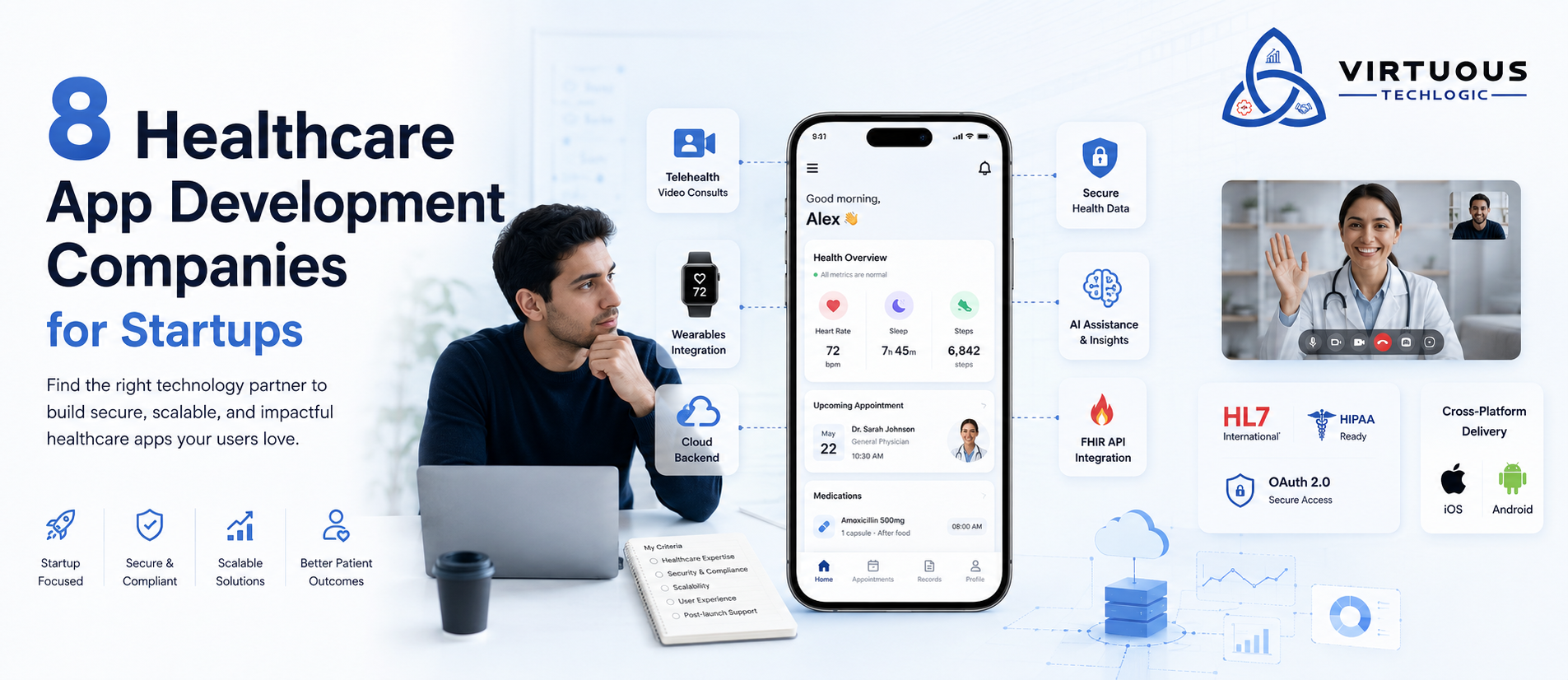
Choosing a healthcare app development company is different from hiring a general mobile app agency.A healthcare startup may need to manage sensitive information, connect with clinical systems, support multiple user roles, document security decisions, and create an experience that patients can use confidently. A technical mistake can cause more than an inconvenient bug—it can affect privacy, clinical workflows, user trust, or patient safety.The right partner therefore depends on what you are building.A wellness tracker has different requirements from a telehealth platform. A patient education app is different from an AI diagnostic tool. A quick FlutterFlow MVP requires a different delivery model from regulated Software as a Medical Device, or SaMD.This guide compares eight healthcare app development companies that startups can evaluate in 2026. It does not claim that one company is universally better than every other provider. Instead, it explains which company may be appropriate for a particular product, budget, regulatory profile, or technical roadmap.Editorial disclosure: Virtuous Techlogic publishes this guide and is included in the list. Every company description is based primarily on capabilities presented on its official website. Founders should independently review case studies, references, contracts, security practices, and technical proposals before selecting a partner.
Quick answer: Which healthcare app development company should you choose?
The best healthcare app development company depends on the type of product you need to launch.
- Virtuous Techlogic: Suitable for Flutter, FlutterFlow, mobile, web, and AI-powered healthcare MVPs that require a scalable cross-platform path.
- MindSea: Suitable for patient-centred digital health products where research, usability, and clinical-team collaboration are priorities.
- Empeek: Suitable for custom healthcare platforms, patient portals, telemedicine, chronic disease management, and backend-heavy systems.
- Yalantis: Suitable for technically complex products involving EHR interoperability, telemedicine, IoT, SaMD, or medical-device workflows.
- ScienceSoft: Suitable for larger healthcare systems, modernization projects, regulated software, and complex enterprise integrations.
- KMS Technology: Suitable for healthcare product engineering, quality engineering, testing, data platforms, and AI-related modernization.
- Kanda Software: Suitable for custom healthcare systems requiring integration with legacy platforms, FHIR APIs, and complex workflows.
- Glorium Technologies: Suitable for startup MVPs, mHealth applications, wearable integrations, telehealth, and patient-facing mobile products.
How we selected these healthcare development companies
The companies were evaluated using six practical criteria:
- Publicly stated healthcare or digital health capabilities
- Mobile and web product development experience
- Security, privacy, or regulatory awareness
- EHR, API, wearable, or interoperability capabilities
- Startup, MVP, or product engineering services
- Ability to support products after their initial launch
This is a shortlist for further evaluation—not a definitive ranking or endorsement.A startup should still conduct technical interviews, request relevant case studies, speak with previous clients, and review the proposed architecture before signing a contract.
Healthcare app development companies at a glance
CompanyPotentially suitable forNotable focusVirtuous TechlogicStartup MVPs and cross-platform productsFlutter, FlutterFlow, Firebase, Supabase, AI and automationMindSeaPatient-facing digital health productsPatient experience, UX, clinician collaboration and research toolsEmpeekCustom healthcare platformsTelemedicine, patient portals, EHR systems and chronic careYalantisComplex regulated productsFHIR, EHR integration, telehealth, IoT and SaMDScienceSoftEnterprise healthcare systemsCompliance consulting, modernization, integrations and medical softwareKMS TechnologyProduct and quality engineeringHealthcare platforms, testing, AI, data and life sciencesKanda SoftwareIntegration-heavy healthcare systemsCustom workflows, FHIR, legacy modernization and cloud systemsGlorium TechnologiesHealthcare startup MVPsmHealth, wearables, EHR integration and cross-platform apps
1. Virtuous Techlogic
Best suited for
Virtuous Techlogic may be a suitable option for healthcare startups that want to launch a mobile or web MVP using Flutter, FlutterFlow, Firebase, Supabase, custom APIs, or AI integrations.The company’s model is particularly relevant for founders who need:
- One cross-platform codebase for iOS and Android
- A fast FlutterFlow MVP with engineering guardrails
- A future migration path from FlutterFlow to custom Flutter
- Patient, clinician, caregiver, and administrator roles
- Appointment booking or telehealth workflows
- Secure document uploads
- Notifications and medication reminders
- Fitness, sleep, mental wellness, or habit-tracking features
- AI assistants connected to an approved knowledge base
- An admin dashboard alongside the patient application
Virtuous Techlogic describes itself as a mobile app, Flutter, FlutterFlow, and AI development company. Its healthcare and fitness offering includes telehealth, wellness applications, patient experiences, Flutter development, and scalable backends. Its website also reports more than 200 completed projects, over 50 clients, and more than 10 years of experience.
Relevant capabilities
A Flutter-based architecture can help startups deliver consistent experiences across iOS and Android while sharing much of the application code. Depending on product requirements, the backend can use Firebase, Supabase, or custom APIs.FlutterFlow can be appropriate for certain healthcare MVPs when it is combined with:
- Carefully designed database rules
- Role-based permissions
- Custom actions and widgets
- Secure API handling
- Separate development, staging, and production environments
- Test coverage for critical workflows
- A documented path to custom Flutter when complexity increases
Virtuous Techlogic also works with AI agents, retrieval-augmented generation, vector databases, workflow automation, and application integrations. In a healthcare product, these technologies may support use cases such as internal knowledge search, patient education, administrative support, document Q&A, or staff assistance.AI features that could influence patient decisions should include clear boundaries, approved data sources, evaluations, logging, escalation rules, and human review.
What startups should confirm
Startups developing a regulated medical product should ask which compliance documentation, quality-management processes, risk controls, and regulatory specialists will be required.Virtuous Techlogic may be a stronger fit for mobile-first MVPs, patient engagement products, wellness platforms, operational systems, and AI-enabled applications than for a medical-device programme requiring an established ISO 13485 quality management system.
2. MindSea
Best suited for
MindSea may be a strong candidate for healthcare organisations that place patient experience, usability, research, and clinical workflow alignment at the centre of product development.Its official website positions the company as a specialised healthcare app development team. MindSea states that it builds secure, patient-centred applications for researchers and healthcare teams, including patient-facing apps, clinician dashboards, remote patient monitoring products, and research tools.This can be relevant for startups developing:
- Remote patient monitoring products
- Digital therapeutics support tools
- Patient-reported outcome applications
- Healthcare research platforms
- Patient engagement applications
- Clinician dashboards
- Care coordination tools
- Applications where adoption depends heavily on usability
Relevant capabilities
MindSea’s positioning is particularly focused on understanding how technology fits into real care delivery.That matters because a technically functional healthcare app can still fail when:
- Patients find onboarding confusing.
- Clinicians must enter the same information twice.
- Alerts do not match clinical priorities.
- Accessibility is treated as a final-stage checklist.
- The app introduces additional work instead of reducing it.
- Research data collection is inconvenient or inconsistent.
Healthcare startups with clinical advisors, researchers, or provider partners may value a team that includes discovery and user experience work before development begins.
What startups should confirm
Founders should discuss the expected engagement size, available development technologies, integration scope, and whether the company’s delivery model fits the startup’s budget and preferred timeline.A specialised North American digital health studio may offer valuable domain alignment, but an early-stage founder should confirm whether the commercial model is appropriate for a narrowly scoped MVP.
3. Empeek
Best suited for
Empeek may suit healthcare startups building custom platforms that require substantial backend logic, healthcare workflows, integrations, or operational automation.The company says it develops secure healthcare software across areas such as chronic disease management, AI-supported diagnostics, revenue-cycle automation, patient portals, telemedicine platforms, and healthcare data interoperability.Potential project types include:
- Custom EHR or EMR products
- Telehealth platforms
- Patient portals
- Chronic disease management apps
- Healthcare CRM systems
- Revenue-cycle software
- Provider-facing dashboards
- Connected device platforms
- Healthcare data and workflow automation
Relevant capabilities
Empeek’s public positioning covers both patient-facing applications and operational healthcare software.This can be useful for startups whose product is more than a standalone mobile app. For example, a chronic-care product may require:
- A patient mobile application
- A clinician dashboard
- Device or wearable data
- Medication and symptom tracking
- Alerts and escalation rules
- Reporting
- Billing or subscription functionality
- EHR connectivity
- Administrator controls
- Support and maintenance processes
A development team that understands the complete healthcare workflow may be more valuable than one focused only on the visible mobile interface.
What startups should confirm
Founders should request case studies that resemble their specific business model and ask which members of the proposed team have healthcare domain experience.They should also confirm whether product discovery, regulatory planning, clinical validation, design, development, QA, DevOps, and post-launch maintenance are included in the proposal or priced separately.
4. Yalantis
Best suited for
Yalantis may be appropriate for healthcare or medtech companies with complex technical, interoperability, medical-device, or regulatory requirements.Its healthcare services include mobile apps, patient portals, EHR and EMR development, telemedicine, practice management, AI integration, FHIR-native systems, SMART on FHIR, medical IoT, and clinical workflow automation. The company also presents healthcare product engineering services aligned with ISO 13485, FDA, MDR, HIPAA, and GDPR requirements.Relevant products may include:
- Software as a Medical Device
- Remote patient monitoring systems
- Connected medical devices
- Telemedicine ecosystems
- EHR-integrated applications
- AI-enabled clinical platforms
- Medical IoT products
- Provider and hospital systems
- Complex healthcare SaaS platforms
Relevant capabilities
Yalantis describes capabilities across mobile, cloud, embedded systems, integrations, and medical-product engineering.This breadth is useful when a healthcare product requires several connected layers, such as:
- Device firmware
- Bluetooth or IoT connectivity
- Patient applications
- Clinician portals
- Cloud data processing
- FHIR or HL7 integrations
- Audit trails
- Risk documentation
- Regulatory submission support
Its public materials also address security-by-design controls such as encryption, authentication, audit logging, vulnerability scanning, and business associate agreements.
What startups should confirm
This level of engineering may be unnecessary for a simple wellness or patient education MVP.Founders should first determine whether they actually require medical-device development, certification support, embedded engineering, or complex EHR integration. They should then confirm the likely discovery cost, minimum engagement size, and documentation responsibilities.
5. ScienceSoft
Best suited for
ScienceSoft may be suitable for established healthtech companies, healthcare providers, and funded startups building enterprise-grade or highly integrated medical software.The company provides healthcare consulting, custom development, modernization, support, mobile development, cloud solutions, and interoperability services. Its website highlights experience with HIPAA, GDPR, FHIR, HL7 and several ISO certifications, including ISO 13485 and ISO 27001.Possible use cases include:
- Healthcare platform modernization
- Hospital or clinic systems
- Laboratory software
- Telehealth platforms
- Medical web portals
- Wearable applications
- EHR-connected software
- Healthcare analytics
- Complex multi-system integrations
- Regulated medical applications
Relevant capabilities
ScienceSoft may be useful when a startup must work with an existing healthcare enterprise environment rather than build an isolated consumer app.Enterprise healthcare projects frequently require:
- Legacy system analysis
- Data migration
- EHR integration
- Identity and access management
- Detailed documentation
- Infrastructure planning
- Security testing
- Multiple stakeholder groups
- Long-term maintenance
- Procurement and vendor assessments
The company’s official materials state that it has worked in healthcare IT since 2005 and provides services across consulting, design, development, integration, and support.
What startups should confirm
ScienceSoft’s breadth and enterprise orientation may be more appropriate for funded companies or larger implementations than for a small validation MVP.Founders should ask whether a lean discovery-and-MVP engagement is available and what team size, contract structure, and budget level the company recommends.
6. KMS Technology
Best suited for
KMS Technology may be relevant for digital health companies that need a combination of product engineering, quality engineering, testing, data, AI, and modernization support.The company’s healthcare and life sciences offering covers healthcare software companies, clinical trials, data platforms, quality engineering, and AI-enabled product development.This may fit startups or scale-ups working on:
- Healthcare SaaS products
- Clinical trial technology
- Data-intensive platforms
- AI-assisted healthcare operations
- Quality engineering programmes
- Application modernization
- Platform testing and automation
- Enterprise healthcare products
Relevant capabilities
Quality engineering is particularly important in healthcare because critical workflows must remain reliable across devices, roles, integrations, and releases.A healthcare testing plan may need to cover:
- Authentication and authorisation
- Permission boundaries
- Data integrity
- API failures
- Interrupted connectivity
- Notification timing
- Audit logging
- Accessibility
- Performance under load
- Mobile device compatibility
- Regression testing
- Recovery and backup procedures
KMS may therefore be worth considering when a startup already has a product and needs to improve engineering maturity, automate testing, modernise architecture, or expand its delivery team.
What startups should confirm
Early-stage founders should ask whether KMS offers small, product-focused MVP teams or is better aligned with established healthcare software vendors.They should also clarify whether user research, product strategy, UI/UX, mobile development, clinical workflow design, and regulatory documentation are included in the proposed team.
7. Kanda Software
Best suited for
Kanda Software may be a suitable option for healthcare systems that require custom workflows, legacy-system modernization, interoperability, cloud engineering, and complex integrations.The company’s healthcare offering emphasises secure and scalable custom software, regulatory requirements, system integration, clinical workflows, and patient experience. Its published technical material also discusses FHIR-based platforms, APIs, and migration from HL7 V2 systems.Potential projects include:
- EHR-connected healthcare platforms
- Custom clinical systems
- Data integration products
- Healthcare analytics
- Patient and provider portals
- Legacy modernization
- FHIR API development
- Cloud migration
- Complex healthcare SaaS applications
Relevant capabilities
Kanda may be relevant where a startup’s competitive advantage depends on connecting data from several sources.For example, a care coordination platform may need to combine:
- Patient-generated data
- EHR records
- Scheduling information
- Laboratory results
- Insurance data
- Device data
- Provider notes
- Communications
- Operational analytics
The difficulty is not merely displaying that information. The product must manage identity matching, permissions, data quality, system availability, format differences, and error handling.
What startups should confirm
Founders should ask for examples of comparable integrations and verify which EHRs, interface engines, FHIR versions, cloud providers, and authentication standards the proposed team has used.They should also clarify who will be responsible for obtaining access to third-party healthcare systems and testing against vendor sandbox environments.
8. Glorium Technologies
Best suited for
Glorium Technologies may be worth evaluating for startup MVPs, mHealth applications, patient-facing products, wearable integrations, telemedicine, and healthcare SaaS.Its public healthcare pages describe mobile health development for iOS, Android, and cross-platform applications, as well as EHR integration, wearable connectivity, remote patient monitoring, telemedicine, and post-launch support. The company also offers dedicated MVP development services for startups.Potential project types include:
- Mental health applications
- Healthcare MVPs
- Patient mobile apps
- Telemedicine platforms
- Fitness and wellness products
- Remote monitoring systems
- Wearable applications
- Medical education apps
- Healthcare SaaS platforms
Relevant capabilities
Glorium combines healthcare development with startup and MVP positioning.That can be useful for founders who need both product validation and industry-specific implementation. The company’s official materials discuss integrating mHealth apps with services such as Apple HealthKit, Apple Watch, Google Fit, wearable devices, EHR systems, healthcare APIs, and payment systems.
What startups should confirm
Founders should examine which case studies are closest to their product and ask who performed the healthcare architecture, security, integration, and compliance work.They should also request a clear breakdown of discovery, design, development, testing, deployment, maintenance, and any optional marketing services.
How to Choose a Healthcare App Development Company
A list of companies can help you create a shortlist, but the final decision should be based on your product’s actual risk, users, integrations, and roadmap.
1. Classify your healthcare product before requesting proposals
Start by identifying which broad category describes your product.
General wellness or self-management app
Examples include:
- Habit tracking
- Meditation
- General fitness
- Sleep journaling
- Nutrition education
- Non-clinical wellness coaching
These products may still process sensitive personal information, but they do not automatically have the same requirements as regulated medical software.
Healthcare administration or patient engagement app
Examples include:
- Appointment booking
- Telehealth
- Patient portals
- Medication reminders
- Secure messaging
- Clinic intake
- Billing
- Care coordination
These products may need stronger privacy, security, healthcare integration, and contractual controls depending on who operates them and how data is processed.
Clinical decision support or medical-device software
Examples include:
- Diagnostic software
- Treatment recommendations
- Device control
- Clinical monitoring
- AI-supported risk assessment
- Software that could affect patient safety when incorrect
The FDA focuses its oversight on certain higher-risk device software functions, while lower-risk or non-device functions may be treated differently. Product classification should be reviewed with qualified regulatory professionals before development decisions are finalised.
2. Ask for architecture and security decisions, not compliance slogans
A statement such as “we build HIPAA-compliant apps” is not enough.Ask the company to explain:
- Where health information will be stored
- Which vendors may handle sensitive data
- Whether required vendors will sign appropriate agreements
- How data is encrypted
- How roles and permissions are enforced
- How access is logged
- How secrets and API keys are managed
- How backups and recovery will work
- How developers access production systems
- How incidents will be detected and handled
- How data deletion and retention will work
- How tracking and analytics tools will be controlled
The HIPAA Security Rule is based on administrative, physical, and technical safeguards for electronic protected health information. The practical implication is that compliance depends on the complete system, configuration, contracts, processes, and operating environment—not a single framework or cloud service.
3. Evaluate healthcare integration experience
Ask whether your application needs to connect with:
- Epic
- Oracle Health or Cerner
- Other EHR platforms
- HL7 interfaces
- FHIR APIs
- SMART on FHIR
- Laboratories
- Pharmacies
- Insurance or claims platforms
- Wearables
- Apple HealthKit
- Health Connect
- Video providers
- Payment systems
- Identity providers
FHIR gives health IT systems a consistent way to exchange healthcare information electronically. However, a vendor saying “we support FHIR” does not prove it has solved your specific integration problem.Request a technical explanation covering authentication, supported resources, data mapping, rate limits, sandbox access, error handling, consent, and system-specific constraints.
4. Examine the MVP-to-scale plan
A healthcare MVP should be small enough to validate the product but robust enough to avoid unsafe shortcuts.Ask the development company:
- Which assumption will the MVP test?
- Which users must be involved in discovery?
- Which features can wait?
- Which security controls are required from the first release?
- Which integrations should be mocked initially?
- What must be built for production rather than prototyped?
- How will the architecture support future roles and workflows?
- When would FlutterFlow remain appropriate?
- When would migration to custom Flutter be recommended?
- What evidence will determine the next product phase?
A good MVP is not simply a cheaper full product. It is a focused product designed to reduce uncertainty.
5. Review the company’s AI development approach
Healthcare AI should be treated as production business software, not as a chatbot demo.Ask how the development team will manage:
- Approved knowledge sources
- Retrieval-augmented generation
- Vector database security
- Access permissions
- Prompt injection
- Hallucinations
- Evaluation datasets
- Human review
- Escalation to a clinician or staff member
- Audit logs
- Model and prompt versioning
- User disclaimers
- Feedback loops
- Unsafe or out-of-scope questions
- Protected information sent to model providers
An internal clinic knowledge assistant presents a different risk profile from a tool making diagnostic or treatment recommendations. The architecture, evaluation plan, user interface, and human-in-the-loop controls should reflect that difference.
6. Confirm ownership, documentation, and post-launch support
Your contract should clearly address:
- Source code ownership
- Design-file ownership
- Infrastructure accounts
- Application store accounts
- Domain and email accounts
- API credentials
- Technical documentation
- Deployment instructions
- Database schemas
- Automated tests
- Third-party licences
- Security responsibilities
- Warranty periods
- Maintenance pricing
- Team transition
- Exit and handover procedures
Avoid building a healthcare product in accounts owned only by the development agency. Your company should control critical infrastructure and business assets.
Questions to Ask Potential Healthcare App Developers
Use these questions during vendor interviews:
- Which healthcare products have you built that resemble ours?
- Can you show a case study involving similar users or workflows?
- Who will be assigned to our project?
- Who is responsible for healthcare architecture and security?
- How do you determine whether HIPAA, GDPR, FDA, or other requirements may apply?
- Do you work with external legal, clinical, security, or regulatory specialists?
- What is your experience with FHIR, HL7, EHRs, and healthcare APIs?
- How will you protect sensitive information in development and testing?
- How do you test permissions across patients, clinicians, staff, and administrators?
- How will you prevent sensitive data from appearing in logs or analytics tools?
- What is included in the MVP?
- Which features should be postponed?
- How will the product scale after validation?
- How do you test AI features for accuracy, safety, and unsupported answers?
- What happens when an AI system is uncertain?
- Who owns the code, infrastructure, designs, and app store accounts?
- What maintenance and monitoring are available after launch?
- Can we speak with a previous healthcare or SaaS client?
- What assumptions could cause the estimate to increase?
- What would make you advise us not to build the product as currently planned?
A credible development company should be willing to discuss trade-offs, uncertainties, and risks—not only features and timelines.
Why Healthcare Startups Consider Virtuous Techlogic
Virtuous Techlogic helps startups build mobile apps, Flutter products, FlutterFlow MVPs, web platforms, and production AI systems.For healthcare and wellness startups, the team can support products such as:
- Telehealth applications
- Patient portals
- Appointment booking platforms
- Mental wellness apps
- Fitness and habit-tracking apps
- Medication reminder apps
- Patient education products
- Care coordination tools
- Clinic administration dashboards
- AI healthcare assistants
- RAG-based internal knowledge assistants
- Secure document workflows
- Staff and administrator portals
A typical project may include:
- Product discovery
- User flows
- UI/UX design
- Flutter or FlutterFlow development
- Firebase, Supabase, or custom backend development
- API integrations
- Notifications
- Payments
- Role-based access
- Admin dashboards
- AI and automation features
- App Store and Google Play launch support
- Ongoing maintenance
Flutter may be appropriate when the startup needs a custom, scalable cross-platform product with advanced workflows or integrations.FlutterFlow may be appropriate when the startup needs faster visual development and the product can be delivered with secure backend rules, custom code where necessary, and a clear scalability plan.One approach is not automatically better than the other. The right choice depends on the product scope, budget, launch timeline, technical complexity, regulatory profile, and long-term roadmap.For AI healthcare products, Virtuous Techlogic focuses on connecting AI to business applications and approved data sources. Relevant technologies can include RAG, vector databases, AI agents, workflow automation, secure integrations, evaluations, and human review.Planning a healthcare, fitness, mental wellness, or AI-powered application?Share your product idea with Virtuous Techlogic to discuss the appropriate Flutter, FlutterFlow, backend, or AI architecture.
Final Recommendation
There is no universally best healthcare app development company.Choose according to the product you are building:
- Select an MVP-oriented cross-platform team when speed, budget, and iterative validation are priorities.
- Select a digital health specialist when patient experience and clinical workflow research are central.
- Select an interoperability specialist when EHR or healthcare data integration is the core technical challenge.
- Select a regulated product engineering company when you are building SaMD, connected devices, or software that could affect patient safety.
- Select an enterprise engineering provider when the product must operate across complex hospital, laboratory, or payer environments.
Before making a decision, shortlist two to four companies and provide each one with the same product brief. Compare their discovery questions, assumptions, architecture, security plan, team composition, timeline, exclusions, and post-launch support.The most credible partner will not simply promise to build every requested feature. It will help you identify what the startup should build first, what must be protected from day one, and what evidence should guide the next stage.
Frequently Asked Questions
Build Your App with Virtuous Techlogic
Book a Free ConsultationTrusted by clients across Clutch and Upwork
Want proof before starting? View our client reviews and agency profiles on Clutch and Upwork.