
Healthcare App Development Guide for Startups
Top-Rated iOS and Android Developers for Healthcare Startups
Looking for iOS and Android developers for a healthcare startup? Learn what to evaluate and how Virtuous Techlogic builds secure, scalable healthcare apps.
· · Written by Virtuous Techlogic · 1 min read
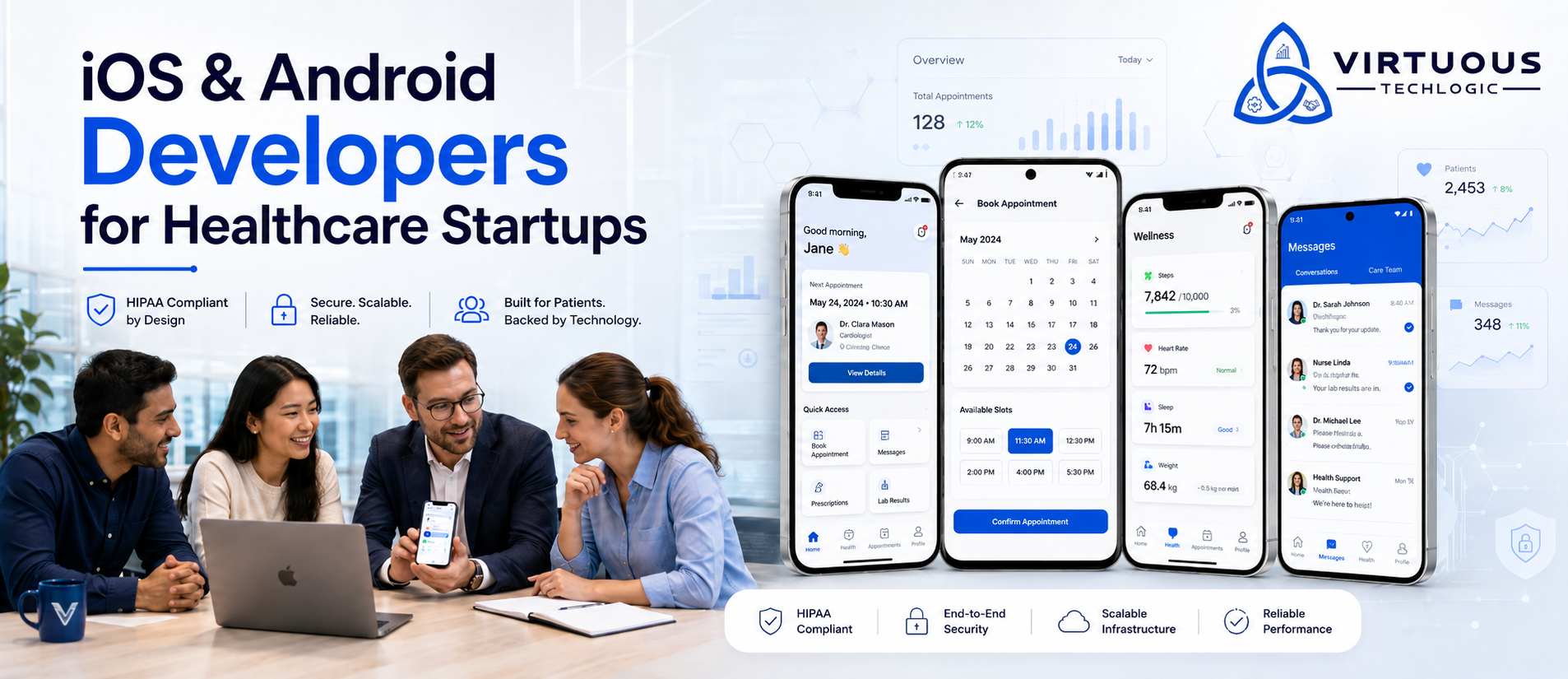
Top-Rated iOS and Android Developers for Healthcare Startups
Finding capable mobile developers is relatively easy. Finding developers who understand healthcare workflows, sensitive user data, patient experience, platform policies, integrations, and startup constraints is much harder.The right iOS and Android developers for a healthcare startup should do more than convert screens into code. They should help the startup define a realistic MVP, identify privacy and regulatory considerations, create dependable patient and provider workflows, plan integrations, and prepare the product for App Store and Google Play submission.Virtuous Techlogic helps healthcare and wellness startups build mobile products using Flutter, FlutterFlow, Firebase, Supabase, secure APIs, custom backends, and practical AI integrations. Our healthcare-related experience includes sleep and wellness tracking, patient-care workflows, mental healthcare management, medical-assistance systems, claims processes, fitness management, and AI assistant concepts.
Why Healthcare Startups Need More Than Mobile App Developers
A healthcare application may serve several different users:
- Patients
- Doctors
- Nurses
- Therapists
- Clinic administrators
- Insurance or claims teams
- Care coordinators
- Family members or caregivers
Each user needs different permissions, information, actions, and safeguards.A patient may need to book an appointment, upload a report, attend a remote consultation, receive a reminder, or monitor progress. A doctor may need access to consultation history, clinical notes, patient-submitted data, and follow-up tasks. Administrators may need scheduling, billing, staff management, analytics, and audit information.Developers without healthcare workflow experience may build an attractive interface while overlooking critical issues such as:
- Role-based access
- Consent management
- Sensitive-data exposure
- Session security
- Reliable reminders
- Failed appointment states
- Clinical escalation
- Data retention
- Audit logging
- Accessibility
- Provider usability
- Store-policy requirements
That is why healthcare founders should evaluate an agency’s product thinking and domain experience—not only its programming language or hourly rate.
What Makes an iOS and Android Healthcare Development Team Top-Rated?
“Top-rated” should not simply mean that a company appears in an online list. Healthcare startups should look for verifiable evidence, relevant technical capability, responsible communication, and a process suited to their product.
1. Relevant Healthcare Product Experience
Ask whether the team has worked with workflows similar to yours.A telemedicine product has different requirements from a fitness tracker. A patient portal is different from a mental wellness journal. A medical claims application is different from an AI healthcare assistant.Relevant experience may include:
- Appointment scheduling
- Telehealth consultations
- Medication reminders
- Care plans
- Patient-provider messaging
- Clinical or therapy notes
- Claims and subsidy management
- Wearable and IoT integrations
- Remote patient engagement
- Healthcare document management
- AI-assisted support
- Administrative dashboards
The strongest development partner does not need to have built an exact copy of your application. However, the team should understand the operational and technical challenges surrounding your core workflows.
2. Privacy-Conscious and Secure Architecture
Healthcare startups should clarify whether HIPAA, GDPR, local health-data laws, contractual obligations, or medical-device regulations apply to the product.HIPAA does not automatically apply to every wellness or consumer health application. Its applicability depends partly on whether the organization acts as a covered entity or business associate and how protected health information is handled. Healthcare founders should obtain appropriate legal and compliance advice instead of relying on a developer’s generic “HIPAA-compliant” marketing statement.From an engineering perspective, a privacy-conscious architecture may include:
- Encryption in transit and at rest
- Multi-factor authentication where appropriate
- Role-based permissions
- Secure API authentication
- Minimal data collection
- Consent records
- Audit-friendly activity logging
- Restricted administrative access
- Secure document storage
- Backup and recovery planning
- Environment separation
- Monitoring and incident-response processes
Virtuous Techlogic uses compliance-aware and secure-by-design language because actual compliance depends on the complete product, infrastructure, vendors, internal policies, contracts, operating procedures, and target market—not code alone.
3. iOS and Android Store-Launch Knowledge
Healthcare applications receive additional scrutiny because inaccurate claims or unsafe functionality may harm users.Apple states that medical apps that could provide inaccurate information or be used for diagnosis or treatment may receive greater scrutiny. Apps making health-measurement accuracy claims must be able to support those claims, and users should be reminded to consult a doctor before making medical decisions.Google Play requires health and medical applications to complete a health-app declaration and publish a privacy policy explaining how personal and sensitive information is collected, used, and shared. Medical functionality may also require regulatory evidence or an appropriate disclaimer.An experienced team should plan for these requirements during discovery—not after development is complete.
4. Healthcare API and Device Integrations
Many healthcare applications depend on external systems, including:
- Electronic health record systems
- Clinic management platforms
- Laboratory systems
- Appointment APIs
- Video consultation services
- Payment gateways
- Insurance systems
- Pharmacy services
- Apple Health
- Health Connect
- Smartwatches
- Sleep-monitoring devices
- Glucose or heart-rate devices
- Push-notification providers
Where EHR interoperability is required, developers may need to work with standards such as HL7 FHIR. FHIR is an API-focused healthcare-data standard used to represent and exchange health information between systems.The development team should evaluate each integration for data ownership, permissions, error handling, vendor limitations, sandbox availability, rate limits, and compliance implications.
5. Startup Product and MVP Experience
Healthcare founders frequently need to validate a product before investing in a large platform.A suitable startup development partner should help separate:
- Essential launch features
- Important but non-critical features
- Post-launch improvements
- High-risk assumptions
- Integration dependencies
- Compliance dependencies
- Features that require clinical review
For example, an early telehealth MVP may begin with registration, practitioner discovery, scheduling, secure consultation, payment, notifications, and a basic administrative dashboard.Advanced patient analytics, wearable integrations, insurance processing, multilingual support, and AI functionality can be added in later phases when appropriate.This prioritization reduces unnecessary development while protecting the product’s long-term roadmap.
6. Long-Term Maintenance and Support
Healthcare products continue evolving after launch. Operating-system updates, device changes, security patches, regulations, APIs, user feedback, and clinical requirements can all affect the application.Before hiring a team, ask:
- Who handles production issues?
- Is post-launch maintenance available?
- How are security updates managed?
- Will the original team remain involved?
- How are feature requests estimated?
- Who monitors crashes and application performance?
- How are App Store and Play Store updates handled?
A low initial quote may become expensive if the product must be rebuilt because the original architecture was difficult to maintain.
Should Healthcare Startups Build Native Apps or Use Flutter?
There is no single correct technology for every healthcare product.The decision should be based on device integrations, performance, product complexity, budget, launch timeline, regulatory needs, offline functionality, and the long-term roadmap.
When Flutter Is a Strong Choice
Flutter is often suitable when a startup needs:
- One maintainable codebase for iOS and Android
- Consistent user experience across platforms
- A faster MVP development cycle
- Custom interfaces and animations
- Firebase, Supabase, or custom API integration
- Push notifications
- Payments and subscriptions
- Patient and provider applications
- Admin or web support
- App Store and Play Store deployment
Using one Flutter codebase can help reduce duplicated feature development across iOS and Android while preserving the ability to integrate platform-specific functionality when necessary.
When Native Development May Be Required
Separate native iOS and Android development may be appropriate when the product requires:
- Highly specialized device integrations
- Platform-exclusive capabilities
- Extensive background processing
- Complex Bluetooth or medical-hardware communication
- Strict native SDK requirements
- Very specialized performance behavior
A discovery phase should identify these requirements before the technology is selected.
When FlutterFlow Can Support an Early MVP
FlutterFlow can be effective for a validation-stage healthcare or wellness MVP when it is used with engineering guardrails.It can support:
- Rapid interface development
- Firebase or Supabase integration
- Appointment flows
- User onboarding
- Basic dashboards
- Notifications
- Custom actions
- Custom widgets
- API integrations
However, database rules, permissions, sensitive-data handling, custom code, and future migration should be planned carefully to avoid no-code debt.Virtuous Techlogic recommends Flutter, FlutterFlow, native integrations, or a hybrid approach based on product scope rather than treating one technology as universally better.
Essential Features of a Healthcare Startup App
The right feature set depends on the business model and target users. Common capabilities include:
Patient Features
- Secure registration and login
- Profile and consent management
- Doctor or provider discovery
- Appointment scheduling
- Telehealth consultation
- Care-plan access
- Medication and appointment reminders
- Secure report upload
- Progress tracking
- Patient-provider messaging
- Subscription or payment management
Provider Features
- Patient lists
- Appointment calendar
- Clinical or consultation notes
- Care-plan management
- Patient-uploaded documents
- Follow-up tasks
- Notifications
- Availability management
- Secure communication
- Outcome tracking
Administrative Features
- Patient and provider management
- Role and permission controls
- Appointment oversight
- Claims or billing status
- Content management
- Notification configuration
- Operational reporting
- Audit events
- Support management
- Subscription analytics
AI Features
Healthcare AI should support a clearly defined workflow rather than being added as a marketing feature.Practical examples include:
- Clinic FAQ assistants
- Patient onboarding support
- Healthcare policy search
- Document Q&A using RAG
- Summarization for authorized staff
- Appointment-routing assistance
- Mental wellness journaling prompts
- Internal knowledge assistants
- Administrative workflow automation
AI-generated healthcare content should use appropriate guardrails, source grounding, evaluation, structured outputs, human review, escalation paths, and clear limitations. It should not be presented as a replacement for qualified medical advice.
Virtuous Techlogic’s Healthcare Application Experience
Virtuous Techlogic has worked on healthcare-style products and workflows covering patient engagement, sleep and wellness, care operations, medical assistance, mental health, fitness management, claims, and AI.Some public portfolio entries are product concepts, while NDA-protected experience is described by workflow rather than disclosing client identities or unsupported performance metrics.
Sleep Monitoring and IoT Integration
Our public Sleep Monitor App portfolio demonstrates a Flutter-based mobile experience designed around connected sleep-tracking devices.The concept includes:
- Sleep-duration tracking
- Sleep-cycle monitoring
- Disturbance tracking
- Connected-device data
- Historical trends
- User-friendly wellness insights
The project demonstrates how device data can be translated into clear, understandable mobile experiences for users.
Patient Care and Nursing Workflows
Our healthcare portfolio includes a Patient Care App concept designed around nursing and care-team operations.Relevant workflows include:
- Customizable care plans
- Real-time patient updates
- Nursing task management
- Patient status visibility
- Care coordination
- Staff-focused mobile UX
This type of experience helps us understand that healthcare software must serve operational users as effectively as it serves patients.
Mental Healthcare Management
Our past healthcare work includes a mental healthcare web application designed to support therapists and clinicians.The workflows include:
- Clinical notes
- Client records
- Notifications
- Consent forms
- Account management
- Therapist-facing administration
Mental healthcare products require calm, accessible UX and careful handling of personal information. Features should reduce administrative effort without making patients or clinicians feel that the technology is controlling the care experience.
Medical Assistance and Claims Workflows
Virtuous Techlogic’s healthcare experience also includes medical-assistance, voucher, subsidy, and claim-management workflows.These systems may require:
- Eligibility information
- Request submission
- Document upload
- Claim-status tracking
- Service booking
- Administrative review
- Notifications
- Multi-role permissions
The most important challenge is often not the form itself, but making a complex operational process understandable to patients, staff, and administrators.
AI Medical Assistant Concepts
Our portfolio includes an AI-powered medical and regulatory assistant concept created to help users query healthcare-related information.Production AI healthcare systems require more than an LLM connection. Depending on the use case, they may require:
- Retrieval-augmented generation
- A controlled knowledge base
- Vector database architecture
- Source citations
- Prompt and output guardrails
- Access controls
- Evaluation datasets
- Human review
- Logging and monitoring
- Clear medical disclaimers
Virtuous Techlogic positions AI as production business software—not as an unmonitored chatbot making clinical decisions.
Fitness and Wellness Management
Our related healthcare and fitness experience includes applications for:
- Fitness professional management
- Client notes
- Provider or coach workflows
- Habit tracking
- Sleep and wellness
- Progress visibility
- Coaching administration
- User engagement
Virtuous Techlogic’s public healthcare and fitness portfolio currently presents projects related to an AI medical assistant, fitness management, medical assistance, mental healthcare, and patient care.
How Virtuous Techlogic Helps Healthcare Startups
Virtuous Techlogic supports healthcare startups from product planning through launch and post-launch improvement.
Product Discovery and MVP Planning
We help define:
- Target users
- Core healthcare problem
- User roles
- MVP workflows
- Integration requirements
- Data sensitivity
- AI opportunities
- Technical risks
- Development phases
- Launch priorities
The result is a practical development roadmap rather than a long feature list without priorities.
Healthcare-Focused UI and UX
We design experiences for patients, providers, administrators, and operational teams.This can include:
- Patient-friendly onboarding
- Accessible navigation
- Calm mental-health interfaces
- Fast provider workflows
- Clear appointment states
- Understandable health information
- Error prevention
- Consent and permission screens
- Mobile-responsive dashboards
iOS and Android Development
Our Flutter development services can support one scalable mobile codebase for iOS and Android, including:
- Custom UI
- State management
- API integration
- Authentication
- Offline workflows
- Push notifications
- Analytics
- Payments
- Subscriptions
- Device integration
- App Store submission
- Play Store submission
Platform-specific native development or native SDK integration can be added where required.
Backend and Administrative Systems
Virtuous Techlogic works with:
- Firebase
- Supabase
- Custom APIs
- Cloud functions
- SQL and NoSQL databases
- Role-based permissions
- Secure file storage
- Admin dashboards
- Notification systems
- Payment platforms
- Third-party healthcare services
Architecture is selected according to the product’s data model, scale, security requirements, integrations, and future roadmap.
AI Healthcare Features
We can help design and develop:
- RAG healthcare assistants
- Vector database search
- Internal knowledge assistants
- Patient-support chatbots
- Document Q&A
- Workflow automation
- AI agents with controlled tools
- MCP integrations
- Structured AI outputs
- Human-in-the-loop review
- AI evaluation and monitoring
AI should improve a measurable workflow, such as reducing repetitive support questions or helping authorized staff search approved information. It should not introduce unnecessary clinical risk.
Testing, Deployment and Support
Our delivery process can include:
- Functional testing
- Device testing
- API testing
- Permission testing
- Role-based workflow testing
- Error-state testing
- Performance monitoring
- App Store preparation
- Play Store preparation
- Release support
- Post-launch maintenance
Public client feedback and work-history information for Virtuous Techlogic can also be reviewed through its linked Clutch and Upwork profiles.
Our Healthcare App Development Process
Step 1: Discovery
We clarify the product idea, target users, business model, healthcare workflows, risk areas, integrations, and target countries.
Step 2: Feature Prioritization
Features are separated into MVP, launch-critical, later-phase, and optional categories.
Step 3: Architecture and Technology Selection
We recommend Flutter, FlutterFlow, custom web development, Firebase, Supabase, custom APIs, or a hybrid architecture based on the product requirements.
Step 4: UX and Prototype
Critical patient, provider, and administrative journeys are mapped before full development.
Step 5: Development and Integration
The team implements the mobile application, backend, dashboard, APIs, notifications, payments, device integrations, and approved AI features.
Step 6: Testing and Store Preparation
User roles, devices, permissions, integrations, disclosures, privacy information, and store assets are reviewed before submission.
Step 7: Launch and Iteration
After launch, analytics, feedback, operational issues, and product priorities guide the next development phase.
Questions to Ask Before Hiring Healthcare App Developers
Before selecting a development company, ask:
- What healthcare or wellness workflows have you previously built?
- Can you show relevant public work or NDA-safe examples?
- How will you determine whether Flutter or native development is appropriate?
- How do you handle role-based permissions and sensitive information?
- Have you worked with wearable, IoT, EHR, telehealth, or healthcare APIs?
- How will you prepare the application for Apple and Google health-app policies?
- Who owns the source code and cloud accounts?
- How are technical decisions documented?
- How are changes in scope handled?
- What post-launch support is available?
- How do you test patient, provider, and administrative workflows?
- How do you prevent AI features from producing unsafe or unsupported answers?
A reliable agency should answer these questions clearly and identify areas that require legal, clinical, security, or regulatory specialists.
Build Your iOS and Android Healthcare App with Virtuous Techlogic
Healthcare startups need a development partner that understands product validation, mobile engineering, sensitive workflows, user trust, integrations, and long-term scalability.Virtuous Techlogic can help you build:
- Telehealth apps
- Patient portals
- Mental healthcare platforms
- Appointment-booking apps
- Healthcare administration systems
- Sleep and wellness apps
- Fitness applications
- Medical-assistance workflows
- Claims-management systems
- AI healthcare assistants
- Provider dashboards
- Remote patient-engagement products
We can help determine whether your product should use Flutter, FlutterFlow, custom backend services, healthcare APIs, device integrations, or production AI features.
Frequently Asked Questions
Build Your App with Virtuous Techlogic
Book a Free ConsultationTrusted by clients across Clutch and Upwork
Want proof before starting? View our client reviews and agency profiles on Clutch and Upwork.