
8 Best AI Development Agencies for the Medical Industry in 2026
What to Verify in a Healthcare AI Development Agency
Hiring a healthcare AI agency is a production and permissions decision: which data the model can see, who reviews outputs, and how audit trails work. This page is a verification checklist—not a clinical ranking or a claim of HIPAA certification.
· · Written by Virtuous Techlogic · 1 min read
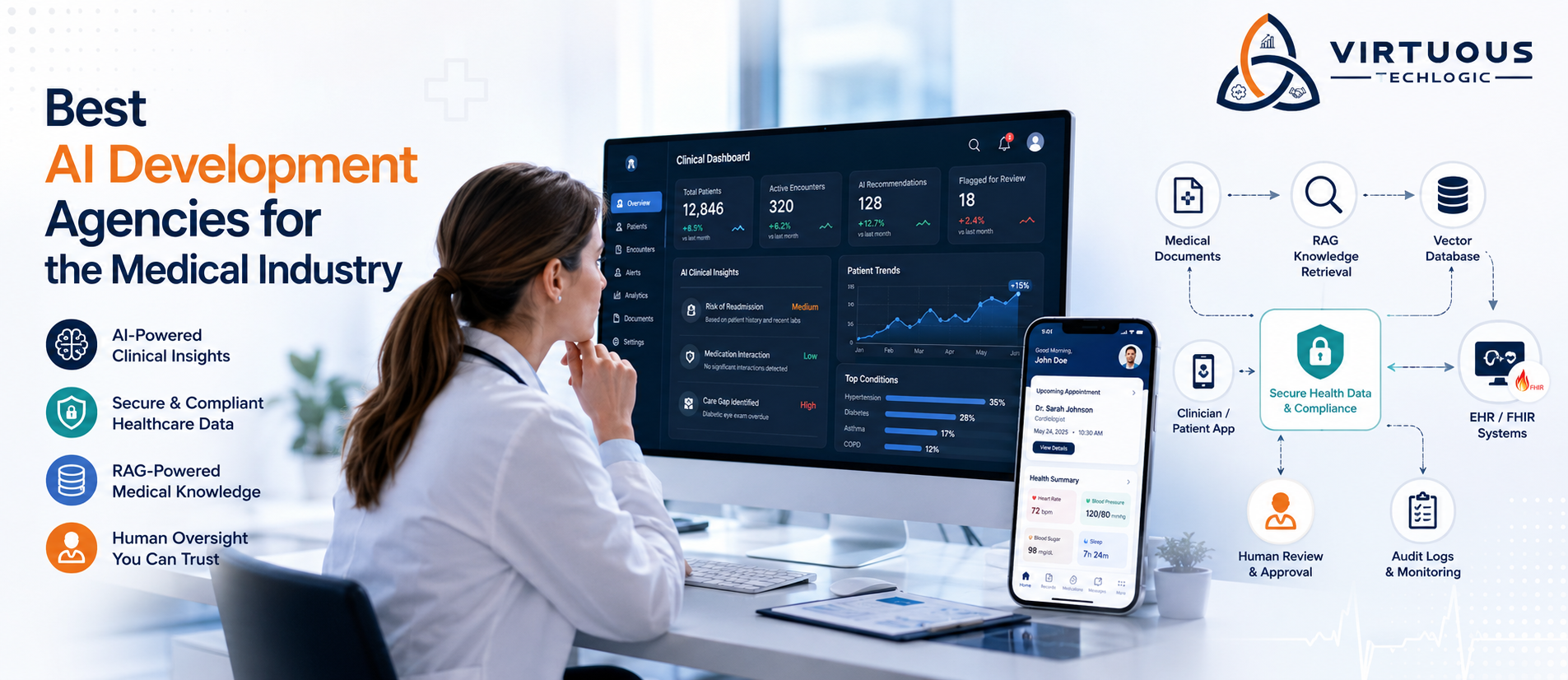
The best AI development agency for a medical project depends on what you are building. A patient engagement app, clinical documentation assistant, AI medical device, hospital data platform, and internal healthcare knowledge assistant require different teams, architecture, validation processes, and regulatory strategies.A practical shortlist of AI development agencies for the medical industry includes Virtuous Techlogic, Technology Rivers, Simform, Apzumi, LeewayHertz, ScienceSoft, Itransition, and Edenlab.These companies publicly demonstrate capabilities related to healthcare software, artificial intelligence, medical data, patient applications, clinical workflows, interoperability, or AI-enabled medical products. However, there is no universally best agency. The right partner must match your exact use case, intended users, risk level, data environment, integration requirements, budget, and product roadmap.
This guide is published by Virtuous Techlogic. The agencies are compared using publicly available information and use-case fit rather than an independently audited performance score. Buyers should verify every vendor’s portfolio, references, security controls, and contractual commitments—including ours—before hiring.
The best medical AI development agencies at a glance
AgencyParticularly suitable forVirtuous TechlogicAI-powered healthcare MVPs, patient apps, RAG assistants, Flutter and FlutterFlow productsTechnology RiversU.S. digital health platforms, remote patient monitoring, HIE and medical integrationsSimformCloud-scale healthcare systems, clinical AI workflows and enterprise modernizationApzumiDigital health products, medical documentation processing and device-connected applicationsLeewayHertzEnterprise generative AI, agentic workflows and healthcare AI consultingScienceSoftAI-enabled medical devices, EHR intelligence, diagnostics and SaMD-related productsItransitionClinical documentation, healthcare automation and enterprise AI platformsEdenlabFHIR interoperability, clinical data infrastructure and healthcare AI agents
How were these medical AI agencies selected?
The shortlist focuses on five criteria.
1. Healthcare-specific experience
A general AI portfolio is not enough. The agency should understand patient and clinician workflows, medical terminology, sensitive health information, healthcare system integrations, and the consequences of inaccurate outputs.
2. Production AI capabilities
The team should be able to build more than a chatbot demonstration. Depending on the product, relevant capabilities may include:
- Retrieval-augmented generation
- Vector database architecture
- AI agents and tool calling
- Machine learning pipelines
- Structured output generation
- Model evaluation
- Hallucination testing
- Human review workflows
- Observability and audit logging
- Secure API integration
3. Security and compliance awareness
The HIPAA Security Rule requires regulated organizations to protect electronic protected health information through appropriate administrative, physical, and technical safeguards. Compliance therefore depends on the complete product environment—not simply whether an AI model is described as secure.
4. Healthcare interoperability
Medical software frequently needs to exchange information with EHRs, laboratories, billing systems, wearable devices, or hospital infrastructure. FHIR is an HL7 standard for exchanging healthcare information electronically and is an important capability for many integration-heavy projects.
5. Fit for the intended medical use
An administrative appointment assistant has a different risk profile from software that recommends treatment or supports a diagnosis. AI-enabled software that functions as a medical device may require a product lifecycle, documentation, validation, and regulatory strategy aligned with medical-device requirements. The FDA maintains resources for AI-enabled medical devices and emphasizes safety and effectiveness throughout the product lifecycle.
1. Virtuous Techlogic
Best suited for: AI-powered healthcare MVPs, cross-platform medical applications, patient portals, healthcare assistants, mental wellness platforms, and workflow automation.Virtuous Techlogic combines mobile app development with production-focused AI engineering. Its capabilities include Flutter, FlutterFlow, Firebase, Supabase, custom APIs, AI agents, RAG pipelines, vector databases, MCP integrations, evaluation harnesses, and workflow automation.This combination is useful when the AI capability needs to be delivered as part of a complete patient, clinician, or administrative product rather than as an isolated model.Virtuous Techlogic’s healthcare positioning covers secure patient-facing digital products, telehealth, wellness applications, healthcare workflows, and compliance-aware product development. Its AI service emphasizes grounded answers, model evaluation, guardrails, and integration with real business systems.
Why consider Virtuous Techlogic?
- Flutter development for iOS, Android, and web products
- FlutterFlow development for rapid healthcare MVP validation
- Firebase, Supabase and custom backend integration
- RAG assistants grounded in approved medical or organizational content
- Vector database and semantic-search implementation
- MCP-connected AI workflows
- Human-in-the-loop approval processes
- Patient, doctor, administrator and staff roles
- AI integration within existing mobile or web applications
- App Store and Play Store launch support
Virtuous Techlogic may be particularly relevant for startups that need to move from product planning to a working MVP without hiring separate mobile, backend, AI, and deployment vendors.For high-risk diagnostic or treatment-related functionality, the project should also include qualified clinical, legal, security, quality, and regulatory specialists.
2. Technology Rivers
Best suited for: U.S.-focused digital health platforms, remote patient monitoring, healthcare integrations, mental health applications, AI agents, and wearable products.Technology Rivers presents healthcare as a core service area. Its published capabilities include medical-device integration, mental health and wellness applications, health information exchange, HL7 and FHIR interoperability, mobile and wearable applications, AI development, clinical decision support, and workflow automation.The company may be a good fit for healthcare organizations that need AI embedded into a broader clinical or operational platform, particularly when remote monitoring, connected devices, or interoperability are central requirements.
Consider Technology Rivers when:
- The application connects to medical or wearable devices
- Remote patient monitoring is central to the product
- The solution requires HL7 or FHIR integration
- You need a U.S.-oriented healthcare development partner
- AI agents will interact with healthcare workflows or software systems
Buyers should request detailed evidence for projects comparable to their intended use, particularly where an application affects clinical decisions.
3. Simform
Best suited for: Enterprise healthcare platforms, cloud modernization, EHR systems, medical IoT, clinical data solutions, and multimodal AI.Simform publishes healthcare capabilities covering EMR and EHR systems, telehealth, medical IoT, clinical decision-support software, cloud infrastructure, and healthcare data analysis. It also presents a multimodal healthcare AI accelerator for research, imaging, documentation, and clinician workflows.Its portfolio includes an AI-driven mental health support application designed to provide contextual support through a conversational interface.Simform may be suitable for larger organizations that need healthcare AI combined with cloud engineering, data platforms, enterprise software development, and modernization.
Consider Simform when:
- You are modernizing an existing healthcare platform
- The product has large-scale cloud or data requirements
- You need medical IoT or EHR capabilities
- The solution includes text, image, voice, or other multimodal inputs
- You need a larger engineering delivery organization
Before selecting the agency, clarify which parts of the proposed solution are existing accelerators and which will be built specifically for your organization.
4. Apzumi
Best suited for: Digital health applications, connected medical products, medical document automation, healthcare UX, and startup product development.Apzumi specializes in healthcare and digital wellness software. Its published service information covers medical-device integration, AI-powered analysis, mobile products, security, privacy, and regulatory considerations.One particularly relevant public case study involves generative AI for medical documentation processing. The solution digitizes and categorizes healthcare documents, extracts important information, and produces medical summaries and reports.This makes Apzumi worth considering for products involving:
- Medical claims and document processing
- Patient or clinician mobile applications
- Connected medical devices
- Health and wellness platforms
- AI-assisted information extraction
- Medical reporting workflows
For generative AI documentation systems, buyers should ask how extracted information is validated, how unsupported statements are detected, and where human approval is required.
5. LeewayHertz
Best suited for: Enterprise generative AI, AI consulting, healthcare agents, data-intensive workflows, and operational automation.LeewayHertz offers healthcare AI consulting and development services covering patient care, operational efficiency, analytics, and enterprise AI implementation. Its healthcare AI content also addresses generative and agentic workflows that retrieve information, classify cases, draft responses, route exceptions, and update systems after approval.The agency may be relevant for hospitals, insurers, pharmaceutical companies, and established healthcare businesses that are exploring multiple AI opportunities rather than building a single mobile application.
Consider LeewayHertz when:
- You need an AI strategy before development begins
- The project includes several enterprise workflows
- You are evaluating AI agents or generative AI use cases
- The solution must process large amounts of organizational data
- You need integrations across existing enterprise systems
A discovery engagement should produce a prioritized use-case map, data-readiness assessment, risk analysis, integration plan, and measurable success criteria—not only a list of possible AI features.
6. ScienceSoft
Best suited for: AI-enabled medical devices, EHR intelligence, medical imaging, patient-record automation, treatment-personalization systems, and SaMD-related projects.ScienceSoft publishes extensive healthcare AI material covering AI-powered medical devices, EHR enhancement, diagnostics, patient-record management, medication review, medical imaging, digital pathology, and treatment personalization.The company may be suitable for projects where the AI software is closer to clinical decision support, medical-device software, diagnostics, or other regulated functionality.
Consider ScienceSoft when:
- The software may qualify as Software as a Medical Device
- The product supports diagnostics or treatment decisions
- You need AI within an EHR or EMR
- Medical imaging or pathology is involved
- Quality-management and medical-device development experience are important
Buyers should still confirm the exact regulatory responsibilities included in the proposal. Software engineering, quality management, clinical validation, cybersecurity, and regulatory submissions may involve different teams and contractual scopes.
7. Itransition
Best suited for: Clinical documentation, healthcare process automation, enterprise AI, telehealth platforms, and AI-enhanced healthcare applications.Itransition offers healthcare software and AI development services across clinical decision support, practice management, patient engagement, data analysis, diagnostic imaging, and task automation.A relevant portfolio example is an AI-powered add-on for Microsoft Cloud for Healthcare that automates clinical encounter documentation during telehealth consultations.This makes Itransition a potential fit for organizations that need AI connected to enterprise healthcare platforms and documentation-heavy workflows.
Consider Itransition when:
- You need to automate clinical documentation
- The product must integrate with Microsoft healthcare infrastructure
- You are developing an enterprise telehealth platform
- The application includes large operational workflows
- You need both healthcare software and AI engineering
For documentation assistants, define whether AI output is a draft, recommendation, or final record. Clinicians should have clear review, correction, and approval controls.
8. Edenlab
Best suited for: FHIR infrastructure, healthcare data platforms, interoperability, clinical data preparation, AI agents, and healthcare chatbots.Edenlab focuses strongly on healthcare data and interoperability. Its services cover AI-ready clinical data, FHIR infrastructure, diagnostics, predictive analytics, workflow automation, virtual assistants, healthcare agents, and conversational analytics.The company also describes healthcare chatbot architectures that use structured clinical data, semantic layers, constrained generation, data normalization, validation, and FHIR transformations to reduce unsupported answers in high-stakes situations.
Consider Edenlab when:
- Your clinical data is fragmented across multiple systems
- FHIR implementation is a major project requirement
- The AI product depends on clean and normalized healthcare data
- You need a medical knowledge assistant or clinical copilot
- Interoperability is more important than a standalone mobile interface
Edenlab may be especially relevant when the primary problem is preparing and connecting healthcare data before developing the visible AI functionality.
How to choose the right medical AI development agency
A polished portfolio does not prove that an agency can safely deliver your particular medical product. Use the following questions during vendor evaluation.
1. Has the agency built a similar healthcare workflow?
Ask for examples involving the same type of users, data, integrations, and risk.A clinic FAQ chatbot is not equivalent to an AI triage system. A fitness recommendation application is not equivalent to diagnostic software.
2. Does the team understand the product’s intended use?
The intended use determines what the AI is allowed to do and how the product may be regulated.Define:
- Who uses the output
- What decision the output influences
- Whether a clinician reviews it
- What happens when the AI is wrong
- Whether it provides administrative support, education, recommendations, or diagnosis
- Which countries the product will operate in
3. How will patient data be protected?
Request a data-flow diagram that identifies:
- Where protected information enters the system
- Where it is stored
- Which vendors process it
- Whether model providers retain prompts or outputs
- How encryption is implemented
- How access is controlled
- How activity is logged
- How data is deleted
- Which parties will sign required agreements
Do not accept “the platform is HIPAA compliant” as a complete security explanation.
4. Can the agency integrate with healthcare systems?
Depending on the product, the agency may need experience with:
- FHIR
- HL7
- EHR and EMR platforms
- Laboratory systems
- Pharmacy systems
- Claims and billing platforms
- Wearables and medical devices
- Identity and access management
- Secure cloud infrastructure
5. How will the AI be evaluated?
A healthcare AI product needs test cases that reflect realistic users and risks.The evaluation plan may include:
- Factual accuracy
- Unsupported-claim rate
- Retrieval relevance
- Citation correctness
- Refusal behavior
- Emergency-intent handling
- Bias testing
- Structured-output accuracy
- Latency and reliability
- Clinician acceptance
- Workflow completion
- Performance across demographic groups
- Regression tests after model or prompt changes
6. Where is human oversight required?
Human review is particularly important when an output could affect a patient’s health, treatment, access to care, or medical record.For organizations operating in Europe, the EU AI Act uses a risk-based framework, and high-risk systems can carry obligations related to quality management, monitoring, documentation and human oversight.
7. What happens after launch?
Ask whether the engagement includes:
- Model and application monitoring
- Incident response
- Prompt and retrieval updates
- Model-change testing
- Security patches
- Performance evaluation
- Data-quality monitoring
- User feedback review
- Audit support
- App Store and Play Store maintenance
- Infrastructure cost optimization
Medical AI capabilities your agency should provide
Not every project requires every capability, but a strong medical AI partner should be able to explain which of the following apply.
Retrieval-augmented generation
RAG can ground an AI assistant in approved sources such as clinical protocols, patient education, internal policies, product documentation, or operational manuals.The system should retrieve relevant information, show source references where appropriate, restrict answers to the intended scope, and avoid presenting retrieved content as individualized medical advice.
Vector database architecture
Vector databases support semantic retrieval across unstructured documents. The development team should address document permissions, metadata, version control, source freshness, deletion, chunking, retrieval quality, and tenant separation.
AI agents and MCP integration
AI agents can interact with scheduling, CRM, support, administrative, and knowledge systems. MCP or other controlled tool-integration approaches can help models access business functions.In healthcare, tool permissions should be narrow. Sensitive actions should require deterministic validation and human approval.
Human-in-the-loop workflows
The application should make it easy for clinicians or authorized staff to:
- Review generated content
- Correct inaccurate information
- Approve or reject proposed actions
- See supporting sources
- Escalate uncertain cases
- Record who approved the output
Evaluation and observability
Teams should be able to measure AI quality before launch and monitor it afterward. Logs must be useful for troubleshooting without unnecessarily exposing protected health information.
Secure mobile and web applications
The AI feature still needs a reliable product around it. Depending on the project, this may include:
- Patient onboarding
- Consent management
- Role-based access
- Appointment booking
- Notifications
- Telehealth
- Secure messaging
- Payments or subscriptions
- Clinician dashboards
- Administrative portals
- Accessibility
- Analytics
- Offline behavior
- Store deployment
Warning signs when evaluating a healthcare AI agency
Be cautious when an agency:
- Promises perfect accuracy
- Claims a general chatbot is automatically suitable for medical use
- Cannot explain where patient data travels
- Has no plan for hallucination or failure testing
- Treats HIPAA as a hosting-provider checkbox
- Cannot distinguish wellness software from regulated medical functionality
- Recommends autonomous clinical decisions without oversight
- Has no experience with healthcare integrations
- Avoids discussing model updates and post-launch monitoring
- Provides a proposal without clarifying intended use
- Claims a product is compliant before conducting a proper assessment
- Wants to train on sensitive data without defining authorization and governance
Why medical AI development requires more than an AI model
A production medical AI system includes much more than an LLM or machine-learning algorithm.It may require:
- A secure patient or clinician application
- Healthcare data ingestion and normalization
- Permission-aware retrieval
- EHR or FHIR integration
- AI orchestration and structured outputs
- Guardrails and emergency handling
- Human review
- Evaluation and monitoring
- Audit logs
- Privacy, security and retention controls
- Clinical and regulatory documentation
- Ongoing maintenance
The strongest agency is therefore not necessarily the team with the most AI demonstrations. It is the team that can connect product strategy, healthcare workflows, data engineering, application development, AI evaluation, security, integrations, and post-launch support.
Frequently Asked Questions
Build Your App with Virtuous Techlogic
Book a Free ConsultationTrusted by clients across Clutch and Upwork
Want proof before starting? View our client reviews and agency profiles on Clutch and Upwork.