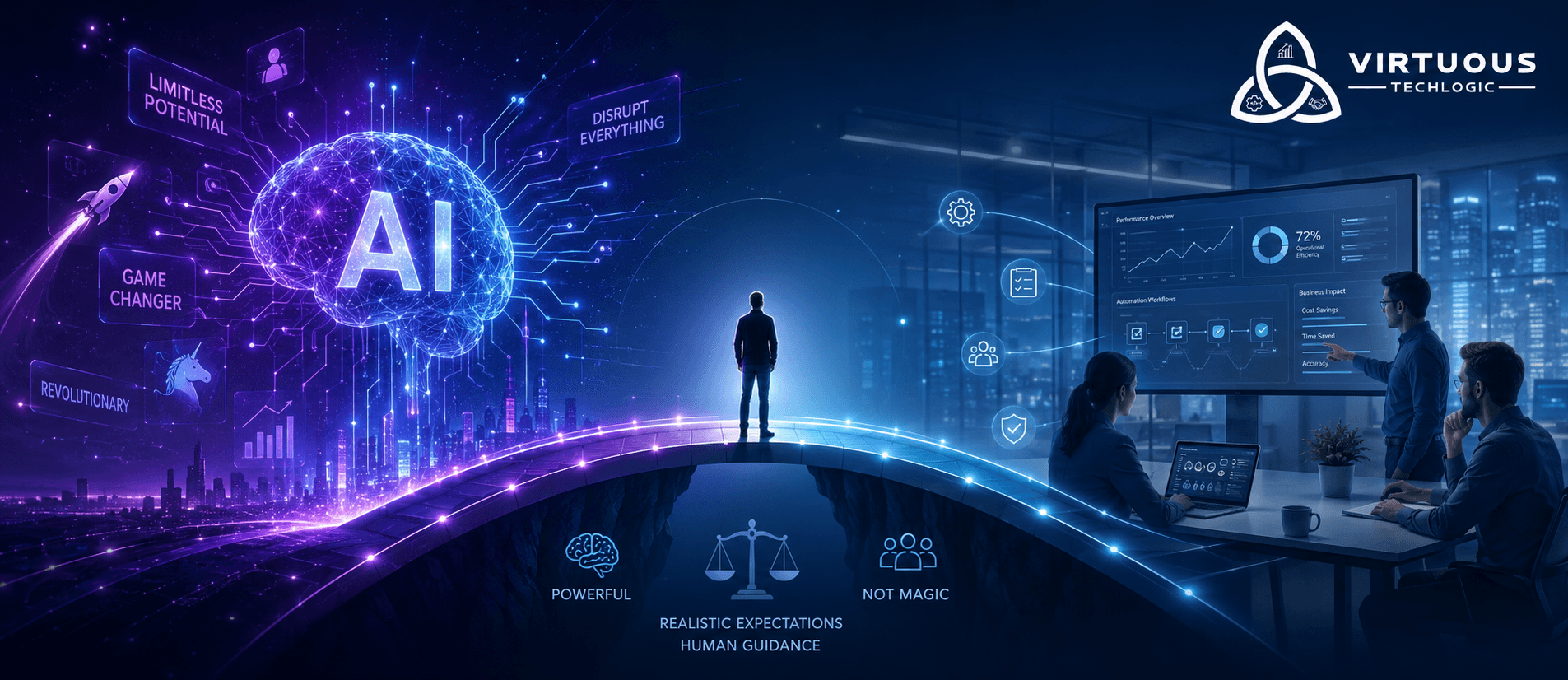
Why There’s a Big “Understanding Gap” About AI And How Virtuous Techlogic Helps Bridge It
· December 10, 2025

Introduction
Artificial Intelligence (AI) is often painted as the magical future, a force that can revolutionize industries, automate jobs, write poetry, compose music, drive cars, predict diseases, and more. Everywhere you look, there’s talk of “AI taking over,” of “super‑intelligent machines,” of “machines replacing human jobs,” or “AI solving all our problems.” But in reality, many people and even many businesses don’t truly understand what AI can do, and just as importantly, what it cannot do. That gap between public/market perception and technical reality is the “AI understanding gap.”
This gap matters. When people expect too much from AI, or misunderstand its capabilities, it leads to failed projects, disappointment, fear, distrust, or misuse. On the other hand, if people misunderstand or underestimate AI, they may fail to exploit its real potential, missing out on powerful tools for automation, efficiency, insight, and growth. Bridging this gap is essential for responsible, effective adoption of AI.
In this article, we’ll explore: What exactly is AI (in today’s context)? Why this understanding gap exists, including myths, misunderstandings, and social factors; what are the real strengths and limitations of AI, and why it matters; consequences of the gap; and finally, how companies like Virtuous Techlogic can help businesses (startups, SMEs, enterprises) navigate the messy reality of AI, adopt it responsibly, and get real value.
What is AI: Reality Check
At its core, AI refers to systems (software or algorithms) designed to perform tasks that typically require human intelligence: tasks like pattern recognition, classification, decision‑making, language understanding, prediction, etc. Over the past decade, especially, rapid advances in techniques (machine learning, deep learning, generative models, large‑language models, computer vision, etc.) have allowed AI to excel at many narrow, well‑defined tasks, e.g., recognizing images, transcribing speech, translating languages, detecting anomalies, recommending products, and automating routine decisions.
This kind of “specialized AI” designed for narrow tasks can often outperform humans in speed, scale, and consistency when the task is clearly defined and data is abundant. But that does not mean AI has human‑like general intelligence. AI lacks consciousness, common sense reasoning, deep contextual understanding, self-awareness, or general problem-solving skills across wide, varied domains.
In short, today’s AI is a powerful tool but only for certain kinds of tasks. It’s not magic, and cannot replace what humans do best: flexible reasoning, empathy, creativity, ethical judgment, deep context comprehension, and handling novel/unstructured challenges.
Why the “Understanding Gap” Exists: Myths, Misconceptions, and Social Factors
There are several interlinked reasons the understanding gap persists.
1. Myths, hype, and oversimplification
Media, marketing, sci‑fi, and even some tech coverage often exaggerate AI’s abilities portraying AI as nearly human, or as capable of solving any problem. Many believe AI can think like a human, make perfect decisions, or learn and evolve on its own. But such beliefs are inaccurate. AI systems rely on data and algorithms; they do not understand or “reason” in human terms.
2. Belief that AI is infallible or objective
Because AI is a computer system, many assume that its outputs are always accurate and unbiased. But in reality, AI is only as good as the data it’s trained on. If data is biased or flawed, the AI’s outcomes will reflect those flaws.
3. Overestimation of autonomy: Thinking AI removes the need for humans
There’s a misconception that once you deploy AI, you don’t need human oversight — that AI will “just work.” In truth, many AI systems require ongoing human involvement: for cleaning and curating data, defining edge cases, auditing outputs, making judgment calls, and ensuring ethical/accurate use.
4. Complexity hidden behind buzzwords and technical jargon
Terms like “machine learning,” “neural networks,” “deep learning,” “generative AI,” “LLM,” etc., sound impressive and technical. For non‑technical audiences — including many business stakeholders — it becomes easy to misunderstand, over-generalize, or conflate everything under “AI.” This confusion contributes to over‑expectation or misapplication.
5. Social and educational inequality, leading to unequal AI literacy
Research shows that awareness and understanding of AI vary significantly across socioeconomic groups and educational backgrounds. Those with less exposure or education tend to have lower AI literacy, making them more susceptible to misconceptions, hype, or fear.
6. Rapid evolution, the goal-post keeps moving
AI technology evolves fast. What was cutting-edge a few years ago may now be outdated. This pace means many people’s perceptions shaped at an earlier time lag behind reality; what they expect or fear from “AI” may reflect past notions, not current capabilities or limitations.
Because of these factors, hype, complexity, inequality of understanding, evolving tech, the gap between perception and reality persists.
What AI Can Do (Realistic Strengths) and What It Cannot Do
Understanding AI’s real strengths and limitations is crucial for making smart decisions.
What AI does well where it shines
- Pattern recognition and data processing at scale: AI can sift through massive datasets, find patterns, detect anomalies, classify data, and surface insights much faster than humans. Useful in industries like finance, healthcare, marketing, fraud detection, logistics, etc
- Automation of repetitive or routine tasks: AI can automate tasks like data entry, response generation (chatbots), scheduling, and basic analytics, freeing human workers to focus on higher‑value, creative, or strategic tasks.
- Supporting decision-making, augmenting human capability: Rather than replacing humans, effective AI can support human decisions by offering suggestions, predictions, insights, or analyses but leaving final judgment to humans. This collaboration often yields better results than either alone.
- Scaling personalization and user experiences: In customer service, marketing, recommendation engines, and UX personalization, AI enables delivering tailored experiences at scale, something impractical with only human labor.
- Enabling innovation in domains difficult for humans alone: For example, predictive maintenance in manufacturing, medical diagnostics (pattern detection in images, signals), fraud detection, natural language applications, chatbots, and translation AI opens possibilities that were too time-consuming or impossible for humans to do manually.
What AI currently cannot do, where caution is needed
- General reasoning, common sense, flexible context understanding: AI struggles with tasks requiring deep contextual understanding, imagination, adaptability, or dealing with novel/unstructured problems. It doesn’t “understand” in the human sense.
- Ethical judgment, empathy, human values, and moral decisions: AI has no consciousness, no moral compass, and no moral decisions on ethics, fairness, empathy, and trust need human oversight. Relying solely on AI can lead to unfair or unintended outcomes.
- Fully autonomous complex tasks requiring creativity or abstract thinking: While AI can generate content (text, images), its “creativity” is statistical of remixing learned patterns. Genuine creativity, innovation, and original thinking remain human strengths.
- Guaranteed unbiased, accurate, or error-free outcomes: If data is biased or flawed, AI outputs are too. Also, complex models may be opaque (“black boxes”), making it hard to explain or audit decisions risky for critical systems.
- Replace human judgment or human-in-the-loop oversight entirely: AI works best as a complement, not a substitute for human insight, creativity, ethics, and judgment.
- Understanding both strengths and boundaries helps avoid overhyping AI or ignoring its value, and use it responsibly where appropriate.
Consequences of the Understanding Gap
When the gap between perception and reality remains unaddressed, there are several risks and drawbacks:
- Failed AI projects and wasted investments: If businesses adopt AI expecting “magic” (e.g., expecting perfect accuracy, fully autonomous systems, or replacing entire teams), they may be disappointed. Projects may fail, costs may rise, and ROI can be poor.
- Disillusionment and distrust: Overpromising and under-delivering can lead to mistrust of AI, reluctance to adopt it, or backlash against AI in general. This may slow down the adoption of genuinely useful AI solutions.
- Underutilization of real potential: On the flip side, if people dismiss AI as “just hype” or too complicated, they may miss out on valuable applications of automation, analytics, personalization, and efficiency that could benefit their work or business.
- Ethical and social risks: Misuse of AI due to misunderstanding, e.g., treating AI as infallible or objective, lack of oversight, blind trust in outputs can lead to biased decision‑making, privacy violations, and unfair outcomes.
- Unequal access and growing “AI divide.” When only some groups (educated, wealthy, well‑informed) understand and use AI effectively, while others remain uninformed or misinformed, it can widen social, economic, or opportunity gaps.
How Virtuous Techlogic Can Help Bridge the Gap
Given the misconceptions, limitations, and risks, how can businesses or individuals navigate this landscape effectively? That’s where specialized technology firms like Virtuous Techlogic come into play.
Virtuous Techlogic (based in Rajkot, Gujarat, India) is a software development and tech‑services company that builds mobile and web applications, often using modern, flexible frameworks (e.g., cross‑platform, cloud-based solutions), and offers services that can incorporate AI‑aware design, automation, and real‑world business needs.
Here’s how such a company can help:
- Translate business needs into realistic solutions: Many business owners or stakeholders may have vague or over‑optimistic ideas about “AI capabilities.” Virtuous Techlogic can act as a bridge: they understand both technical realities and business requirements, helping to scope projects realistically, align expectations, and deliver solutions that fit actual needs.
- Provide accessible, affordable, scalable tech solutions: Instead of requiring an in-house team of data scientists or a huge investment, small or mid-sized businesses can contract firms like Virtuous Techlogic to build custom apps or automation tools, making technology adoption accessible and affordable.
- Ensure practical, human‑centered design and oversight: By combining human insight with AI‑aware or automation-enabled software, Virtuous Techlogic ensures solutions avoid common pitfalls: bias, over-automation, and misaligned expectations. Human-in-the-loop, transparency, and clear design help ensure AI/support tools remain effective and responsible.
- Help with education, awareness, and ethical adoption: For businesses new to AI or digital transformation, such firms can provide guidance not just on building software, but on how to use AI responsibly, ethically, and effectively; what to expect; what not to expect; and how to use human oversight. This helps mitigate the “understanding gap.”
- Deliver tangible value, not hype: By focusing on realistic applications of automation, efficiency, data handling, user experience, and avoiding overpromising “super‑AI,” firms like Virtuous Techlogic help clients see real return on investment, thereby building trust and setting a foundation for future growth.
In essence, such firms act as mediators between human aspirations and technological possibilities, helping businesses benefit from AI/automation where useful, without falling for hype or unrealistic demands.
Toward Better AI Literacy: What Individuals, Organizations Should Do
Bridging the understanding gap isn’t only the responsibility of technology firms; it requires collective effort. Here are some steps:
- Promote AI literacy & education: Understanding basics of what AI is, how it works, and what it can/cannot do is essential. Education, whether in schools, workplaces, or public awareness campaigns, helps build informed users.
- Foster transparent communication about AI projects: Stakeholders should clearly communicate limits, expected outcomes, and risks. Avoid overhyping; set realistic expectations from the start.
- Adopt human‑in‑the‑loop approaches: Use AI to augment humans, not fully replace them. Maintain human oversight, judgment, and ethical decision‑making.
- Ensure ethical, responsible AI deployment: Consider bias, privacy, data quality, fairness, accountability, especially for sensitive applications (hiring, justice, finance, healthcare).
- Evaluate if AI is the right solution or just a tool for a need: Not every problem requires AI. Sometimes simpler software or human-led solutions suffice. AI should only be used when it genuinely adds value (scale, automation, data handling).
- Start small and iterate: Rather than aiming for a grand “AI overhaul,” begin with small, well-defined use‑cases. Test, learn, assess. Gradual, informed adoption reduces risk and maximizes value.
Conclusion
The “understanding gap” around AI, the disconnect between what people think AI is and what it actually is, is real, widespread, and consequential. Misconceptions stem from media hype, technical jargon, unequal access to education, and social inequality. When left unaddressed, this gap can lead to failed projects, distrust, underuse of technology, or misuse.
But AI also holds tremendous potential: for automation, data processing, personalization, innovation, especially when used strategically and responsibly. The key lies in realistic understanding, human‑centric design, ethical oversight, and transparent communication.
This is where firms like Virtuous Techlogic become important: they help translate business needs into workable solutions, mediate between human aspirations and technical realities, and build technology that adds real value, not hype. Whether you are a small business, startup, or established enterprise, partnering with a smart, trustworthy tech firm can help you harness AI/automation meaningfully, avoid pitfalls, and grow sustainably.
As we move forward into an increasingly AI-integrated future, bridging the gap between perception and reality through education, transparent design, and human-in-the-loop collaboration will ensure that AI lives up to its promise: not as magic, but as a powerful, responsible tool for growth and innovation.
FAQs
1. What exactly is “AI”? Is it the same as human intelligence?
A: AI refers to computational systems designed to perform tasks normally associated with human intelligence, like pattern recognition, classification, decision‑making, prediction, etc. But today’s AI is “narrow” (specialized), excellent at specific tasks, but lacking general reasoning, consciousness, or human‑like understanding.
2. Will AI replace human jobs entirely?
A: Unlikely. While AI can automate repetitive, data-intensive tasks, it cannot replicate human creativity, judgment, empathy, or flexible problem-solving. Many experts believe AI will transform jobs, replacing routine parts while creating new roles that require uniquely human skills.
3. Is AI always objective and unbiased?
A: No. AI’s outputs depend heavily on the data used to train it. If training data is biased or flawed, AI decisions will reflect those biases. Also, complex AI models may be opaque (“black box”), making it hard to trace how they arrived at conclusions.
4. Does AI mean we can stop human oversight or human involvement?
A: Not really. Effective AI deployment requires human oversight for data preparation, interpreting AI outputs, handling edge cases, making ethical judgments, and ensuring decisions are fair and appropriate.
5. Can AI become “super-intelligent,” like human-level (or beyond) general intelligence, soon?
A: As of now, no. Current AI systems are specialized for narrow tasks. General AI machines that can reason, learn, and understand broadly like humans remain speculative and are not yet a reality.
6. What is Virtuous Techlogic, and what do they offer?
A:Virtuous Techlogic is a software and technology services company (based in Rajkot) that offers custom mobile and web application development, cloud‑based solutions, automation services, and tech consulting. They help businesses by building realistic, scalable solutions, sometimes incorporating AI-aware or automation-driven design tailored to client needs.
7. Can Virtuous Techlogic help small or medium businesses adopt AI or automation affordably?
A: Yes. By offering outsourcing and custom software development services, Virtuous Techlogic lowers barriers to entry. Small and mid-sized businesses don’t need large in-house data science teams or big investments; they can leverage such firms to integrate automation, data-driven features, or AI-aware design into their workflows without huge overhead.
8. Does working with Virtuous Techlogic mean overpromising ‘AI magic’?
A: One of the valuable roles of such firms is to translate business needs into realistic technical solutions, balancing aspiration and feasibility. They help avoid hype, overexpectation, or unrealistic demands, focusing instead on what’s practical, ethical, and deliverable.
9. Will I get ongoing support and clarity when I build a software/app with Virtuous Techlogic?
A: Yes, companies like Virtuous Techlogic typically provide not just development, but also maintenance, consulting, and guidance. That means clients get clarity about what technology can or cannot do, and support over time as needs evolve.
10. As an individual or startup, how should I approach AI adoption or automation?
A: Start with clear, well-defined problems that truly need automation or data-driven solutions. Evaluate if AI adds real value over simpler alternatives. Work with a trusted, transparent tech partner (like Virtuous Techlogic) to avoid hype. Maintain human oversight, ethical considerations, and realistic expectations. Start small, test, learn, and scale gradually.
Ready to build your product?
Get in TouchRelated
Related Articles

Best health care mobile apps for managing prescription medications
Introduction Managing prescription medications can be challenging, especially for individuals who take multiple medications daily. Missing doses, taking incorrect amounts, or forgetting refill dates can lead to serious health risks. Fortunately, the rise of healthcare mobile applications has made medication management easier, smarter, and more efficient. Healthcare mobile apps designed for prescription management help patients stay on track with their medication schedules through reminders, tracking tools, and automated alerts. These apps are particularly useful for patients with chronic illnesses, elderly individuals, and caregivers responsible for managing medications for loved ones. Today, mobile technology plays a crucial role in improving healthcare outcomes. With smartphone adoption growing worldwide, medication management apps provide a convenient and accessible way to ensure patients follow their prescriptions correctly. In this blog, we will explore some of the best healthcare mobile apps for managing prescription medications, the features that make them effective, and how modern mobile app development technologies like Flutter and FlutterFlow are helping healthcare organizations build innovative medication management solutions. We will also look at how Virtuous Techlogic helps businesses develop advanced healthcare applications tailored to patient needs. Why Medication Management Apps Are Becoming Essential The Problem of Missed Medications Medication adherence is a significant challenge in healthcare. Many patients forget to take their medications on time or skip doses altogether. This can result in worsening medical conditions, increased hospital visits, and higher healthcare costs. For individuals dealing with chronic diseases such as diabetes, hypertension, or heart conditions, missing medications can lead to serious complications. Medication management apps help solve this problem by providing timely reminders and easy tracking systems. Digital Healthcare and Mobile Solutions Digital healthcare solutions are transforming how patients interact with their treatment plans. Mobile apps allow patients to manage prescriptions directly from their smartphones, eliminating the need for manual tracking or written reminders. With the integration of smart notifications, automated reminders, and health monitoring tools, these apps help users stay organized and consistent with their medications. Benefits of Medication Management Apps Medication management apps provide several benefits, including: Automated medication reminders Dose tracking and history logs Refill alerts for prescriptions Drug interaction warnings Health monitoring features Caregiver access for family members These features help patients maintain better control over their treatment plans and improve overall health outcomes. Key Features of the Best Prescription Medication Apps Smart Medication Reminders One of the most important features of medication management apps is the reminder system. These apps send notifications when it is time to take medication, ensuring patients never miss a dose. Some apps even offer persistent reminders that continue until the medication is marked as taken. Medication Tracking and History Medication tracking allows users to log when they take their medications. This creates a detailed history that patients and doctors can review to monitor adherence. Tracking features also help identify patterns and ensure medications are taken consistently. Refill Alerts and Pharmacy Integration Running out of medication can interrupt treatment. Many healthcare apps include refill reminders that notify users when they need to refill prescriptions. Some apps even integrate directly with pharmacies, making it easier to order refills quickly. Health Monitoring and Symptom Tracking Advanced medication management apps also allow users to track symptoms, health metrics, and treatment progress. This information can be useful during doctor consultations and helps healthcare providers make informed decisions. Caregiver and Doctor Integration Many apps allow users to share medication schedules with caregivers or healthcare providers. This feature is especially useful for elderly patients or individuals who require assistance managing their medications. Best Health Care Mobile Apps for Managing Prescription Medications Several mobile apps have gained popularity for their effectiveness in helping users manage prescription medications. Medisafe Medisafe is one of the most widely used medication reminder apps. It offers a virtual pillbox that helps users organize their medications and receive reminders throughout the day. Key features include: Smart medication reminders Drug interaction warnings Caregiver notifications Detailed medication reports MyTherapy MyTherapy combines medication reminders with health tracking features. It allows users to track symptoms, monitor health progress, and maintain a comprehensive health diary. Key features include: Pill reminders Health and symptom tracking Medication logs Health reports for doctors Dosecast Dosecast provides flexible scheduling options for medications. It is designed for users who need complex medication schedules. Key features include: Custom reminder schedules Refill reminders Dose history tracking Multi-device syncing CareClinic CareClinic offers a comprehensive health management platform that includes medication tracking along with wellness monitoring tools. Key features include: Medication management Symptom tracking Health journaling Caregiver collaboration Pillo Pillo focuses on providing persistent medication reminders. The app ensures users receive continuous alerts until they confirm that the medication has been taken. Key features include: Strong reminder system Unlimited medication tracking Simple user interface Daily health tracking How Healthcare Mobile Apps Improve Patient Outcomes Medication management apps significantly improve patient outcomes in several ways. First, they help increase medication adherence by ensuring patients take medications on time. Consistent medication intake is essential for managing chronic conditions and preventing complications. Second, these apps reduce the risk of medication errors. With reminders and tracking features, patients are less likely to take incorrect doses or forget medications. Third, mobile healthcare apps enhance communication between patients and healthcare providers. By sharing medication records and health data, doctors can better monitor patient progress and adjust treatment plans when necessary. Finally, these apps empower patients to take control of their health. When individuals actively track their medications and symptoms, they become more engaged in their treatment journey. The Future of Prescription Management Apps Healthcare mobile technology continues to evolve, and medication management apps are becoming more advanced. Future innovations may include: AI-powered medication tracking Integration with wearable health devices Telehealth connectivity with doctors Smart pharmacy integrations Personalized treatment insights based on health data These advancements will make healthcare apps even more powerful tools for improving patient care and medication adherence. Building Medication Management Apps with Flutter and FlutterFlow For businesses and healthcare organizations looking to build medication management apps, choosing the right technology is essential. Why Flutter is Ideal for Healthcare Apps Flutter is a powerful cross-platform framework that allows developers to build mobile apps for both Android and iOS using a single codebase. Benefits of Flutter for healthcare apps include: Faster development time Consistent performance across platforms High-quality user interfaces Cost-effective development Strong community support These advantages make Flutter a popular choice for healthcare startups and enterprises. Benefits of FlutterFlow for Rapid Development FlutterFlow is a low-code development platform built on Flutter. It allows developers and businesses to build mobile apps quickly with visual development tools. Key benefits include: Faster MVP development Easy backend integration Visual UI building tools Scalable architecture FlutterFlow is ideal for startups and healthcare organizations that want to launch their apps quickly while maintaining high performance. How Virtuous Techlogic Builds Healthcare Mobile Applications Developing healthcare apps requires expertise in both mobile technology and healthcare compliance. Virtuous Techlogic specializes in building custom healthcare mobile applications designed to improve patient care and digital health services. As a mobile app development agency with expertise in Flutter and FlutterFlow, Virtuous Techlogic helps businesses create scalable, user-friendly, and secure healthcare applications. Services provided by Virtuous Techlogic include: Custom healthcare mobile app development Medication reminder and prescription management apps Telemedicine platform development Secure and scalable healthcare architectures API integration with pharmacies and healthcare systems Advanced UI/UX design for healthcare applications By leveraging modern frameworks like Flutter and FlutterFlow, Virtuous Techlogic ensures faster development cycles while maintaining high performance and reliability. Healthcare organizations, startups, and digital health platforms can partner with Virtuous Techlogic to build innovative mobile solutions that enhance patient engagement and improve medication adherence. Conclusion Medication management is a critical aspect of modern healthcare. With the help of healthcare mobile apps, patients can easily track prescriptions, receive reminders, and stay consistent with their treatment plans. The best healthcare apps for managing prescription medications offer powerful features such as reminders, medication tracking, refill alerts, and caregiver integration. These tools help patients avoid missed doses and maintain better control over their health. As digital healthcare continues to grow, technologies like Flutter and FlutterFlow are enabling developers to build powerful, cross-platform healthcare applications faster than ever before. Companies like Virtuous Techlogic play an important role in this transformation by developing innovative healthcare mobile apps that improve patient outcomes and simplify medication management. FAQs 1. What is the best app to manage prescription medications? A. Popular apps like Medisafe, MyTherapy, and CareClinic are widely used for managing prescription medications. 2. Are medication reminder apps safe to use? A. Yes, most medication apps are designed with security features to protect personal health information. 3. Can medication apps remind me to refill prescriptions? A. Yes, many apps provide refill reminders so users can order medications before they run out. 4. Do medication management apps work for elderly users? A. Yes, many apps offer simple interfaces and caregiver access features that help elderly patients manage medications easily. 5. Are healthcare apps HIPAA compliant? A. Some healthcare apps are designed to meet HIPAA compliance standards for protecting medical data. 6. Can medication apps track multiple prescriptions? A. Yes, most medication management apps allow users to track multiple medications and dosage schedules. 7. Are there free medication reminder apps? A. Yes, several medication reminder apps offer free versions with essential features. 8. Can I share my medication schedule with my doctor using an app? A. Many healthcare apps allow users to export or share medication reports with healthcare providers. 9. How do medication reminder apps improve adherence? A. They send automated reminders and alerts that help users take medications on time consistently. 10. How much does it cost to develop a medication management mobile app? A. The cost depends on features, integrations, platform requirements, and development complexity.

Best Platforms for building cross mobile apps
Introduction Mobile applications have become essential for businesses aiming to reach customers on both Android and iOS devices. However, building separate native applications for each platform often increases development time, cost, and maintenance complexity. This challenge has led to the rise of cross mobile app development, where a single codebase can be used to build apps that run on multiple platforms. Today, businesses prefer cross-platform development because it allows faster deployment, reduced costs, and easier scalability. With the advancement of modern frameworks and development tools, developers can now create high-performance applications that feel nearly identical to native apps. Among the many tools available today, Flutter and FlutterFlow have emerged as two of the most powerful platforms for building cross mobile apps. These tools simplify development, provide faster UI building capabilities, and enable businesses to launch products quickly. In this blog, we will explore the best platforms for building cross mobile apps, discuss their benefits, and explain how Virtuous Techlogic helps businesses build scalable and high-performing cross-platform applications. What is Cross Mobile App Development? Cross mobile app development is a method where developers write a single codebase that runs on multiple operating systems such as Android, iOS, and sometimes even web and desktop platforms. Instead of building separate applications using different programming languages, cross-platform frameworks allow developers to create apps once and deploy them everywhere. Key Benefits Faster development cycles Lower development costs Single codebase maintenance Consistent user experience across devices Easier updates and scalability Because of these advantages, cross-platform development is now widely used by startups, enterprises, and product-based companies. Why Businesses Prefer Cross Mobile App Development Businesses are increasingly choosing cross-platform development because it helps them launch products faster and reach a larger audience. Cost Efficiency Developing separate apps for Android and iOS can double the cost. Cross-platform tools reduce development costs significantly. Faster Time to Market Companies can launch their applications much faster because developers work on a single codebase. Simplified Maintenance Updates and bug fixes only need to be implemented once, which saves time and resources. Wider Audience Reach A cross-platform application ensures that businesses can reach both Android and iOS users simultaneously. Best Platforms for Building Cross Mobile Apps Let’s explore the most powerful platforms currently used by developers and companies worldwide. 1. Flutter – The Leading Cross Mobile App Framework Flutter has become one of the most popular frameworks for cross mobile app development. Developed by Google, Flutter enables developers to create visually appealing and high-performance applications using a single codebase. Key Features of Flutter Single codebase for Android and iOS High performance close to native apps Beautiful and customizable UI widgets Fast development with hot reload Strong community and ecosystem Flutter uses the Dart programming language and provides a powerful rendering engine that ensures smooth UI performance. Many well-known companies use Flutter to build scalable mobile applications. Why Flutter is the Best Choice Flutter stands out because it allows developers to build apps that look and perform like native applications while maintaining development efficiency. This makes it an ideal solution for startups, enterprises, and SaaS platforms. 2. FlutterFlow – No-Code / Low-Code App Development FlutterFlow is a modern visual development platform built on top of Flutter. It allows developers and even non-technical users to create cross-platform applications using a drag-and-drop interface. Key Features of FlutterFlow Visual UI builder Integration with Firebase and APIs Rapid prototyping Built on Flutter technology Exportable Flutter code FlutterFlow significantly speeds up development and is perfect for startups that want to build MVPs quickly. Why FlutterFlow is Growing Fast FlutterFlow bridges the gap between traditional coding and no-code platforms. Developers can visually design applications and still maintain control over the code. This makes it a powerful tool for rapid product development. 3. React Native React Native is another widely used cross-platform development framework created by Facebook. It allows developers to build mobile applications using JavaScript and React. Key Features Large developer community Reusable components Strong third-party library support Faster development process React Native is especially popular among companies that already use React for web development. 4. Xamarin Xamarin is a Microsoft-supported framework used for cross-platform mobile development. Developers use C# and .NET to create applications for Android and iOS. Key Features Native performance Strong Microsoft ecosystem integration Code sharing across platforms Secure enterprise development Xamarin is commonly used by enterprise-level applications. 5. Ionic Ionic is a framework that allows developers to build mobile apps using web technologies like HTML, CSS, and JavaScript. Key Features Easy to learn for web developers Large UI component library Progressive web app support Strong framework integrations Ionic is suitable for businesses that want hybrid mobile applications with faster development. Why Flutter and FlutterFlow Are the Best Tools Today While several frameworks exist, Flutter and FlutterFlow stand out as the most powerful solutions for modern cross mobile app development. Faster Development Flutter’s hot reload feature allows developers to instantly see changes, speeding up development significantly. Beautiful UI Flutter provides highly customizable UI components that help developers create visually stunning applications. Scalability Applications built with Flutter can scale easily as businesses grow. Rapid MVP Development FlutterFlow allows startups to build and launch MVPs quickly without extensive coding. Because of these advantages, many companies now choose Flutter-based development for their mobile applications. How Virtuous Techlogic Helps Businesses Build Cross Mobile Apps At Virtuous Techlogic, we specialize in building scalable, high-performance cross-platform mobile applications tailored to business needs. Our team focuses on creating modern, efficient, and user-friendly applications using the latest technologies such as Flutter and FlutterFlow. Our Cross Mobile App Development Services Custom Mobile App Development We build tailored applications designed specifically for your business goals. Flutter App Development Our expert Flutter developers create high-performance applications with beautiful UI and seamless performance. FlutterFlow Development We help startups and businesses rapidly build MVPs and scalable applications using FlutterFlow. UI/UX Design Our design team ensures that every application delivers an intuitive and engaging user experience. API Integration & Backend Development We integrate secure and scalable backend systems to power your applications. Why Choose Virtuous Techlogic Experienced mobile app development team Expertise in Flutter and modern frameworks Scalable architecture for growing businesses Faster development cycles Reliable support and maintenance By partnering with Virtuous Techlogic, businesses can turn their ideas into powerful mobile applications that perform seamlessly across platforms. Conclusion Cross mobile app development has transformed the way businesses build and launch mobile applications. Instead of investing in separate development processes for Android and iOS, companies can now use powerful cross-platform frameworks to create scalable apps with a single codebase. Among all available tools, Flutter and FlutterFlow stand out as the most efficient platforms for building cross mobile apps. They offer faster development, modern UI capabilities, and scalable architecture for businesses of all sizes. As the demand for mobile applications continues to grow, choosing the right development partner becomes equally important. With expertise in modern frameworks and scalable development strategies, Virtuous Techlogic helps businesses build innovative cross-platform mobile applications that deliver exceptional user experiences. If you are planning to build a mobile application for your business, adopting cross-platform technologies like Flutter can help you save time, reduce costs, and reach a wider audience. FAQs 1. What are cross mobile apps? A. Cross mobile apps are applications built using a single codebase that runs on multiple platforms such as Android and iOS. 2. Which platform is best for building cross mobile apps? A. Flutter is widely considered one of the best platforms due to its performance, UI capabilities, and strong ecosystem. 3. What is Flutter used for? A. Flutter is used to build cross-platform mobile, web, and desktop applications using a single codebase. 4. What is FlutterFlow? A. FlutterFlow is a visual app development platform built on Flutter that allows developers to create applications using a drag-and-drop interface. 5. Is Flutter better than React Native? A. Flutter offers better UI performance and customization, while React Native benefits from a larger JavaScript ecosystem. 6. Can startups use cross-platform app development? A. Yes, cross-platform development is ideal for startups because it reduces development costs and speeds up product launch. 7. Are cross-platform apps as fast as native apps? A. Modern frameworks like Flutter can deliver performance that is very close to native applications. 8. How much does it cost to build a cross mobile app? A. The cost varies depending on complexity, features, and development time. 9. How long does it take to develop a cross-platform mobile app? A. Development time usually ranges from a few weeks for simple apps to several months for complex applications. 10. Why choose Virtuous Techlogic for cross mobile app development? A. Virtuous Techlogic offers expert developers, modern technologies like Flutter and FlutterFlow, and scalable solutions tailored to business needs.

Top Flutter Healthcare App Development Companies in the UK
The UK healthcare sector is undergoing a rapid digital transformation. From AI-driven diagnostics to remote patient monitoring, healthcare apps are redefining patient care and operational efficiency. Among the many technologies powering this shift, Flutter, FlutterFlow, and AI integrations are leading the way. If you’re searching for the Top Flutter healthcare app development companies in the UK, this comprehensive guide will help you identify the best partners and understand how the right company can turn your healthcare idea into a secure, scalable, and compliant solution. Why Flutter Is Transforming Healthcare App Development Flutter has become one of the most preferred frameworks for healthcare applications due to its: Single codebase for iOS & Android Fast development cycles Cost efficiency Customizable UI/UX High performance Seamless AI integration Support for IoT & wearable devices With growing demand for telemedicine, EHR integrations, e-prescriptions, and AI-driven patient analytics, Flutter AI-powered healthcare apps are becoming the industry standard in the UK. Key Features to Look for in a Flutter Healthcare App Development Company Before choosing a partner, ensure they offer: HIPAA & GDPR compliance expertise Experience with NHS integrations AI & Machine Learning capabilities FlutterFlow rapid prototyping Secure API & cloud integrations HL7 & FHIR healthcare standards Telemedicine and remote monitoring solutions Strong UI/UX for patient engagement Top Flutter Healthcare App Development Companies in the UK Here are some of the most reliable and experienced companies delivering cutting-edge Flutter healthcare solutions in the UK: 1. Virtuous Techlogic – AI-Powered Flutter Healthcare Specialists Virtuous Techlogic stands out as a leading Flutter healthcare app development company delivering intelligent, scalable, and compliant medical solutions. Why Virtuous Techlogic? Expertise in Flutter AI healthcare apps Advanced development using FlutterFlow for rapid deployment Deep understanding of GDPR & healthcare compliance Integration with AI diagnostics & predictive analytics Telemedicine app development EHR & wearable device integration Custom healthcare dashboards How Virtuous Techlogic Helps Healthcare Businesses Virtuous Techlogic focuses on: Building secure patient portals Developing AI-driven symptom checker apps Creating remote patient monitoring solutions Implementing chatbot-based healthcare assistants Designing intuitive UI for doctors & patients If you're planning to launch a next-gen healthcare application in the UK, Virtuous Techlogic offers the right blend of technical expertise, compliance knowledge, and AI-driven innovation. 2. Fueled Fueled is known for delivering high-end digital healthcare solutions with robust design and functionality. They have experience in building scalable mobile applications for healthcare startups and enterprises. 3. Intellectsoft Intellectsoft offers enterprise-grade healthcare app development solutions with strong security architecture and AI capabilities. They provide Flutter-based cross-platform solutions for medical organizations. 4. Waracle Waracle has worked with healthcare organizations and focuses on digital transformation. They offer secure mobile app development services tailored for regulated industries. 5. Apadmi Apadmi specializes in mobile app development for healthcare and public services, delivering secure and scalable Flutter-based applications. The Role of Flutter AI & FlutterFlow in Healthcare Apps Flutter AI Integration AI in Flutter healthcare apps enables: Predictive patient monitoring Automated diagnosis assistance Smart appointment scheduling Chatbot support Medical image analysis Personalized treatment suggestions FlutterFlow for Rapid Healthcare App Development FlutterFlow accelerates healthcare app development by: Reducing development time Providing visual app-building tools Enabling real-time UI previews Simplifying backend integrations Supporting Firebase & cloud services For healthcare startups in the UK, this means faster go-to-market with regulatory compliance maintained. Benefits of Choosing a UK-Based Flutter Healthcare App Development Company Better understanding of NHS & UK regulations Compliance with GDPR Easier communication Local market knowledge Time-zone compatibility On-site consultation possibilities How to Choose the Right Flutter Healthcare App Partner Ask these questions: Do they have healthcare compliance experience? Have they developed AI healthcare apps before? Can they integrate with NHS systems? Do they offer post-launch support? What is their FlutterFlow expertise level? Choosing the right partner ensures long-term scalability, security, and performance. Conclusion The UK healthcare industry is rapidly adopting digital transformation, and Flutter is leading this innovation. Selecting one of the Top Flutter healthcare app development companies in the UK can significantly impact your project’s success. Among them, Virtuous Techlogic stands out for its expertise in Flutter AI, FlutterFlow, healthcare compliance, and scalable mobile app solutions. Whether you're building a telemedicine platform, an AI diagnostic tool, or a remote patient monitoring system, partnering with the right company ensures a secure and future-ready healthcare solution. FAQs 1. Why is Flutter good for healthcare app development? A. Flutter allows cross-platform development, faster deployment, strong UI design, and easy AI integration, making it ideal for healthcare apps. 2. Is Flutter secure for medical applications? A. Yes, when developed with proper encryption, GDPR compliance, and secure APIs, Flutter apps can meet healthcare security standards. 3. Can Flutter integrate AI into healthcare apps? A. Yes, Flutter supports AI/ML libraries for predictive analytics, chatbots, and smart diagnostics. 4. What is FlutterFlow in healthcare app development? A. FlutterFlow is a visual development tool that speeds up Flutter app creation, making rapid prototyping easier. 5. Are Flutter healthcare apps GDPR compliant? A. They can be, provided the development company follows strict compliance protocols. 6. Can Flutter healthcare apps integrate with wearable devices? A. Yes, Flutter supports IoT and wearable integrations for remote patient monitoring. 7. What features should a healthcare app include? A. Appointment booking, telemedicine, EHR access, chat support, AI analytics, and secure payment gateways. 8. Why choose Virtuous Techlogic for healthcare app development? A. Virtuous Techlogic combines Flutter AI expertise, compliance knowledge, FlutterFlow efficiency, and scalable architecture to deliver future-ready healthcare apps in the UK.