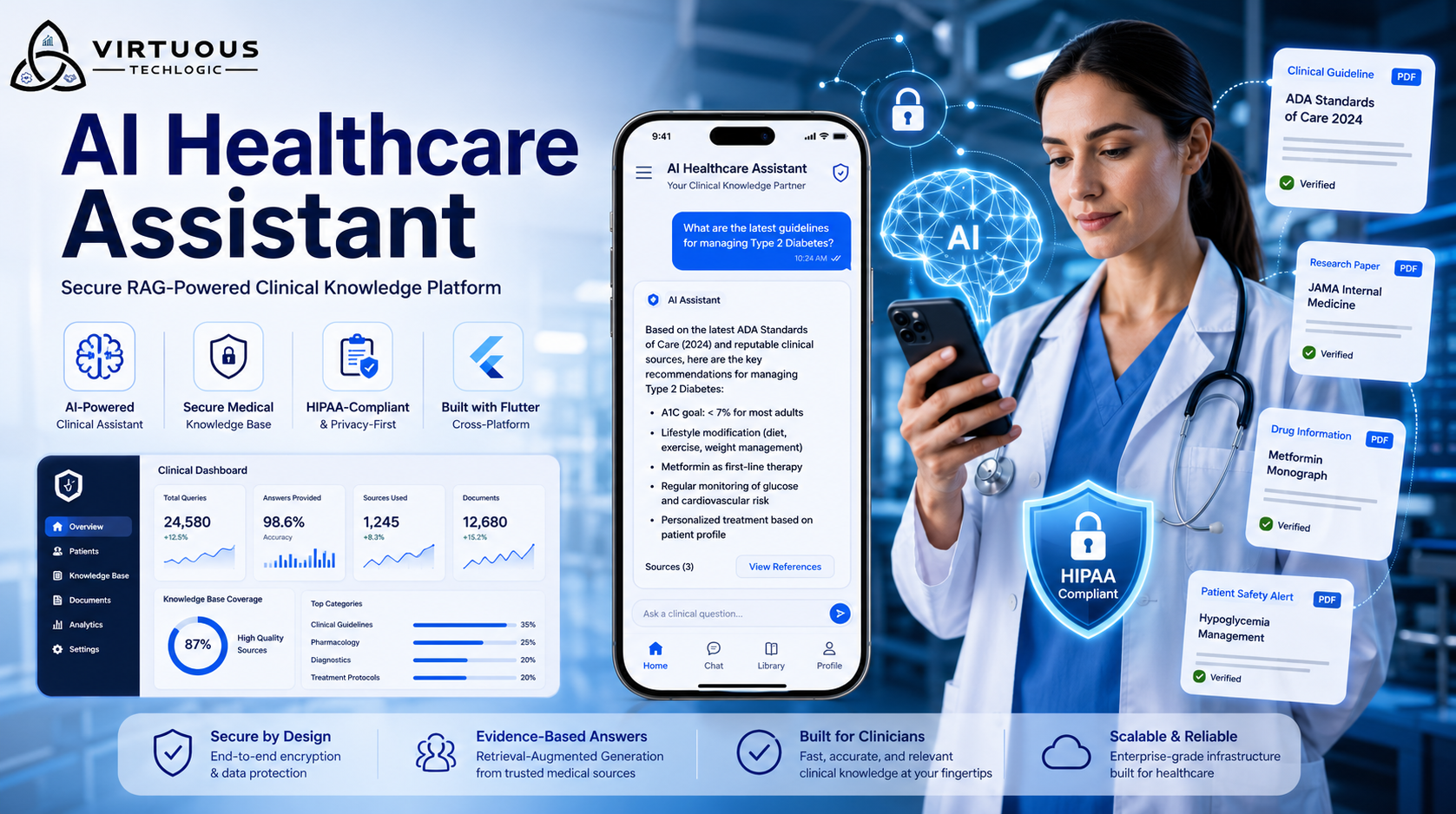
A healthcare organization required an intelligent digital assistant that could help healthcare professionals quickly access trusted clinical knowledge through natural language conversations.
The objective was to improve knowledge accessibility while ensuring responses were grounded in approved medical content rather than relying solely on a language model's general knowledge.
Virtuous Techlogic developed a secure AI Healthcare Assistant using Flutter, Retrieval-Augmented Generation (RAG), Large Language Models (LLMs), and vector search technology to provide context-aware answers based on authorized healthcare documentation.
Business Challenge
Healthcare organizations manage large volumes of clinical guidelines, protocols, medical literature, and internal documentation that can be difficult to access quickly during day-to-day operations.The client needed a solution capable of:
- Fast clinical knowledge retrieval
- Natural language interaction
- Secure access to approved medical content
- Intelligent document search
- Role-based user access
- Scalable AI architecture
- Mobile accessibility
- Future integration with healthcare systems
- Privacy-conscious design
- Long-term maintainability
The platform also needed to reduce manual document searches while ensuring that AI-generated responses remained grounded in trusted organizational knowledge.
Our Solution
Virtuous Techlogic developed a secure Flutter-based healthcare application powered by a Retrieval-Augmented Generation (RAG) architecture.The platform combines semantic search, vector embeddings, document retrieval, and Large Language Models (LLMs) to generate context-aware responses based on approved healthcare resources.Rather than replacing existing healthcare workflows, the AI assistant complements them by providing faster access to relevant information while supporting future integrations with Electronic Health Records (EHR), clinical systems, and healthcare APIs.
Core Features
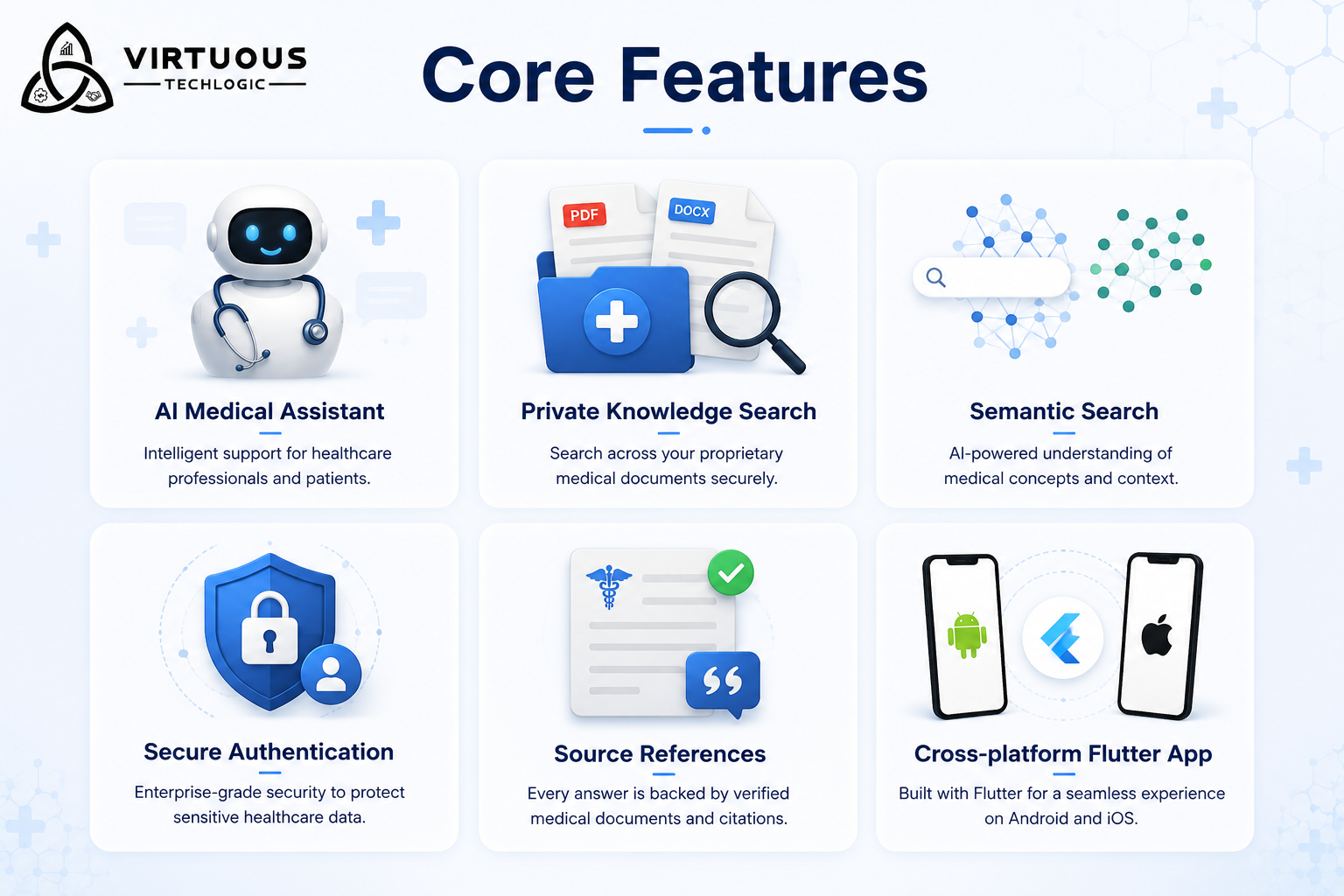
AI Clinical Assistant
- Natural Language Conversations
- Context-Aware Responses
- Clinical Knowledge Search
- Follow-Up Questions
- Multi-Turn Conversations
RAG-Powered Search
- Semantic Search
- Vector-Based Retrieval
- Intelligent Document Ranking
- Source-Aware Responses
- Knowledge Context Injection
Knowledge Management
- Clinical Document Library
- Medical Guidelines
- Internal SOP Access
- Knowledge Base Updates
- Metadata Management
User Features
- Secure Authentication
- Personalized Dashboard
- Search History
- Saved Conversations
- Role-Based Permissions
Administrative Features
- Knowledge Base Management
- User Administration
- AI Configuration
- Analytics Dashboard
- Usage Monitoring
Technology Stack
Frontend
- Flutter
AI Layer
- Large Language Models (LLMs)
- Retrieval-Augmented Generation (RAG)
Backend
- Python
- REST APIs
- Cloud Functions
Vector Database
- Vector Embedding Storage
Database
- Firebase / Cloud Database
Authentication
- Firebase Authentication
Cloud Infrastructure
- Secure Cloud Deployment
Solution Architecture
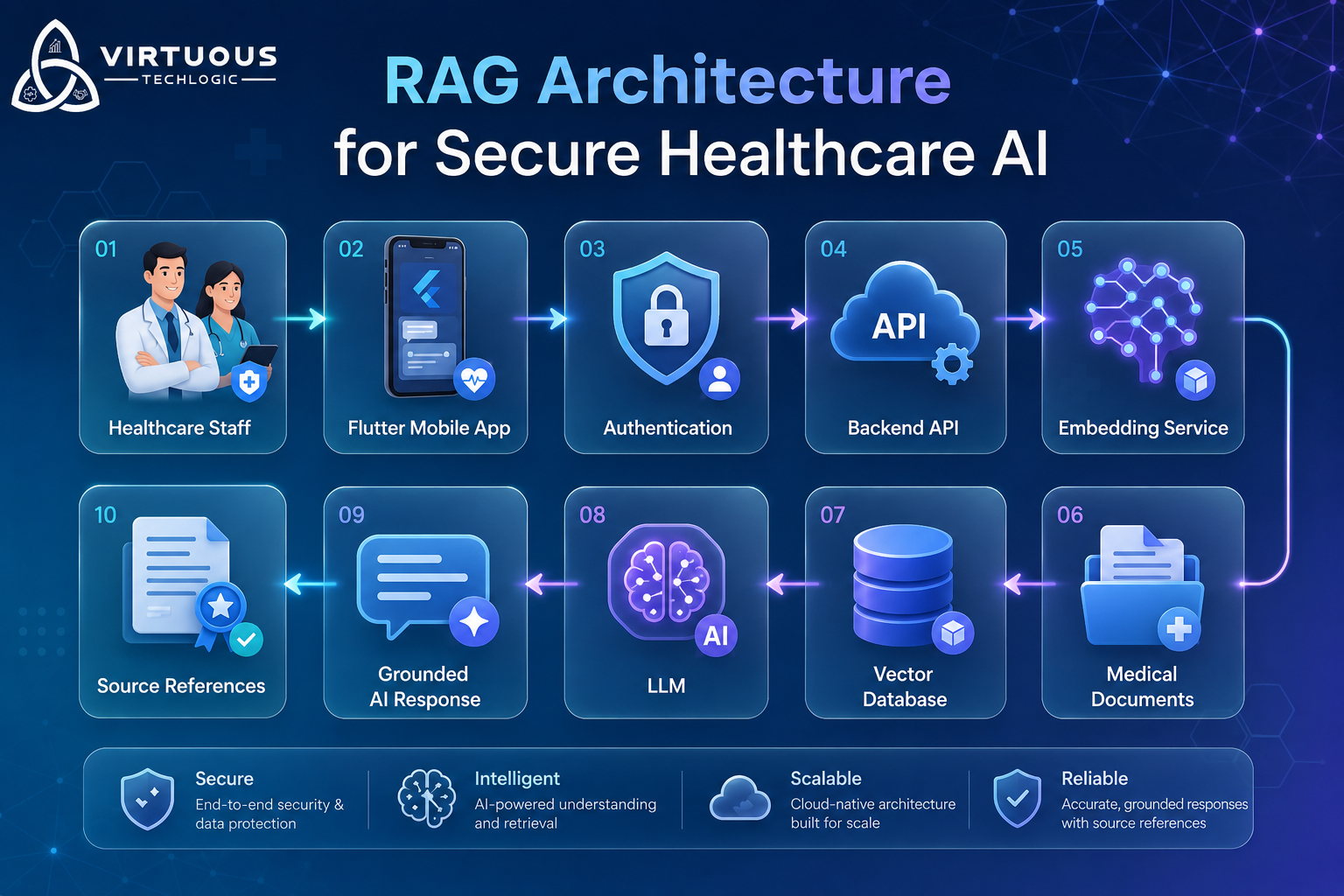
The AI Healthcare Assistant follows a modular architecture designed for secure clinical knowledge retrieval.Core components include:
- Flutter Mobile Application
- Authentication Layer
- AI Orchestration Service
- Retrieval-Augmented Generation (RAG) Engine
- Vector Database
- Clinical Knowledge Repository
- Document Processing Pipeline
- API Gateway
- Administrative Dashboard
- Monitoring & Logging
This architecture enables efficient document indexing, secure semantic search, and scalable AI-powered healthcare knowledge access.
AI Workflow
The platform processes healthcare queries through the following workflow:
- A healthcare professional submits a natural language question.
- The system converts the query into vector embeddings.
- The vector database retrieves the most relevant approved clinical documents.
- Retrieved context is passed to the Large Language Model (LLM).
- The AI generates a context-aware response based on retrieved information.
- The user receives an answer that can include references to supporting source material where applicable.
Using Retrieval-Augmented Generation (RAG) helps improve answer relevance by grounding AI responses in authorized healthcare knowledge rather than relying solely on the model's pre-trained information.
Security & Privacy
Security and patient privacy considerations were integrated throughout the solution architecture.Implementation areas included:
- Secure Authentication
- HTTPS/TLS Encryption
- Role-Based Access Control (RBAC)
- Protected API Communication
- Secure Knowledge Repository
- User Session Management
- Administrative Access Controls
- Audit Logging Support
- Secure Cloud Infrastructure
- Data Encryption in Transit
Compliance Considerations
The healthcare AI assistant was developed using security and privacy best practices commonly adopted for healthcare software.Development considered:
- Secure authentication workflows
- Role-based authorization
- Privacy-aware information access
- Encrypted communications
- Secure cloud infrastructure
- Audit-friendly architecture
- Data minimization principles
- Responsible AI implementation
Compliance Note: Compliance with HIPAA, GDPR, NHS DSP Toolkit, PIPEDA, or other healthcare regulations depends on deployment architecture, hosting environment, operational policies, business associate agreements (BAAs), legal requirements, and client-specific implementation. Compliance certification was outside the scope of this project.
Clinical Disclaimer: The AI assistant is designed to support knowledge retrieval from approved information sources. It is not intended to replace professional clinical judgment, diagnosis, or medical decision-making.
Healthcare Integrations
The solution architecture can support integration with:
- Electronic Health Record (EHR) Systems
- Electronic Medical Record (EMR) Platforms
- Clinical Knowledge Repositories
- Hospital Information Systems
- Laboratory Systems
- Healthcare APIs
- Telemedicine Platforms
- Identity Providers
- Secure Cloud Storage
- AI Evaluation Frameworks
Quality Assurance
The AI healthcare platform underwent structured validation, including:
- Functional Testing
- AI Response Validation
- RAG Retrieval Testing
- Authentication Testing
- API Integration Testing
- Performance Testing
- Security Validation
- Regression Testing
- User Acceptance Testing
- Knowledge Accuracy Verification
Technical Challenges Solved
The project addressed several AI healthcare challenges, including:
- Clinical document indexing
- Semantic medical search
- Context-aware answer generation
- Reducing AI hallucinations using RAG
- Secure healthcare authentication
- Managing role-based knowledge access
- Optimizing vector search performance
- Scalable AI orchestration
- Healthcare-ready architecture
- Future integration readiness
Why RAG for Healthcare?
Healthcare applications require responses grounded in trusted information.Retrieval-Augmented Generation (RAG) enables the assistant to retrieve relevant organizational content before generating a response, improving transparency and reducing unsupported outputs.Benefits include:
- Context-aware responses
- Improved information relevance
- Reduced hallucinations
- Secure enterprise knowledge access
- Up-to-date document retrieval
- Scalable knowledge management
- Explainable AI responses
- Flexible integration with evolving healthcare content
Business Value Delivered
The delivered AI Healthcare Assistant provides healthcare organizations with a secure platform for intelligent knowledge access.The solution enables:
- Faster clinical information retrieval
- Improved knowledge accessibility
- Reduced manual document searches
- Mobile-first healthcare experience
- Secure AI-powered assistance
- Scalable cloud architecture
- Future AI expansion
- Centralized knowledge management
Business performance metrics remain client-specific and are not publicly disclosed.
Ideal Use Cases
This AI healthcare solution is suitable for:
- Hospitals
- Multi-Specialty Clinics
- Telemedicine Providers
- Healthcare Networks
- Medical Research Organizations
- Pharmaceutical Companies
- Clinical Education Platforms
- Healthcare Startups
- Nursing Organizations
- Internal Clinical Knowledge Systems
Frequently Asked Questions
What is an AI Healthcare Assistant?
An AI Healthcare Assistant is a software application that uses artificial intelligence to help healthcare professionals access approved clinical information, answer questions, and improve knowledge discovery.
What is Retrieval-Augmented Generation (RAG)?
RAG combines semantic search with Large Language Models (LLMs) to generate responses based on trusted organizational knowledge, improving accuracy and reducing unsupported AI outputs.
Does the AI replace healthcare professionals?
No. The assistant is designed to support information retrieval and knowledge access. Clinical decisions should always be made by qualified healthcare professionals.
Can the platform integrate with existing healthcare systems?
Yes. The architecture can support integrations with EHR, EMR, telemedicine platforms, healthcare APIs, and internal knowledge repositories based on project requirements.
How is healthcare information protected?
The platform incorporates secure authentication, encrypted communications, role-based access controls, and privacy-focused development practices. Regulatory compliance depends on the deployment environment and organizational governance.
Can additional AI capabilities be added later?
Yes. Future enhancements may include AI agents, multilingual support, medical document summarization, workflow automation, voice interfaces, and predictive analytics.
Related Services
- AI Healthcare Solutions
- AI App Development
- RAG Development
- AI Agent Development
- Healthcare App Development
- Flutter App Development
- Enterprise AI Solutions
- API Integration Services
- Custom Software Development
Call to Action
Build a Secure AI Healthcare Assistant with Virtuous Techlogic
Whether you're developing a clinical knowledge platform, an AI-powered healthcare assistant, or an intelligent medical information system, Virtuous Techlogic can help you build a secure, scalable solution using Flutter, Retrieval-Augmented Generation (RAG), and modern AI technologies.Book a free consultation with Virtuous Techlogic to discuss your AI healthcare application.