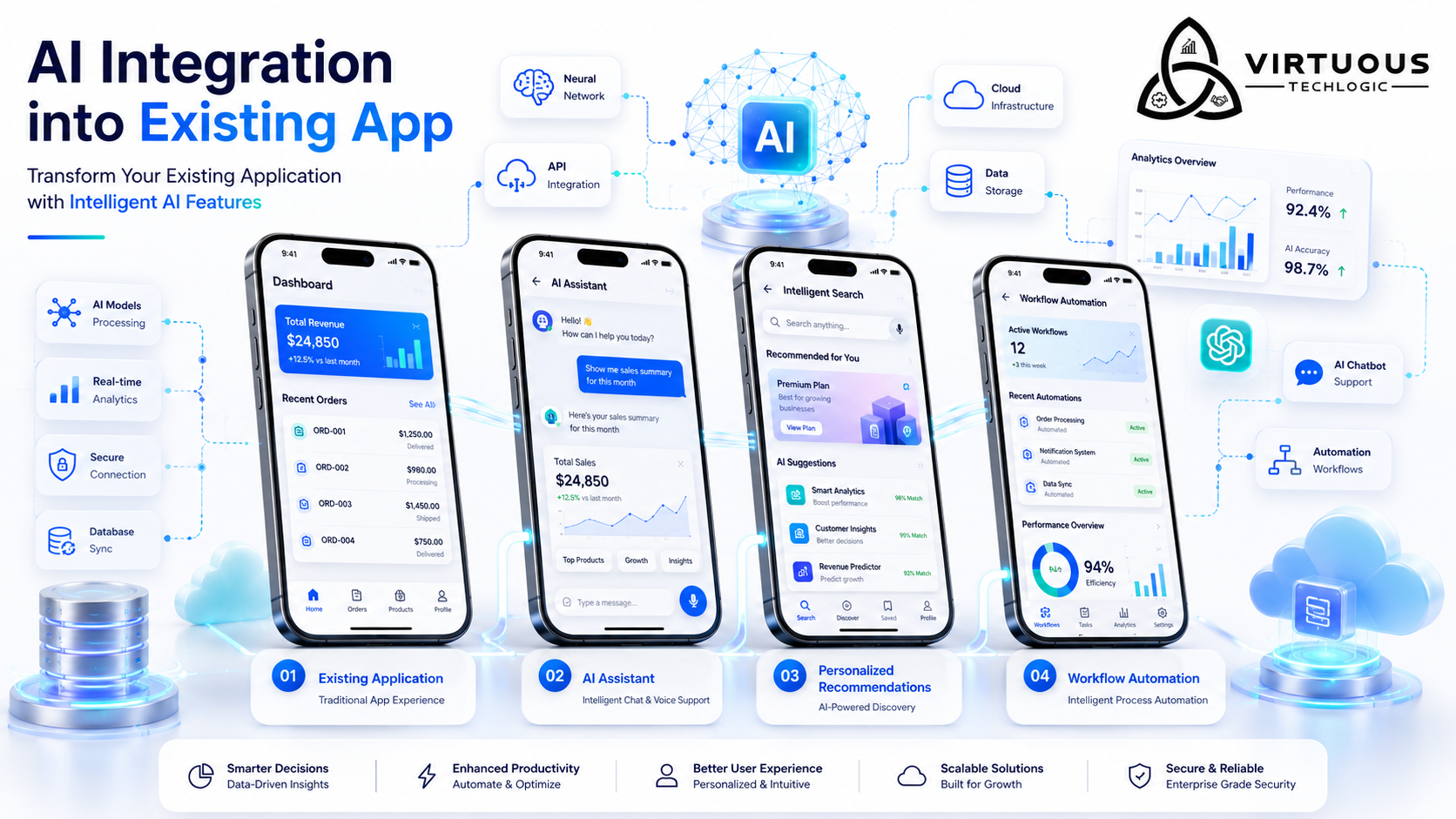
An organization wanted to enhance its existing application with modern AI capabilities without replacing its existing technology stack or disrupting daily operations.
The objective was to introduce intelligent features such as conversational AI, semantic search, workflow automation, and AI-assisted decision support while preserving existing business workflows and ensuring a seamless user experience.
Virtuous Techlogic integrated AI into the client's application using a modular architecture, enabling the platform to evolve into a smarter, more efficient solution while remaining scalable for future innovation.
Business Challenge
The existing application was performing its core functions effectively but lacked modern AI capabilities that could improve productivity, automation, and user engagement.The client required a solution that could:
- Add AI without rebuilding the application
- Preserve existing business workflows
- Integrate with current APIs and databases
- Enable conversational AI
- Support intelligent search
- Automate repetitive tasks
- Improve operational efficiency
- Scale with future AI capabilities
- Minimize implementation risk
- Reduce disruption for existing users
The integration also needed to fit within the client's current infrastructure and support future enhancements.
Our Solution
Virtuous Techlogic designed and implemented a modular AI integration layer that seamlessly connected with the existing application.The solution introduced AI-powered capabilities while preserving the application's existing architecture and user experience.Using Large Language Models (LLMs), Retrieval-Augmented Generation (RAG), vector search, and secure API integrations, the platform gained intelligent features without requiring a complete redevelopment.
Core Features
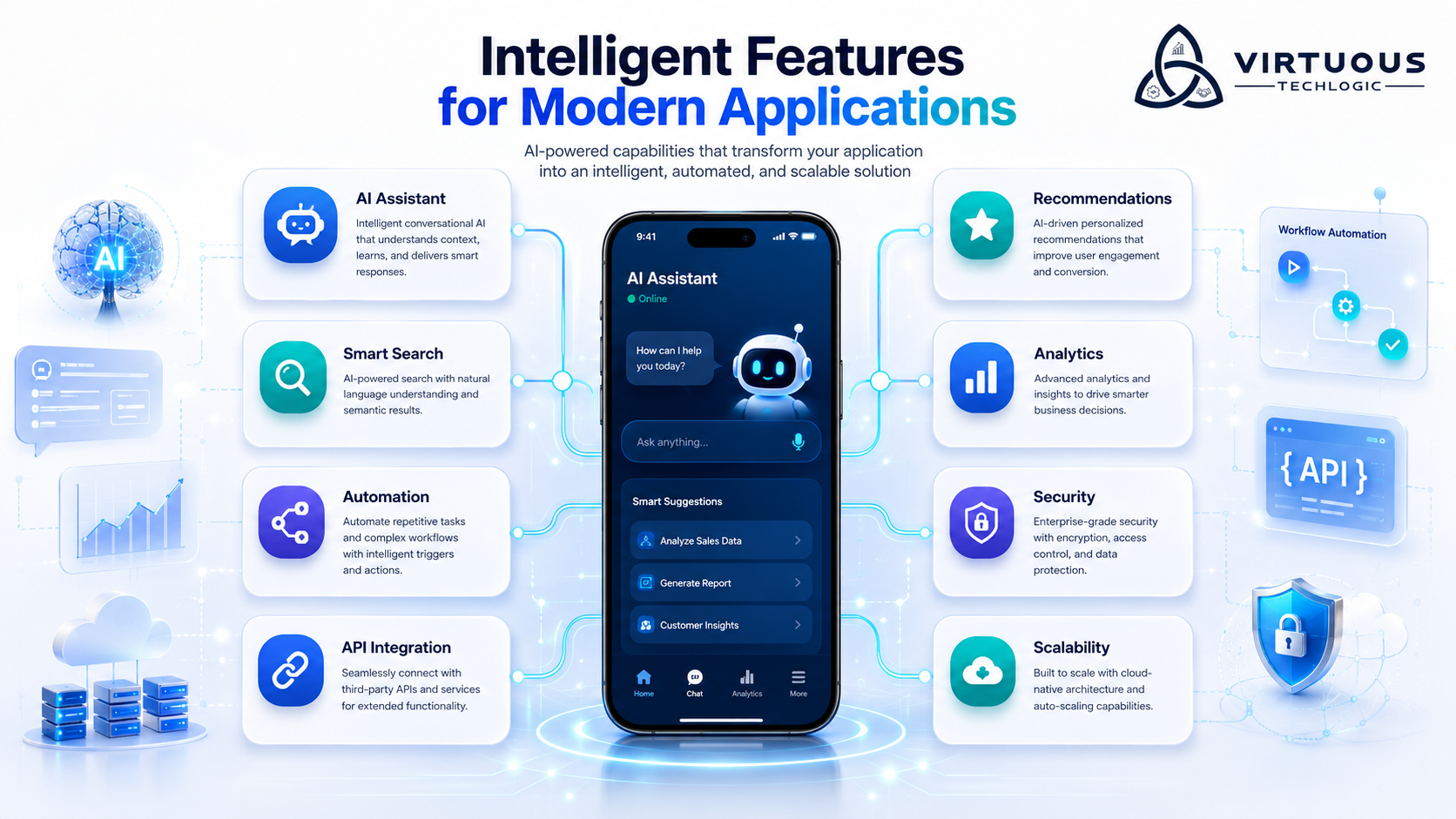
AI Assistant
- Conversational AI
- Natural Language Queries
- Context-Aware Responses
- Multi-Turn Conversations
- AI-Powered Recommendations
Intelligent Search
- Semantic Search
- Document Search
- Knowledge Retrieval
- Smart Filtering
- Context-Based Results
AI Automation
- Workflow Automation
- Content Generation Assistance
- Intelligent Suggestions
- Data Classification
- Process Optimization
Existing System Integration
- API Integration
- Database Connectivity
- Authentication Integration
- User Role Synchronization
- Event-Based AI Triggers
Administrative Features
- AI Configuration
- Usage Monitoring
- Prompt Management
- Analytics Dashboard
- User Access Management
Technology Stack
Frontend
- Flutter
AI Layer
- Large Language Models (LLMs)
- Retrieval-Augmented Generation (RAG)
Backend
- Python
- REST APIs
- Cloud Functions
Vector Database
- Vector Embedding Storage
Database
- Firebase / Cloud Database
Authentication
- Firebase Authentication / Existing Identity Provider
Cloud Infrastructure
- Cloud-Based Deployment
Solution Architecture
The AI integration was implemented using a modular architecture to minimize disruption and simplify future enhancements.The solution includes:
- Existing Application
- AI Integration Layer
- LLM Service
- RAG Engine
- Vector Database
- API Gateway
- Business Logic Services
- Existing Database
- Authentication Service
- Administrative Dashboard
- Monitoring & Logging
This architecture enables AI capabilities to be introduced incrementally without replacing the existing platform.
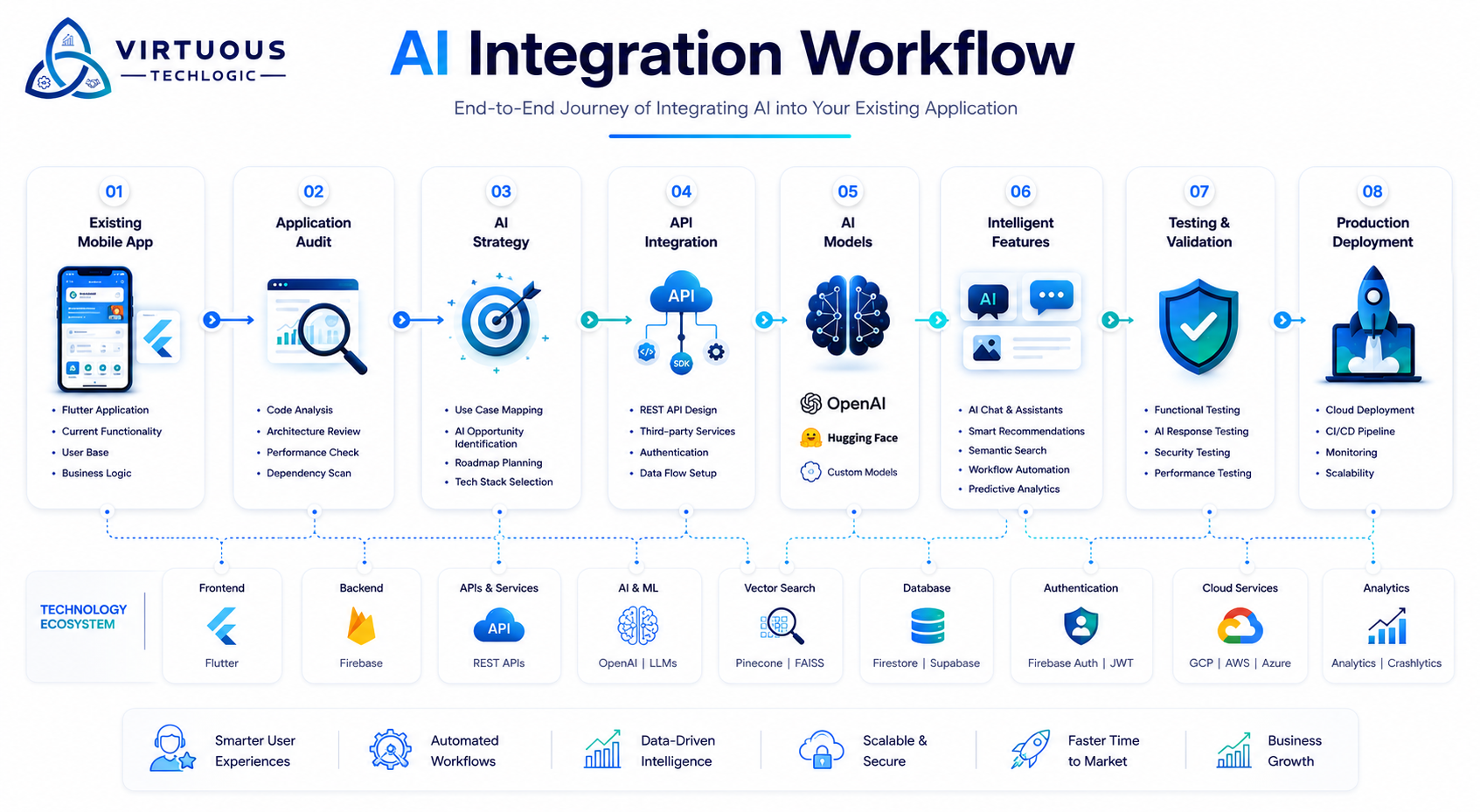
AI Integration Workflow
The AI integration process followed a structured workflow:
- Assessment of the existing application architecture.
- Identification of AI use cases and business priorities.
- Integration of AI orchestration services and APIs.
- Implementation of Retrieval-Augmented Generation (RAG) for knowledge-based responses where applicable.
- Connection to existing authentication and data sources.
- Testing, optimization, and deployment with minimal disruption to ongoing operations.
This approach enabled the client to modernize the application while preserving core business functionality.
Security & Privacy
Security was integrated throughout the AI implementation to protect user data and business information.Key implementation areas included:
- Secure Authentication
- Role-Based Access Control (RBAC)
- HTTPS/TLS Encryption
- Protected AI API Communication
- Secure Prompt Handling
- Controlled Knowledge Access
- Session Management
- Audit Logging Support
- Secure Cloud Infrastructure
- Administrative Access Controls
Compliance Considerations
The AI integration followed security and privacy best practices suitable for enterprise software.Development considered:
- Secure authentication workflows
- Role-based authorization
- Encrypted communication
- Privacy-aware AI interactions
- Secure API integrations
- Audit-friendly architecture
- Data minimization principles
- Responsible AI implementation patterns
Compliance Note: Compliance with GDPR, HIPAA, SOC 2, ISO 27001, PCI DSS, or industry-specific regulations depends on production infrastructure, governance policies, hosting configuration, legal agreements, and client-specific implementation. Compliance certification was outside the scope of this AI integration project.
Quality Assurance
The integrated solution underwent comprehensive validation, including:
- Functional Testing
- AI Response Validation
- API Integration Testing
- Authentication Testing
- Performance Testing
- Regression Testing
- Security Validation
- Compatibility Testing
- User Acceptance Support
- AI Workflow Testing
Technical Challenges Solved
The project addressed several AI integration challenges, including:
- Integrating AI without rebuilding the application
- Maintaining existing user workflows
- Reducing AI response latency
- Secure API orchestration
- Context-aware AI responses
- Enterprise authentication integration
- Scaling AI services
- Optimizing vector search performance
- Supporting modular future enhancements
- Minimizing operational disruption
Why Integrate AI into an Existing App?
Rather than replacing a working application, AI integration enables businesses to extend product capabilities while preserving previous investments.Benefits include:
- Faster modernization
- Lower redevelopment costs
- Minimal operational disruption
- Improved user productivity
- Enhanced customer experiences
- Smarter business workflows
- Future-ready architecture
- Incremental innovation
Business Value Delivered
The AI-enhanced application provides organizations with intelligent capabilities while preserving existing business operations and technology investments.The solution enables:
- AI-powered user experiences
- Improved information discovery
- Workflow automation
- Intelligent decision support
- Scalable AI architecture
- Reduced manual effort
- Future AI feature expansion
- Long-term platform modernization
Business performance metrics remain client-specific and are not publicly disclosed.
Ideal Use Cases
This AI integration approach is suitable for:
- SaaS Platforms
- Enterprise Applications
- CRM Systems
- ERP Platforms
- Healthcare Applications
- E-commerce Platforms
- Customer Support Portals
- HR Management Systems
- Internal Business Tools
- Manufacturing Software
Frequently Asked Questions
Can AI be integrated into an existing application without rebuilding it?
Yes. AI capabilities can often be added through modular services and APIs, allowing businesses to enhance existing applications while preserving core functionality.
What AI features can be integrated?
Depending on the application, AI features may include conversational assistants, intelligent search, workflow automation, document analysis, recommendations, summarization, and predictive insights.
What is Retrieval-Augmented Generation (RAG)?
RAG combines semantic search with Large Language Models (LLMs) to generate responses based on trusted business data, improving accuracy and reducing unsupported outputs.
Will AI integration affect existing users?
A well-planned integration minimizes disruption by introducing AI features alongside existing workflows rather than replacing them.
Can the AI solution connect with our existing systems?
Yes. The architecture is designed to integrate with existing APIs, databases, authentication providers, CRM systems, ERP platforms, and third-party services based on project requirements.
How is data protected during AI integration?
The solution incorporates secure authentication, encrypted communication, role-based access controls, and privacy-focused AI implementation practices. Compliance with specific regulations depends on the deployment environment and governance policies.
Related Services
- AI App Development
- AI Integration Services
- AI Agent Development
- Retrieval-Augmented Generation (RAG) Development
- Enterprise AI Solutions
- Legacy Application Modernization
- Flutter App Development
- Custom Software Development
- API Integration Services
Call to Action
Add AI to Your Existing Application Without Starting from Scratch
Whether you're looking to introduce AI chat, intelligent search, workflow automation, document analysis, or enterprise AI features into your existing mobile or web application, Virtuous Techlogic can help you integrate modern AI capabilities with minimal disruption and a scalable architecture.Book a free consultation with Virtuous Techlogic to explore AI integration opportunities for your existing application.