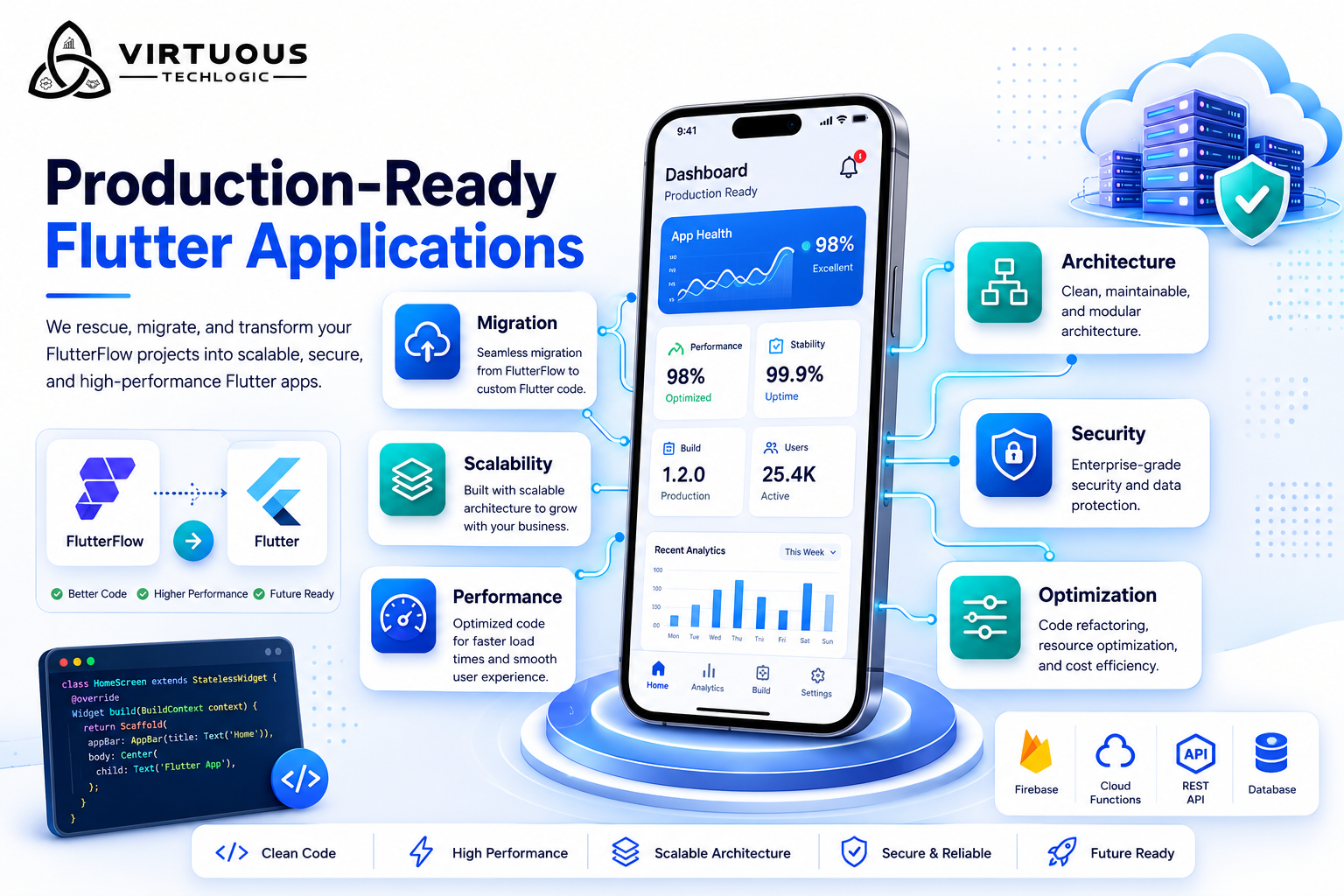
A startup had successfully built an initial MVP using FlutterFlow but encountered limitations as the product evolved. Growing feature requirements, performance concerns, and increasing technical complexity made it difficult to continue scaling the application efficiently.
The client partnered with Virtuous Techlogic to stabilize the existing solution, improve performance, implement advanced functionality, and establish a scalable foundation for future product development.
Rather than replacing the product, our team modernized the existing application while preserving valuable business logic and reducing redevelopment effort.
Business Challenge
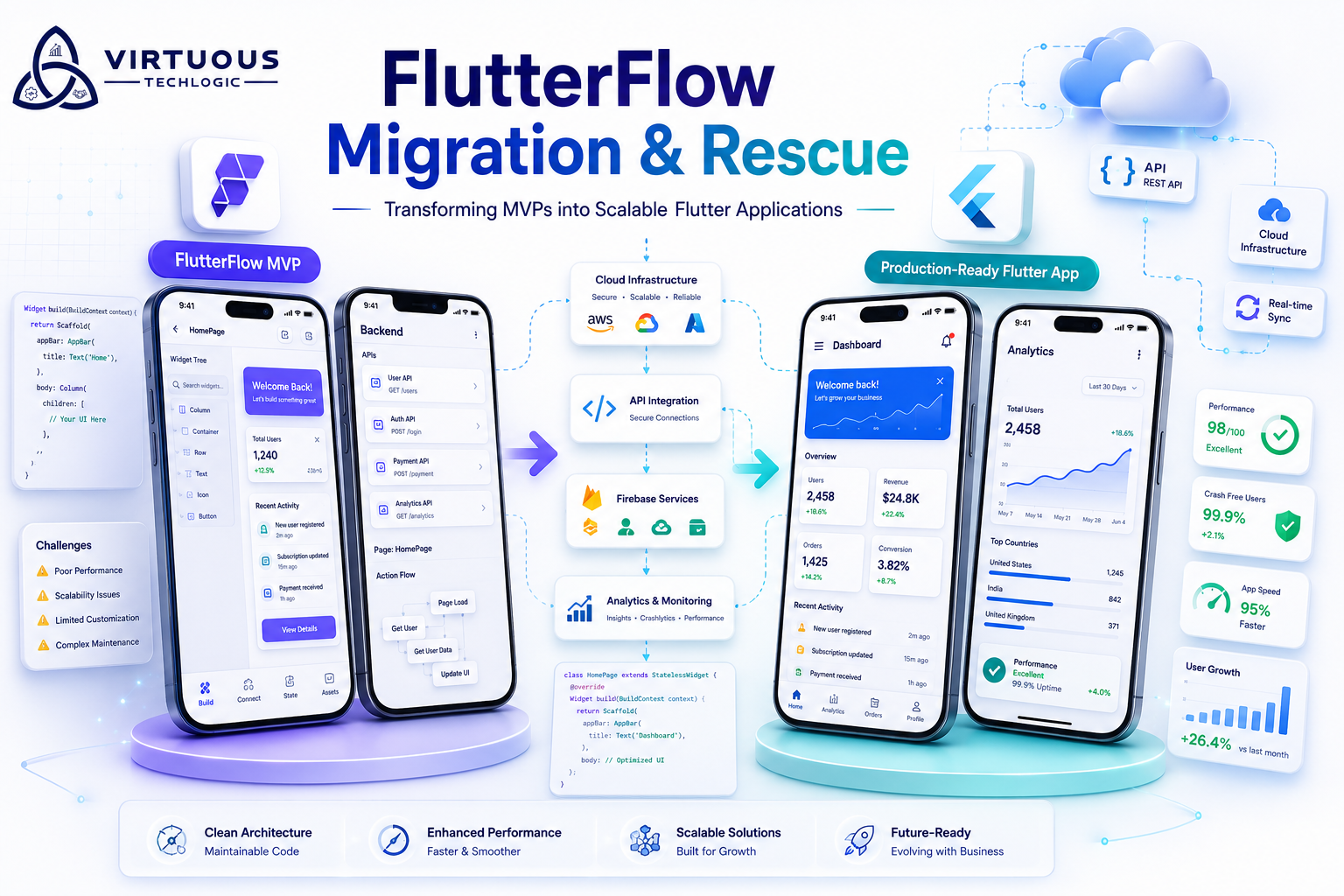
The existing FlutterFlow application faced several challenges common to rapidly growing MVPs:
- Performance bottlenecks
- Increasing technical complexity
- Custom feature limitations
- API integration challenges
- Maintainability concerns
- Code organization improvements
- Scalability planning
- Third-party integration requirements
- UI consistency enhancements
- Future product roadmap support
The client required a solution that balanced rapid delivery with long-term maintainability while minimizing disruption for existing users.
Our Solution
Virtuous Techlogic assessed the existing FlutterFlow project, identified architectural bottlenecks, and implemented a structured migration and optimization strategy.Depending on project requirements, this included enhancing FlutterFlow with custom code where appropriate and migrating critical modules to Flutter for greater flexibility and performance.The result was a production-ready architecture capable of supporting advanced business logic, scalable integrations, and future feature expansion.
Core Features
FlutterFlow Optimization
- Existing Project Assessment
- UI/UX Refinements
- Performance Improvements
- Custom Actions
- Custom Widgets
Flutter Migration
- Modular Flutter Architecture
- Business Logic Refactoring
- Reusable Components
- Improved State Management
- Clean Code Structure
Backend Integration
- Firebase Integration
- REST API Integration
- Authentication
- Cloud Storage
- Push Notifications
Product Enhancements
- Advanced User Workflows
- Improved Navigation
- Better Error Handling
- Enhanced User Experience
- Feature Expansion Support
Administrative Features
- User Management
- Content Management
- Analytics Dashboard
- Configuration Controls
- Monitoring & Logging
Technology Stack
Frontend
- FlutterFlow
- Flutter
- Dart
Backend
- Firebase
- Cloud Functions
- REST APIs
Database
- Cloud Firestore
Authentication
- Firebase Authentication
Notifications
- Firebase Cloud Messaging
Dev Tools
- GitHub
- CI/CD Pipelines
- Firebase Console
Solution Architecture
The migration strategy followed a modular architecture to preserve existing functionality while improving maintainability.Key components included:
- FlutterFlow Frontend
- Flutter Modules
- Authentication Layer
- API Gateway
- Firebase Services
- Cloud Database
- Notification Service
- Administrative Dashboard
- Analytics & Monitoring
This hybrid architecture enabled gradual modernization while reducing migration risk and supporting future scalability.
Migration Strategy
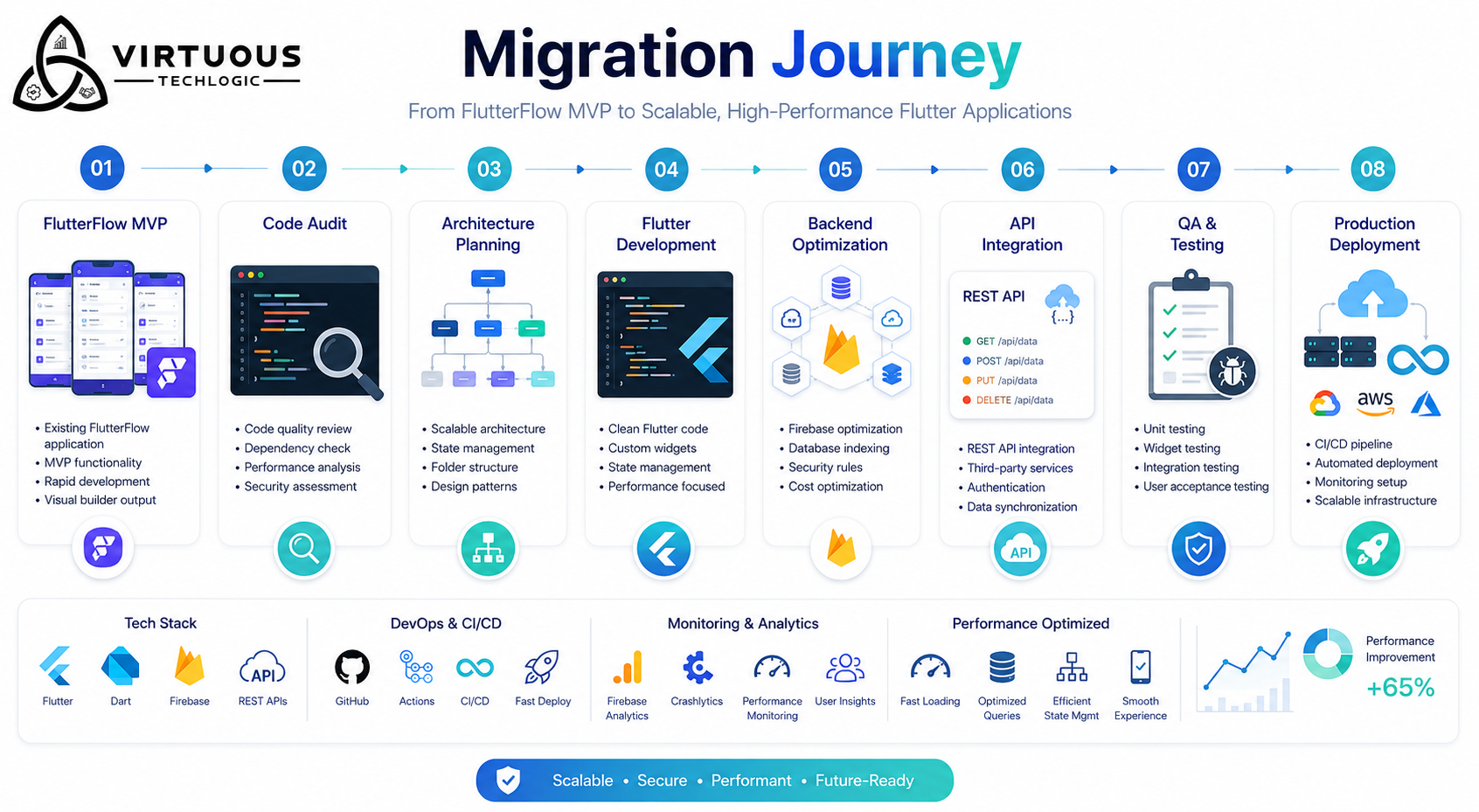
The application modernization followed a phased approach:
- Technical assessment of the existing FlutterFlow project.
- Identification of performance bottlenecks and architectural constraints.
- Prioritization of modules requiring custom Flutter development.
- Enhancement of FlutterFlow with custom actions and widgets where appropriate.
- Migration of complex business logic to Flutter.
- Integration testing, optimization, and production readiness.
This approach reduced redevelopment effort while creating a more flexible, maintainable product.
Security & Privacy
Security was incorporated throughout the modernization process.Key implementation areas included:
- Secure Authentication
- HTTPS/TLS Encryption
- Role-Based Access Control (RBAC)
- Protected API Communication
- Secure Firebase Configuration
- Session Management
- Administrative Access Controls
- Activity Logging
- Secure Cloud Storage
- Environment Configuration Management
Compliance Considerations
The application modernization followed secure software engineering and privacy best practices suitable for production applications.Development considered:
- Secure authentication workflows
- Role-based authorization
- Encrypted communications
- Secure API integrations
- Privacy-focused user management
- Audit-friendly architecture
- Data minimization principles
- Cloud security practices
Compliance Note: Compliance with GDPR, HIPAA, SOC 2, ISO 27001, or industry-specific regulations depends on the production environment, infrastructure, hosting configuration, legal agreements, and client-specific implementation. Compliance certification was outside the scope of this migration project.
Quality Assurance
The migrated application underwent comprehensive validation, including:
- Functional Testing
- UI/UX Testing
- Cross-Platform Testing
- API Integration Testing
- Performance Optimization
- Regression Testing
- Device Compatibility Testing
- Security Validation
- User Acceptance Support
- Release Readiness Testing
Technical Challenges Solved
The project addressed several FlutterFlow migration challenges, including:
- Scaling beyond no-code limitations
- Migrating complex business logic
- Improving application performance
- Optimizing Firebase integration
- Enhancing API connectivity
- Refactoring reusable components
- Supporting advanced user workflows
- Reducing technical debt
- Preparing for future feature development
- Improving maintainability
Why FlutterFlow + Flutter?
FlutterFlow is an excellent choice for rapidly validating ideas and launching MVPs. As products evolve, combining FlutterFlow with Flutter—or selectively migrating features to Flutter—provides greater flexibility for advanced functionality, custom integrations, and long-term scalability.Benefits include:
- Faster MVP development
- Smooth transition to production-ready architecture
- Support for custom business logic
- Better performance optimization
- Flexible integrations
- Cleaner code organization
- Reduced long-term maintenance effort
- Scalable application foundation
Business Value Delivered
The migration provided the client with a stronger technical foundation while preserving prior development investment.The modernized solution enables:
- Improved application performance
- Enhanced maintainability
- Flexible feature expansion
- Better scalability
- Production-ready architecture
- Cross-platform consistency
- Reduced technical debt
- Future integration readiness
Business performance metrics remain client-specific and are not publicly disclosed.
Ideal Use Cases
This migration and rescue approach is suitable for:
- FlutterFlow MVPs
- Startup Applications
- SaaS Platforms
- Marketplace Applications
- Healthcare Apps
- E-commerce Platforms
- Internal Business Tools
- Fintech Applications
- Education Platforms
- Social Networking Apps
Frequently Asked Questions
When should I migrate from FlutterFlow to Flutter?
Migration is worth considering when your application requires advanced business logic, complex integrations, custom UI components, higher performance, or long-term scalability beyond the capabilities of visual development alone.
Do I need to rebuild my FlutterFlow app from scratch?
Not necessarily. Many projects can retain valuable FlutterFlow assets while selectively enhancing or migrating specific modules to Flutter, reducing redevelopment time and cost.
Can you rescue an existing FlutterFlow project?
Yes. We can review an existing FlutterFlow application, identify bottlenecks, optimize the architecture, implement custom code, improve integrations, and prepare the application for production growth.
Can existing Firebase data be preserved?
Yes. Migration strategies can typically preserve Firebase Authentication, Firestore data, Storage, and backend services while improving the application's architecture.
Can new AI features be added after migration?
Yes. The modernized architecture supports future integration of AI assistants, intelligent search, workflow automation, recommendation systems, and other AI-powered capabilities.
How is security maintained during migration?
The project follows secure development practices, including encrypted communication, secure authentication, role-based access controls, protected APIs, and cloud security best practices. Regulatory compliance depends on the production deployment and organizational governance.
Related Services
- FlutterFlow Development
- Flutter App Development
- FlutterFlow to Flutter Migration
- MVP Development
- Mobile App Development
- Firebase Development
- API Integration Services
- AI App Development
- Custom Software Development
Call to Action
Scale Beyond FlutterFlow with Virtuous Techlogic
Whether you've outgrown your FlutterFlow MVP, need advanced custom functionality, or want to prepare your application for long-term growth, Virtuous Techlogic can help you optimize, migrate, and scale your product with a future-ready Flutter architecture.Book a free consultation with Virtuous Techlogic to discuss your FlutterFlow migration or application rescue project.