
AI Fitness App Development Company
An AI fitness app is a product that uses models for recommendations, search, summaries, or coaching assistance on top of workouts, profiles, and approved content. It is not a medical device and should not diagnose or treat. We build the mobile, web, backend, and AI services together when the product needs those surfaces.
Who this is for
You want a serious AI fitness or wellness product—not a chatbot wrapper—and you need a team that can ship mobile, subscriptions, and optional wearable data with clear non-clinical limits.
Common situations
- Generic AI demos are disconnected from workouts, roles, and subscriptions
- Fear of unsafe health claims or app-store rejection
- Need both member app and trainer/admin surfaces
- Unclear whether to generate plans or retrieve from an approved library
- Wearable data exists but has no product workflow
What we deliver
- Product architecture for member, trainer, and admin roles as scoped
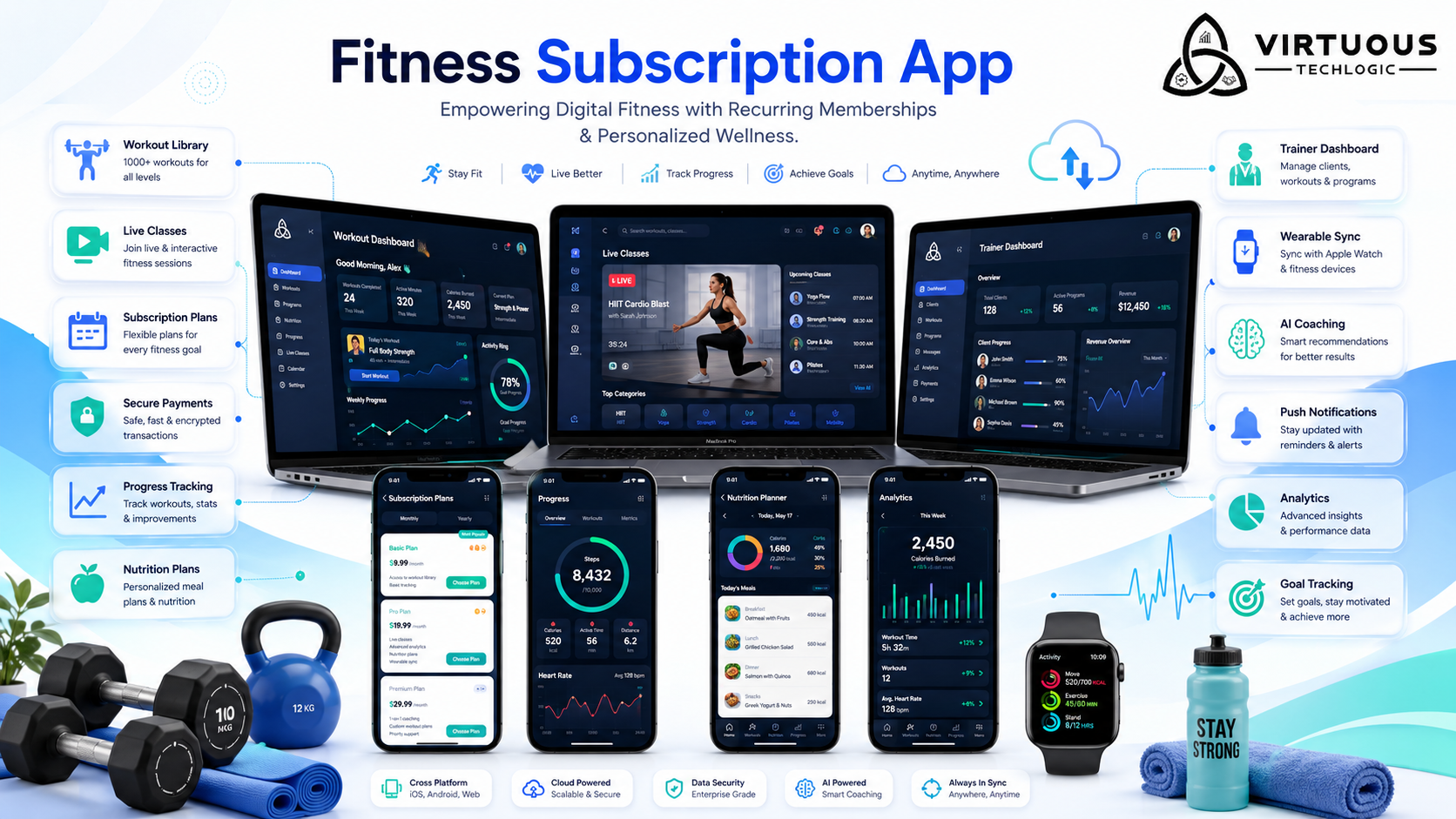
- Mobile and/or web client with authentication and subscriptions
- Backend AI proxy, retrieval over approved content, and evaluation set
- Optional wearable integration scoped per API
- Safety policy: refusals, disclaimers, and optional trainer review
- Source-code handover as defined in the engagement
Use cases
- Personalized workout discovery and adaptive plans from your library
- AI coaching assistance (form cues, scheduling, motivation—non-medical)
- Nutrition-content assistance with source boundaries
- Semantic search across workouts, recipes, and media
- Progress intelligence from sessions and permitted wearable metrics
- Trainer copilots and support automation
Independent client proof on Clutch
Review verified Clutch feedback before you inquire. An Upwork agency profile is also available for additional history.
Also on Upwork.
Good fit
- Funded or revenue-backed fitness/wellness teams, or founders building a serious MVP
- Willingness to keep AI inside coaching/wellness policy
- Need for mobile plus backend, not a single prompt demo
When this is not the right fit
- Medical diagnosis, treatment, or guaranteed body-composition outcomes
- Very cheap trainer white-label apps with no product scope
- Existing live app that only needs AI bolted on—see AI integration for existing fitness apps
How we work
A structured delivery path—not vague promises.
- Step 1
Product and risk scoping
Roles, content ownership, AI surfaces, and what the model must never say.
- Step 2
Architecture
Mobile/web/backend, retrieval, subscriptions, and wearable boundaries.
- Step 3
Build and evaluate
Ship core journeys first; add AI with tests, flags, and cost controls.
- Step 4
Launch path
Store submission, admin handover, and monitoring for quality and spend.
AI architecture
- Backend proxy for model calls—no keys in the client
- RAG or retrieval over approved workouts and content
- User-scoped personalization from profiles and permitted data
- Evaluation and refusal rules for medical and emergency topics
Product architecture
- Flutter or FlutterFlow mobile; Next.js web when needed
- Firebase or Supabase auth, data, and APIs
- Subscriptions and role-based admin
- Wearable adapters scoped per provider
Security & quality
- Consent for AI and health-data features
- PII minimization in prompts and logs
- No medical-grade accuracy claims
- QA on member, trainer, and billing paths
Integrations
- Apple Health / HealthKit, Android Health Connect, Apple Watch, Oura, Fitbit, Garmin, and other vendor SDKs/APIs when scoped
- Payment providers for subscriptions
- Push notifications and analytics
- CMS or content APIs for workouts and nutrition
Cost factors
- Number of roles and client surfaces
- AI surfaces (search, coaching, nutrition, summaries)
- Wearable and subscription complexity
- Evaluation depth and trainer-review workflows
- Store and launch requirements
Timeline factors
- Content corpus readiness
- Legal review of wellness disclaimers
- Wearable API access and device testing
- App-store review cycles
Important decisions
Balanced guidance—not one-size-fits-all answers.
Retrieval vs generative plans
Retrieving from your approved library is usually safer and cheaper than open-ended workout generation. We use generation only with constraints and optional human review.
New product vs adding AI to a live app
This page is for greenfield AI fitness products. If members already exist, use AI integration for existing fitness apps.
Relevant case studies
Proof aligned to this topic—not generic filler.
Related services
Primary capability pages for this topic.
Related pages
- AI Integration for Existing Fitness and Wellness Apps
Add AI coaching assistance, personalized recommendations, semantic search, progress summaries, and support automation to an existing fitness or wellness app—without promising medical outcomes.
- Fitness & Wellness MVP Development
Ship a fitness or wellness MVP with mobile, backend, and admin foundations you can scale—subscriptions, analytics, optional AI and wearables included only when they prove the core loop.
- Personal Training Management & AI-Assisted Coaching Platforms
Custom PT operations platforms: trainer scheduling, session tracking, client management, compensation/commission automation, and revenue attribution—with optional AI-assisted coaching tools. Focused on trainer business operations, not consumer fitness apps.
- Fitness Wearable Integration & Health Data Synchronization Engineering
Custom wearable integration engineering: device SDK integration, health data normalization, sync reliability across platforms, privacy-compliant data pipelines, and real-time or batch data synchronization for fitness applications and operations platforms.
- Gym Member Retention & Lifecycle Automation
Custom member-retention engineering: lifecycle event triggers, churn-risk scoring, re-engagement orchestration, and win-back workflows integrated with the membership platforms you already operate.
Frequently asked questions
Yes for coaching and wellness products: personalization, search, summaries, and assistance with safety boundaries. We do not build diagnostic medical software on this page.
Planning highlights often start around $5,000 for a focused MVP and $10,000+ for custom mobile/web/AI. Complex systems are estimated after evaluation. A quote is issued after scoping—not from these ranges alone.
Yes as scoped features. Nutrition stays content-and-assistance. Wearables use the vendor SDK, API, or connectivity path—HealthKit, Health Connect, Oura, Fitbit, Garmin, and others when documented access exists.
This page is a new product build. Existing user bases belong on the fitness AI integration solution.