
How to Choose a Flutter App Development Company
A strong Flutter app development company shows how it owns architecture, automated tests, App Store/Play release, and source-code handover. Ranked directory lists rarely prove those capabilities. Score vendors on evidence you can verify, then run a short architecture review before a full build.
By Shivam Jotangiya
Publisher: Virtuous Techlogic · Published July 22, 2026
Trusted by clients across Clutch and Upwork
Want proof before starting? View our client reviews and agency profiles on Clutch and Upwork.
Who this is for
You are comparing Flutter agencies (including remote partners for U.S./EU teams) and need structured criteria before signing a statement of work.
Common situations
- Top-10 blogs do not explain architecture or ownership
- Portfolios show UI demos without backend or release process
- Unclear whether the team can take over an existing Flutter repo
- Quotes omit QA, CI/CD, or post-launch maintenance
What we deliver
- Flutter-specific evaluation scorecard
- Interview questions for agencies
- Red flags and when to prefer FlutterFlow vs custom Flutter
- Path to an architecture review CTA
Use cases
- Agency shortlist scoring
- Existing Flutter takeover due diligence
- White-label Flutter vendor selection
Good fit
- You can share a product brief and ask for architecture samples
When this is not the right fit
- Selecting solely from a paid or self-published top-10 list
How we work
A structured delivery path—not vague promises.
- Step 1
Define product constraints
Platforms, backend (Firebase/Supabase/API), offline needs, AI features, compliance.
- Step 2
Score Flutter capability
State management, testing, CI/CD, store release, documentation.
- Step 3
Validate proof
Case studies, Clutch/Upwork, repo ownership terms, reference calls when available.
- Step 4
Pilot with an architecture review
Read-only review of your brief or existing codebase before a large SOW.
Flutter vendor scorecard
- Clean architecture / modular feature structure (not only screens)
- State management and API layer clarity
- Unit, widget, and critical-path integration tests
- CI/CD and store release process from Git
- Firebase/Supabase or existing API integration experience
- Source-code, store, and cloud account ownership in writing
- Timezone overlap and async communication discipline
- Honest guidance when FlutterFlow is enough vs when custom Flutter is required
Security & quality
- Ask how secrets stay off the client and how roles are enforced in rules/APIs
- Request an example test plan and release checklist
Cost factors
- Focused Flutter MVPs often land in average planning bands similar to other MVPs (~$5,000–$30,000, ~1–4 months) when scope stays thin
- Takeover, enterprise identity, or multi-module apps usually cost and take longer
- Bands are planning averages—not fixed quotes
Timeline factors
- Existing codebase quality
- Store account access
- Founder feedback speed
Important decisions
Balanced guidance—not one-size-fits-all answers.
FlutterFlow agency vs Flutter company
FlutterFlow can speed MVPs; custom Flutter wins for deep platform work and long-term ownership. A good partner explains the cutover path instead of forcing one tool.
Relevant case studies
Proof aligned to this topic—not generic filler.
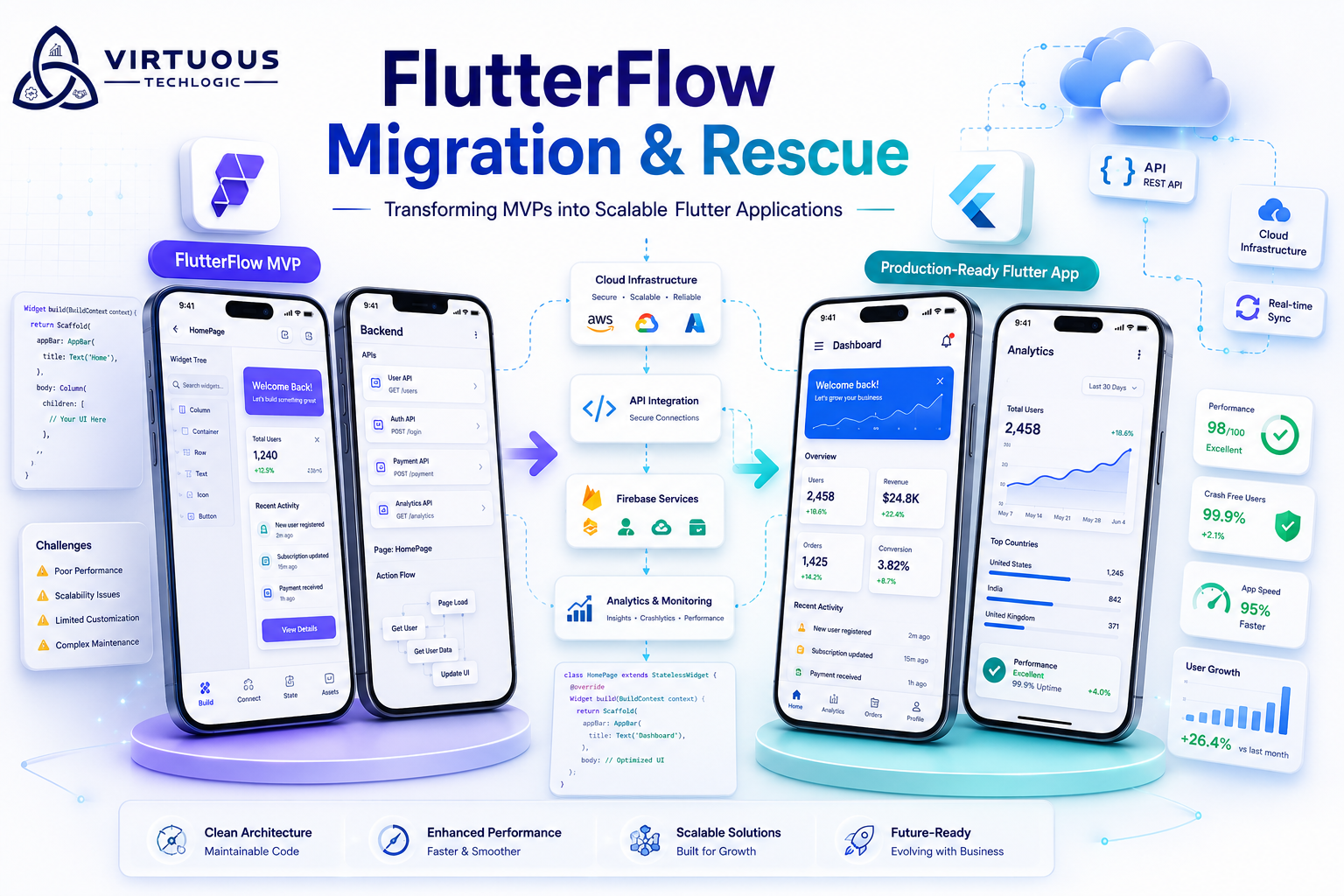
FlutterFlow Migration & Rescue: Transforming an MVP into a Scalable Flutter Application
Startup & SaaS Helping startups scale beyond MVP with production-ready Flutter applications.

White-Label Flutter Development: Helping Agencies Deliver High-Quality Mobile Apps Under Their Own Brand
Industry Digital Agencies Supporting agencies, consultancies, and software companies with dedicated Flutter expertise.
Related services
Primary capability pages for this topic.
Related pages
- How to Choose a Mobile App Development Company
Vendor evaluation framework—technical depth, proof, communication, ownership, security, and warning signs.
- FlutterFlow vs Custom Flutter
When FlutterFlow MVPs make sense—and when to migrate to full Flutter for scale, permissions, and custom logic.
- Mobile App Development Cost in the USA
What drives U.S. mobile app budgets—scope, platforms, backend, QA, and release—plus questions to get a realistic estimate.
- Software Development Partner for U.S. Companies
Remote product engineering for U.S. startups, agencies, and established businesses—structured overlap, clear ownership, and production-ready delivery.
Frequently asked questions
Treat them as directories, not proof. Prefer scorecards, architecture samples, ownership terms, and reviews you can verify. Many lists are marketing content from agencies themselves.
Who owns the repo and stores? How do you test and release? Can you take over an existing Flutter app? When would you recommend FlutterFlow instead?
Yes—as a remote product-engineering partner with overlap hours. See our U.S. location page and Flutter service page for delivery context.
We deliver Flutter products, white-label capacity for agencies, existing-app takeover, and AI inside live Flutter apps. Evaluate us with this scorecard like any other vendor.
Use the scorecard on this page, then request a Flutter architecture review. A reliable partner shows tests, store release, and who owns the repo before a large statement of work.
Ask who owns the repository and store accounts, how releases are tested, whether they can take over an existing Flutter app, and when they would recommend FlutterFlow instead. Then compare answers on a review call.
Outsource when you need a full delivery team and you will keep the repo, cloud project, and stores. The outsourcing checklist covers the contract items; this page covers Flutter-specific proof. U.S. teams use the same remote model described on the United States location page.