Loading page content

Yes—AI can be added to many existing mobile and web products without a full rebuild. Success depends on architecture fit, data and permission boundaries, evaluation, cost/latency controls, and gradual rollout. If you are hiring an AI integration company, start with our AI integration and implementation service. This page explains how we add AI to an app you already run.
Trusted by clients across Clutch and Upwork
Want proof before starting? View our client reviews and agency profiles on Clutch and Upwork.
Your app already has users and a working release process. Leadership wants copilots, automation, or intelligent search—but engineering is cautious about hallucinations, cost spikes, security reviews, and breaking core flows.
A structured delivery path—not vague promises.
Review current product, users, architecture, data, APIs, security posture, and business goals.
Score opportunities by business value, user value, feasibility, risk, cost, and data readiness.
Select model/provider patterns (API, RAG, or agent), backend proxy, permissions, evaluation plan, and feature flags.
Integrate into existing frontend, backend, APIs, authentication, data systems, and UX states (loading, failure, fallback).
Evaluation datasets, regression testing, fallbacks, human review for high-risk flows, moderation, and audit logging.
Pilot users, cost and latency controls, quality monitoring, feedback collection, and iteration.
Balanced guidance—not one-size-fits-all answers.
APIs suit structured generation tasks; RAG suits document-grounded answers; agents suit multi-step tool use; fine-tuning needs data volume and maintenance. We recommend the simplest option that meets the goal—see our API vs RAG vs fine-tuning guide.
Rebuild only when the codebase cannot safely support the AI surface. Most live products benefit from phased integration that preserves users and release cadence.
Proof aligned to this topic—not generic filler.
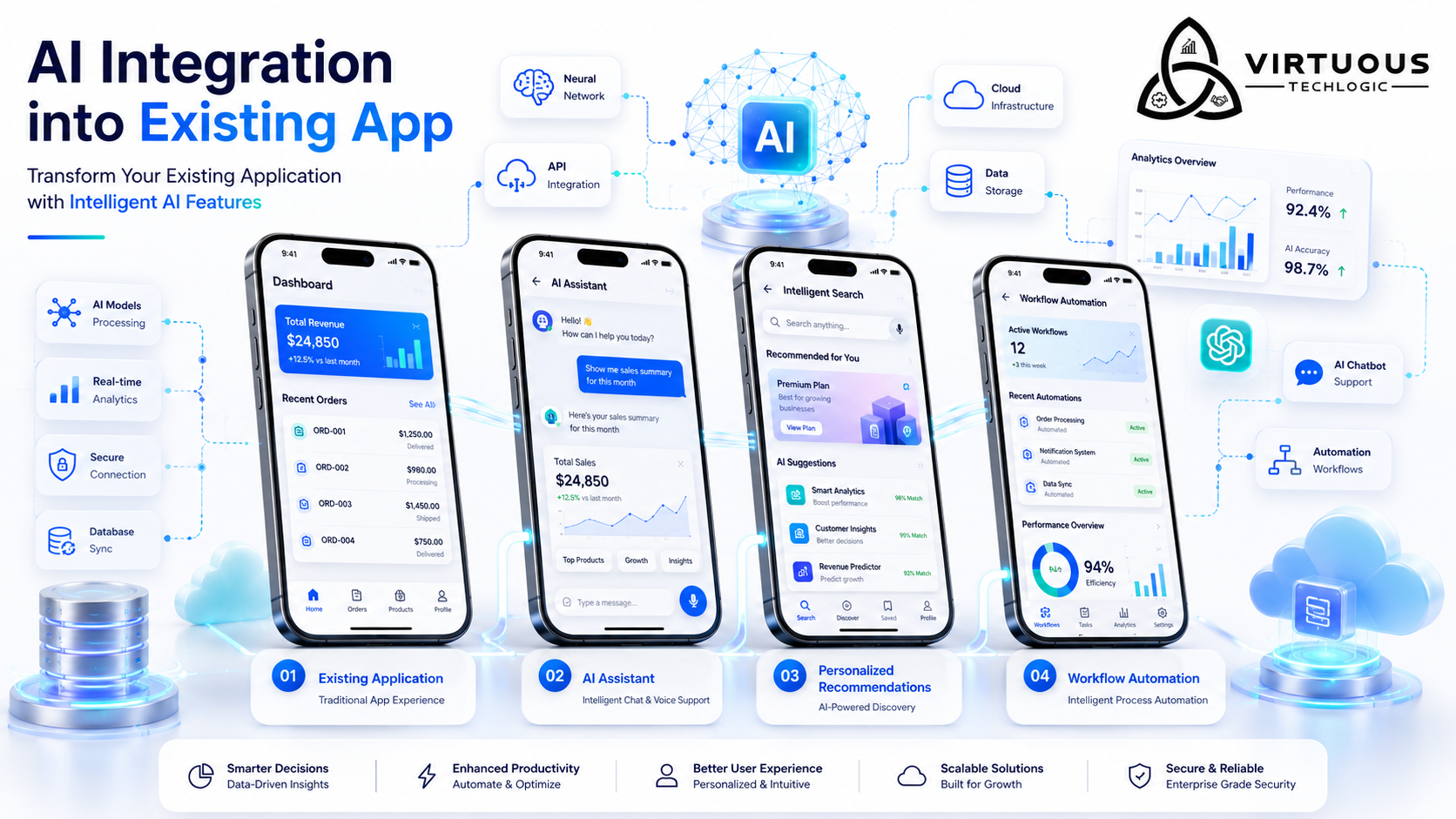
Industry Business Applications Modernizing existing mobile applications with intelligent AI capabilities.
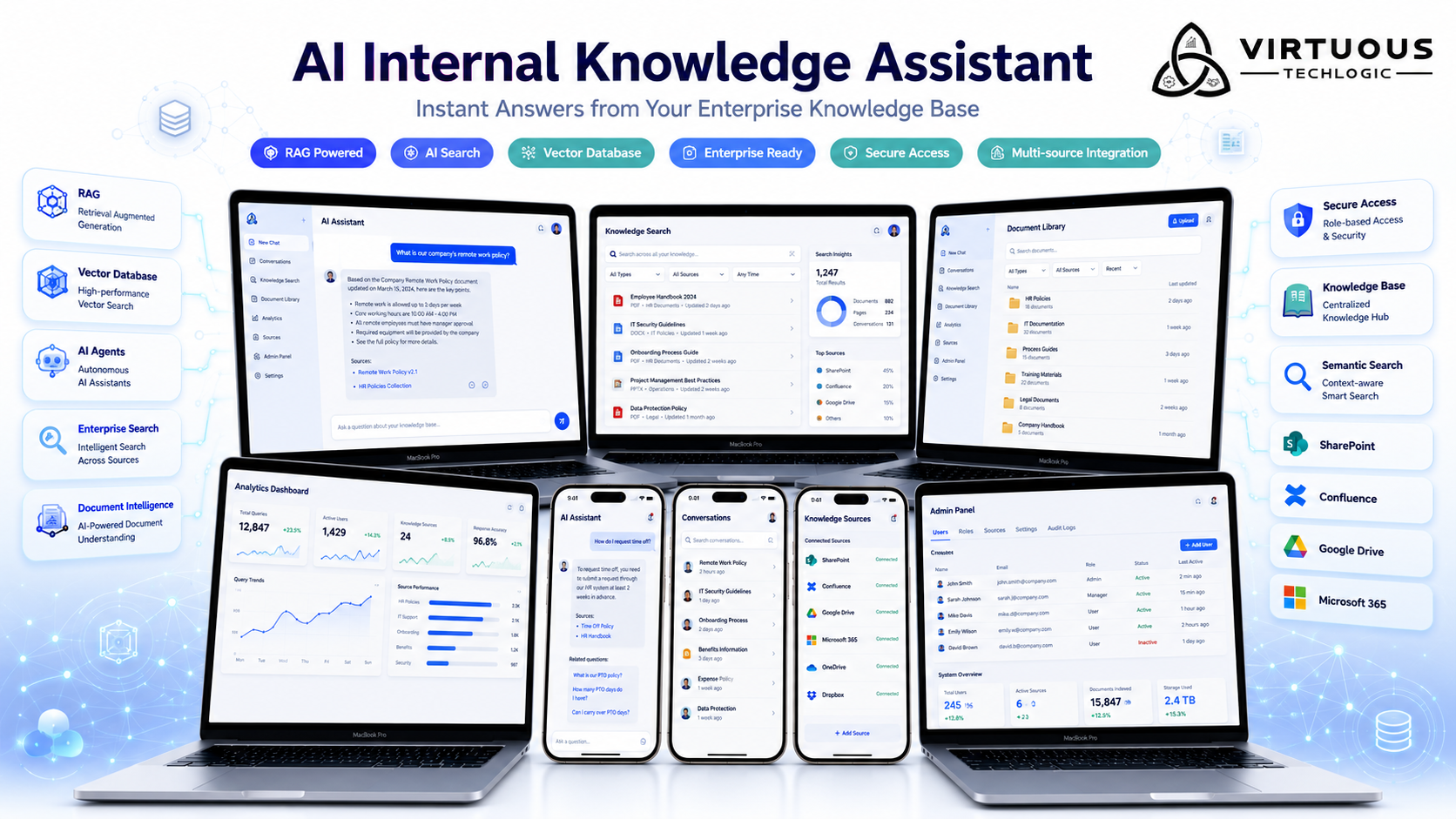
Industry Enterprise AI AI-powered knowledge management solution for businesses and enterprises.
Primary capability pages for this topic.
Add production AI to existing iOS, Android, and cross-platform mobile apps—with backend proxies, streaming UX, store-safe rollout, and mobile-specific latency and privacy controls.
Add production AI to existing Flutter apps—secure backend proxies, state-management integration, streaming UI, Firebase/Supabase, and store-ready rollout without exposing credentials.
Add AI to browser-based apps, dashboards, portals, and internal platforms—server-side orchestration, session-aware permissions, streaming UI, and no exposed API keys.
Add AI features to established multi-tenant SaaS—tenant isolation, entitlements, usage metering, admin controls, and customer-specific knowledge without breaking subscriptions.
Integrate AI into existing healthcare mobile apps, patient portals, and care-management platforms—with permissions, human review, auditability, and clinical boundaries.
A focused pilot into an existing app often lands in about 1–4 months on average, depending on data access, auth complexity, and review cycles. Multi-surface rollouts or regulated workflows take longer. Timeline is scoped after assessment—not a guarantee.
Often yes. We assess architecture, data, auth, and release process first, then integrate selected capabilities with feature flags and monitoring—without assuming a full rewrite.
Add one feature behind existing auth and a backend proxy, then ship it with a feature flag. The mobile AI integration page covers store and device constraints. Request an assessment from this page.
Support answers grounded in your own content, document Q&A, and a single workflow assistant usually beat a generic chat tab. Pick one, measure it, then expand.
If the app already has users, integrate AI into it. If you are starting from zero, build the core product first and add AI on a scoped path. Production AI means evaluation, permissions, and cost controls—not a demo prompt.
Not usually. Rebuild is recommended only when the current system cannot safely support the AI surface. Prefer phased integration that preserves working workflows.
Common options include assistants/copilots, semantic search, RAG, workflow automation, agents, recommendations, support automation, document intelligence, voice, and analytics insights—selected after prioritization, not as a mandatory package.
Yes, when architecture and security allow. We typically add a secure backend path for model calls, permissions, logging, and retrieval rather than exposing keys in the client.
Yes—that is a core requirement. Retrieval and tool actions should respect your existing roles and data boundaries.
It depends on the job. APIs for generation tasks, RAG for grounded document answers, agents for multi-step tool workflows, fine-tuning only when data and maintenance justify it. Assessment decides.
We reduce risk with retrieval grounding, refusal rules, evaluation datasets, UI fallbacks, and human review for high-risk flows. We do not promise zero hallucinations.
Scoped access, minimization, provider review, logging controls, and permission-aware retrieval. Regulatory work is scoped with your counsel for that engagement. We do not issue a compliance certificate.
Cost depends on use-case count, model usage, RAG needs, evaluation depth, and integrations. We outline ranges after assessment; model/infrastructure usage is often ongoing and separate from build fees.
A focused pilot can move in weeks when data and APIs are ready; multi-system or regulated scopes take longer. Timeline is confirmed after the audit—not promised as a fixed universal number.
Yes. Feature flags, pilot cohorts, cost caps, and kill switches are standard so you can expand only when quality and operations support it.
Yes—when we can access the current implementation. We review quality, cost, safety, and architecture, then harden or re-scope rather than starting from marketing demos.
Yes, as part of support or dedicated-team engagements: usage, latency, quality regressions, and iteration backlog.
Yes—via secure backends and native UI patterns appropriate to each stack. Exact approach is scoped during assessment.
This page covers how we add AI to an existing product. For a mobile release, a Flutter app, a web app, a SaaS product, healthcare, or fitness, use the matching page linked below.